
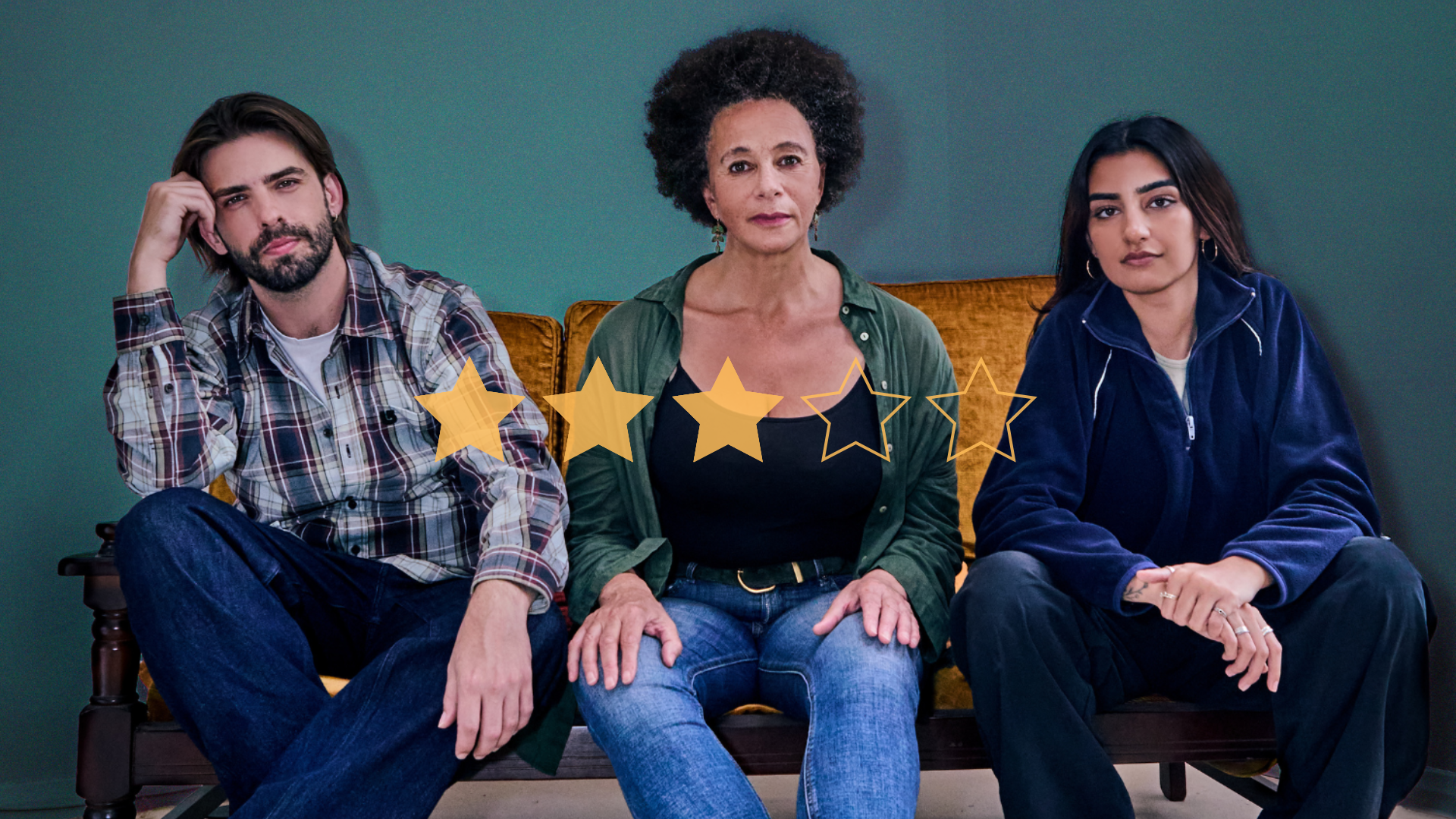
★★★
The idea of someone dying in a housing block and being discovered years later is always going to be an unsettling concept, but that’s the subject of writer Farah Najib and director Jess Barton’s play Maggots, currently running in the Studio space at the Bush Theatre. It’s impressive how much comedy Najib manages to derive from that premise, given its social justice demands for progressive change within a neglectful housing landscape are anything but cheery.
The play starts with residents of a working-class housing association growing aware of a strange smell emanating from flat number 61—“a sweet meat stench.” As the inhabitants gain a creeping certainty that the woman in Number 61 may well have died, complaints are raised, pest control is called—and then the maggots appear. It draws inspiration from real-life stories, sharing specific similarities with the Sheila Seleoane case, whose body was found in her south London flat in 2022 after lying undiscovered for over two years. A “Note of Inspiration” at the script’s start lists real-life cases of lonely deaths, and it’s particularly haunting seeing them laid out so plainly.
The title Maggots is a stark one and prompts the question of who the maggots are. Are they the insects that arrive to feast on rot and prove a pest in our houses, or a derogatory term for an insipid landlord, jobsworth neighbourhood managers or a faceless housing association’s unhelpful staff (who are all frequently lampooned in the play)? Or even the tenants themselves, huddled into small, confined spaces and treated like pests by the very systems meant to protect them? The ambiguity is effective. The name of the House the characters live in seems significant too, the artfully selected “Laurel,” a word that suggests awards and ceremony but also has floral connotations, a grandiose title bestowed on a hovel, used to brilliant ironic effect.
Three actors (Sam Baker Jones, Safiyya Ingar and Marcia Lecky) signify at the outset that this is a story they are telling us—“a story about all of us”—and we realise quickly they’re narrators rather than fixed characters. The trio’s performances are strong and there’s an effortless dexterity to the choreography of their fast-paced dialogue as they complete each other’s sentences and unveil details of Laurel House’s inhabitants. Barton makes good use of the Studio’s sparse space, having the actors move into every corner of it and occasionally up the stairs into the audience, making you feel part of a collective. Caitlin Mawhinney’s set design is well-judged and restrained too: a lattice of dried flowers suspended from the ceiling, a vase on an end table, a settee, crafting the bare bones of a living room. Flowers function as funereal icons here, and the fact that they’re dried up feels quietly symbolic. The play doesn’t overwork its design to situate us in a domestic setting; absence does much of the work.
It’s an impactful story, but the storytelling style is less consistently effective. Predominantly told in prose, it often feels caught between two styles. At times, you wonder whether this might have worked more naturally as a series of interweaving short stories. The chosen Scheherazade-esque format can feel supplanted from another medium and doesn’t always justify itself. That said, the characterisation is vivid enough that you can easily visualise the residents, which is a credit to both the writing and performances, even if it occasionally feels like something is missing.
There is, throughout the play, a surprising wealth of humour threaded through the horror. The repeated reference to “Number 61” has parallels with horror cinema, namely Room 237 in The Shining, and later imagery leans closer to Psycho, which seems intentional. But the comedy is there in the strength of the characterisation, accentuated by cultural touchstones like Saturday Kitchen and Gogglebox, which lend the residents texture and universality. There’s a particular poignancy too in how the mystery of their absent neighbour unites the tenants. They know her name, they’ve seen her at the bus stop. In a system where residents are treated as numbers, their insistence on Shirley’s personhood becomes a kind of resistance, underlining the consequences of a housing model in which landlords and associations profit obscenely from derelict properties while maintenance and welfare are treated as inconveniences—as long as rent is paid, nobody seems to care who’s inside.
There’s only so much depth you can delve into with a runtime of 65 minutes, but Maggots does ask its questions well and deserves credit for it. Even if the storytelling style doesn’t always hammer the point home, that’s not enough to derail it. It is, without a doubt, a story worth telling, and Najib’s work here will help facilitate conversations.
Maggots will be performed at the Bush Theatre until 28 February.
Words by James Morton
Support The Indiependent
We’re trying to raise £200 a month to help cover our operational costs. This includes our ‘Writer of the Month’ awards, where we recognise the amazing work produced by our contributor team. If you’ve enjoyed reading our site, we’d really appreciate it if you could donate to The Indiependent. Whether you can give £1 or £10, you’d be making a huge difference to our small team