
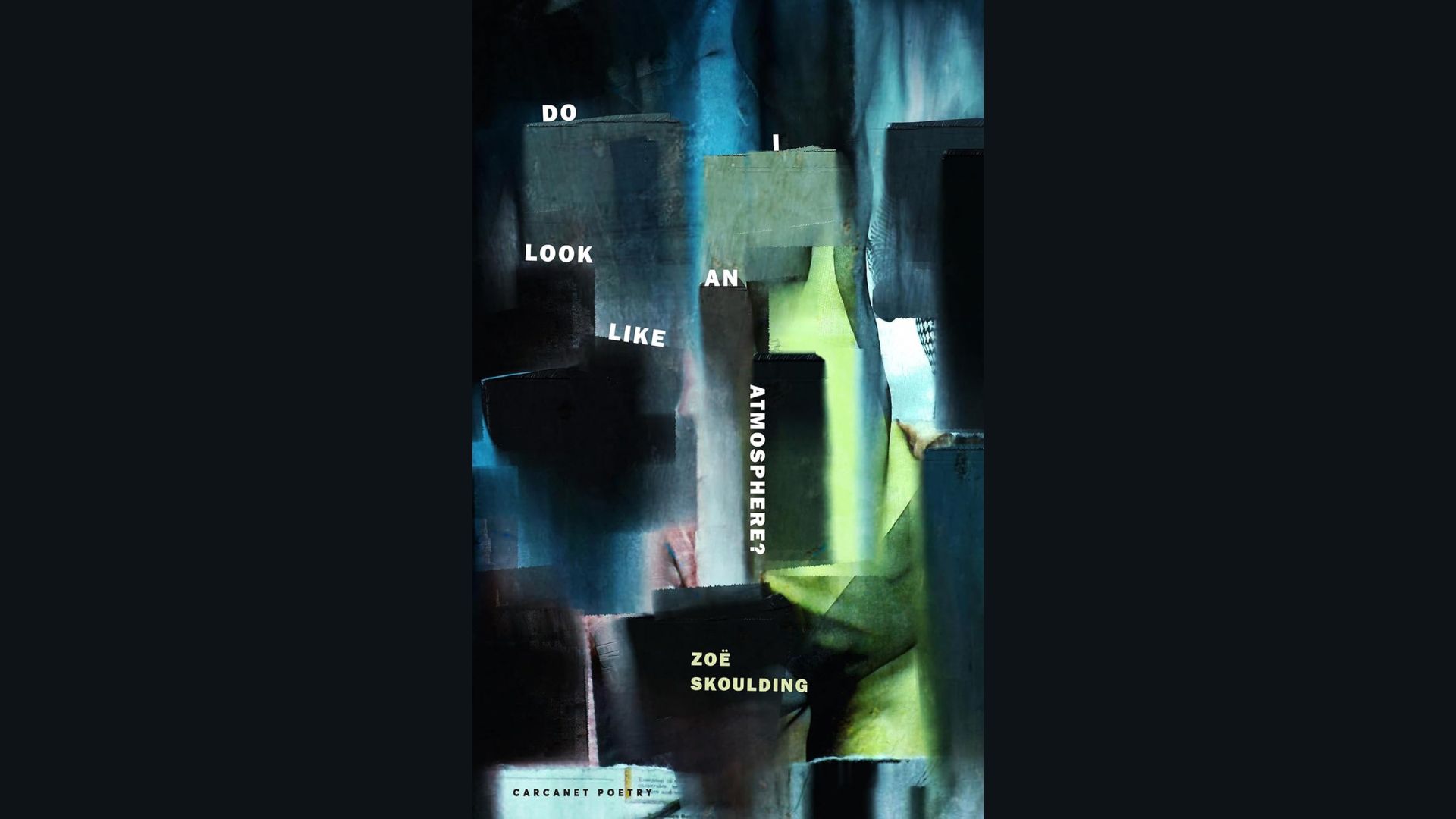
North Wales residing but Bradford born poet Zoë Skoulding rhythmically stamps her new collection Do I Look Like An Atmosphere onto the literary landscape. A near seventy-page volume with a cover like an abstract painting and a name that harks back to a 1938 French film about a failed suicide pact, named Hotel du Nord.
But believe me, it’s no new feat for Skoulding to churn out a complete body of work, celebrating a vibrant literary or critical history and is so quick to draw us in. Her expansive career as performer/poet has been translated into twenty-five languages, breathed air at numerous international festivals and has been awarded by the Society of Authors, as well as The Wales Book of the Year. It’s a reputation which certainly proceeds her when picking up a page that bears her print.
Casually jumping between style and subject, Skoulding’s anthology may struggle to hold itself together on the whole. From a customary address to the reader named ‘On Touch’ (common to many such collections), we are slung between separate microcosms of space and feeling, through oceans, investigations into the shape or meanings of birds, or looser discussions of natural form, essence, or sound. A notable moment of her habitual shift between subjects or cosmos comes when she writes about breaking her hand towards the collection’s end and a few pages before, in an elegy to the Welsh music legend, Emyr Glyn Williams (‘Dyfodlwr’).
Yet, every individual work is a surprising wonder of its own. Each poem here has been sliced to the bare bone and Skoulding’s phrases or indeed, words themselves, have razor-sharp edges which often abruptly cut into the next line. Throw any wearisome expectation of formal constraints out the window with Skoulding as in ‘Epiphytics’ lines like carefully cut petals are arranged across the page, surely in some kind of ode to epiphytes, the botanical name for a plant that grows on top of another plant. Skoulding’s theory is embodied viscerally and with great care into each work, a premise of ecology and how nature relates to itself, either in harmony or in clear disruption.
She has been quick to snap up an identification with Wales, at least in Do I Look Like An Atmosphere. As Professor of Poetry and Creative Writing at Bangor University, a Welsh tongue punctuates many poems, and she stamps the titles of most works with their alternative Welsh name. She flows through language and linguistics with perfect ease, but this is all anticipate. Skoulding is known for her many translations of French or Spanish authors, to name but a few. Linguistics take precedence to such a great extent that in a work fittingly named ‘Bulbul Orphée’ – the French name for the red-whiskered bubul – many different languages are layered on top of one another to create a polyphonic, orchestral effect, as if many different instruments were playing on top of one another.
Skoulding has a great music and internal spirit in her work which, though difficult to contain in one collection, still is a pleasurable read. Forget rules, rhyme and constraint, embrace a wilderness where the very sure outlines of objects, landscapes or animals are blurred, or at the very least, questioned.
Words by Harry Speirs
Want more Books content from The Indiependent? Click here
Support The Indiependent
We’re trying to raise £200 a month to help cover our operational costs. This includes our ‘Writer of the Month’ awards, where we recognise the amazing work produced by our contributor team. If you’ve enjoyed reading our site, we’d really appreciate it if you could donate to The Indiependent. Whether you can give £1 or £10, you’d be making a huge difference to our small team.