
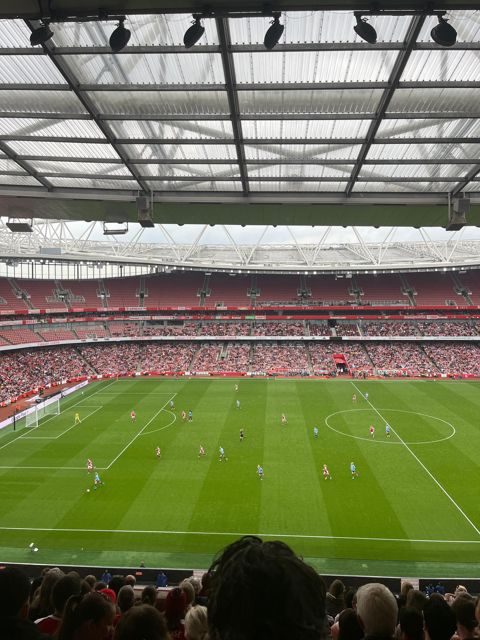
From a 50-year ban, to winning back-to-back Euros – how the Lionesses are making up for lost time.
If you’re a sports fan from Wales, Scotland or Ireland, there’s a good chance you agree on one thing: anyone but England. And I say that lovingly, as a Welshwoman who has lived in England for the last six years. The rivalry, although a bit of a joke, runs deep and is wrapped up in a lot of history (just ask me about the Welsh-Not next time we’re down the pub).
So, it’s no surprise that for most non-English Brits, the idea of repping a foam finger in support of their English neighbours on the football pitch is a mostly unfathomable act that would likely have their ancestors in the recovery position.
There is, however, one thing that sets the England Lionesses apart from their male counterparts – and no, it’s not just their back-to-back Euro wins. It’s the support they’ve managed to garner from their Celtic cousins. Fans, who in some cases have never, and would never, cheer for the men’s team.
Alan Cook, a 67-year-old Scotsman now living in High Wycombe, said: “I wouldn’t want the Lionesses to do remotely well against Scotland, but I don’t want them to lose to teams other than Scotland either, which might not always be the case with the men’s team.”
Cook is not alone in this mentality. Frankie Hartland, a 29-year-old football fan from South Wales was left feeling particularly conflicted when watching this year’s England v Wales group stage match.
“I was actually wanting the Lionesses to win because I love football, and I want to watch it as much as I can,” she said. “I knew England could give me more games, whereas Wales would probably be out very soon.”
England went on to play three more games and won their second UEFA European Women’s Championship in a row. Around 12.2 million fans tuned in to watch Chloe Kelly’s winning 110km/h penalty shot against Spain, making the game the most watched TV moment of the year.
Nicky Anderson, a 27-year-old London-based journalist originally from Galway on the west coast of Ireland, says that no matter your nationality, as a woman it’s difficult not to have a huge amount of respect for the team.
“I think they are trailblazers,” she said, “And when I watch women’s football on the telly, at the pub, like we’ve done with men’s football for so many years, it gives me a really nice feeling of pride.”
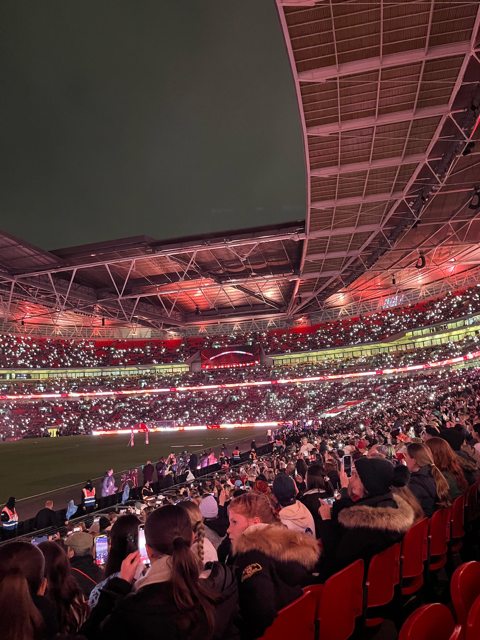
Not only are people tuning in, they’re also showing up in their thousands to show their support. A record 87,192 spectators witnessed England triumph over Germany at Wembley Stadium for the 2022 Euros finale, and it’s likely no coincidence that the second biggest crowd – an astounding 68,871 – came to see England play Austria at the group stage of the same tournament, at Old Trafford.
Cook thinks the growing crowds could be put down to the family-friendly environment, which showcases ‘less tribalism’ and a ‘less aggressive vibe’ compared to the hooliganism sometimes seen at men’s games.
Hartland, who attends both men’s and women’s matches, agreed. For her, women’s games feel more ‘inclusive, generally happy, and safe’, while the men’s games too often feature some level of antisocial behaviour. Of course, there are bad eggs in every sport, but there’s no denying that men’s football has a reputation of bringing in the wrong crowds at times, which is reflected in the recent crackdown and increased number of bans.
The women’s game also carries the weight of history. For half a century, between 1921 and 1971, women were banned from playing football in the UK after World War I. This ‘Play Gap’ continues to impact the sport today, and despite the increased visibility over recent years, we still have a long way to go to undo the damage.
For Hartland, the history behind the sport makes the Lionesses’ success feel even more meaningful. It’s less about the nationality of the players and more about what they’re achieving for the sport in general. She’s especially passionate because, as a young girl, in order to play football she had to play on the boys’ teams. “I was a really good footballer in school but there wasn’t a team for me, and that pissed me off,” she said.
“I am a woman first and Welsh second,” she said. “I don’t care that they’re English – it’s just women supporting women and supporting a sport that we love.”
Anderson agrees: “It’s nice to think that the young girls at home across England, Wales, Ireland, Scotland and the world can see people like Leah Williamson, or Chloe Kelly and think I could actually do that.”
Whether it’s the history, the joy of seeing women succeed, or simply the love of the game that has driven support for England’s women’s team, viewership is only growing. Equality on the pitch is still a way off, but for the Lionesses, it’s worth a shot.
Written by Ulan Harrison-Davies
Support The Indiependent
We’re trying to raise £200 a month to help cover our operational costs. This includes our ‘Writer of the Month’ awards, where we recognise the amazing work produced by our contributor team. If you’ve enjoyed reading our site, we’d really appreciate it if you could donate to The Indiependent. Whether you can give £1 or £10, you’d be making a huge difference to our small team.