
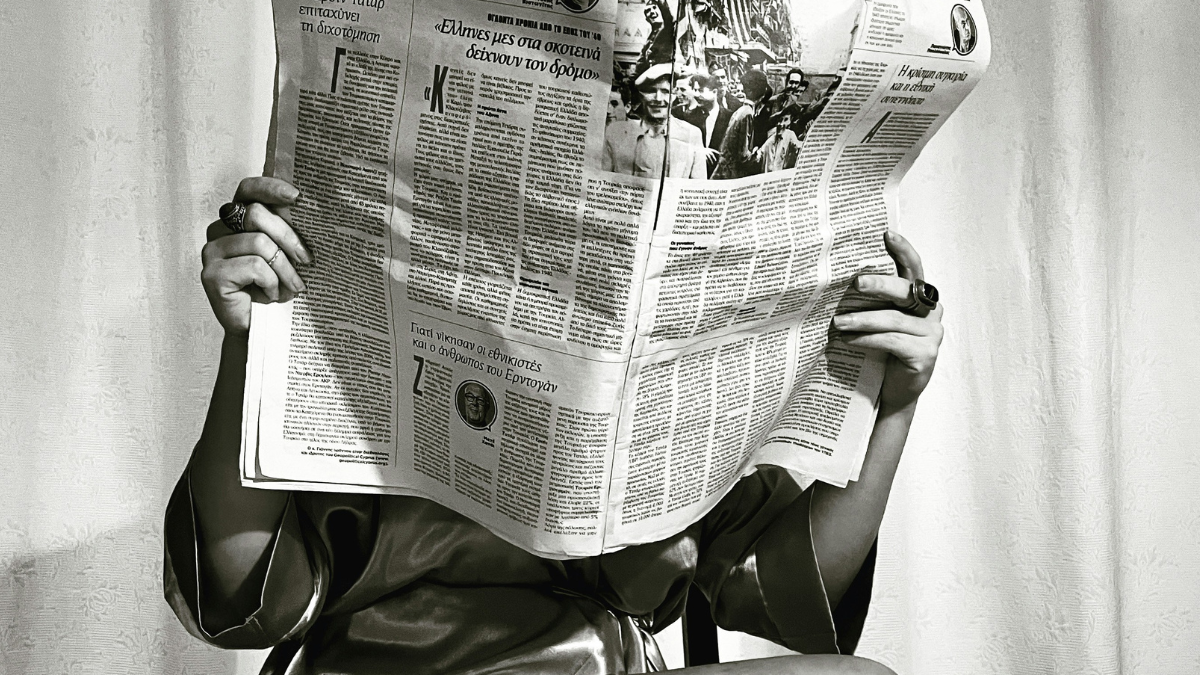
Sitting in one of my local cafes, enjoying the warmth and cosy harbour, and reading my favourite magazine, I noticed a select few were also holding their paper of choice in their hands. As someone who loves reading the ‘old-fashioned way’, it delighted me to see this, and it got me thinking about just how special print truly is.
The stories you can read in print share something with you that you may never gain from the online world. Reading newspapers and magazines has been a pastime since the 17th century. The latter term is credited to English publisher Edward Cave, who founded The Gentleman’s Magazine in the 18th century, and which ran until the early 20th century. Cave derived the term from the Arabic word makhazin, which translates to storehouse in English.
Cave’s publication was a knowledge collective of general interest, and is considered the first wide-ranging publication (hence storehouse). By comparison, at that time many other publications were specialised, thereby homing in on specific demographics. Periodicals such as The Monthly Review, which was founded by Ralph Griffiths in 1749 and ceased publishing in 1845, featured writers such as Oliver Goldsmith and focused on literary criticism.
That being said, the first ‘true’ magazine is widely regarded to be Edifying Monthly Discussions, which was first published in 1663 by German theologian and poet Johann Rist. Edifying Monthly Discussions set both the format and tone, by issuing a series of scholarly articles and book summaries monthly for an intellectual audience. This inspired numerous people across Europe to begin printing their own periodicals with their own specialisms.
From then, all the way up until the beginning of this century, print was the mainstream way of staying informed. In the online era, however, it has morphed into an alternative avenue that is filled with opportunities to take breaks from the digital world. To reconnect with stories not solely engineered for (or driven by) algorithms, and which are now hiding in plain sight with the declining circulation levels of newspapers and magazines.
Publisher, founder and CEO of Ralph Magazine, Chris Hassell, made the following comment when being interviewed by Steven Heller of The Daily Heller: “The world is being dragged down the gutter creatively by following the algorithms, and digital content often gets overwhelmed by negative sentiment and virtual battling between people. We were keen to slow down a bit and allow people to discover new things, and in the process perhaps be a bit more understanding of other humans and what brings them joy.”
Contemporary society runs at an immeasurable pace, and therefore, so does the online media. This has built-in problems, one of the biggest ones being the immediacy requirement to break new stories to the public, due to the ‘now’ factor of the present day. The online era has revolutionised the news cycle, transforming it from a solid one-day-at-a-time model to a fluid, constant and unrelenting stream of information. The increasing volume of stories the media are expected to post every single day leads to a damaging culture of publish first, verify second.
Relatively recent research by Ofcom found that 71% of UK adults have witnessed misinformation online, whilst only 21% have seen misinformation in print. Granted, social media exacerbates this, with it being found to be one of the major factors behind these statistics. This is illustrated by a damning survey carried out by The Alan Turing Institute, which revealed that more than 90% of the UK had discovered misinformation online via social media platforms.
This damaging culture is not unique to online and has happened in print. For instance, back in 2013, The New York Post were sued for falsely reporting two men as the cause of the Boston marathon bombing. Yet it remains true that with the speed demanded from online reporting, journalists are not required to be as accurate as humanly possible upon first report anymore, because they can amend and update their stories whilst they continue to develop. Why? Because humanity has gone the way of The Matrix, with most of us plugged into a system that feeds us all kinds of news relentlessly, whilst eating up all our attention span in return.
There are other reasons, of course, one of them being that the stories you find in print are not the ones you find online. However, today print is used to complement the mainstream like a trusty companion. Despite print’s social and economic demotion, it still has immense value and does a great service to the public through its timeless appeal. It is also the only form of media that allows the public to hit the brakes and slow down.
Print gives much more in-depth information and is therefore much more credible. Print demands much more diligence, is less susceptible to manipulation, and lasts longer (if preserved), serving not only modern life but also acting as a historical record. It has now also become a much-needed tonic and token of mercy to a digitally overwhelmed audience. Print cuts out the noise that comes with the online age, allowing you to delve into a story with no distractions and providing much more understanding. Print is the only format that provides the parameters to wade beyond the shallows and into the depths of stories.
Print also gifts us the unique experience of tactile connection. The physical act of holding a newspaper or magazine establishes an intangible and powerful cord between the publication and the readership. You are not just seeing the stories with your eyes but holding them in your hands; print is an embodied practice.
Magazines, especially, have always had a unique style, which has enabled the blending of creativity and storytelling. But this (usually) comes without reducing the truth of stories in any way whatsoever.
Now, there is a new threat to truth and credibility. Media and readers all over the world are venturing into uncharted territory with artificial intelligence (AI) advancing all the time. More stories are being AI-generated. Fears of digital damage (psychological and emotional effects of us all living our lives virtually) are growing, and increasing toxicity is being seen on platforms such as X (formerly Twitter) triggered by stories that may be falsities or half-truths at best. Not to mention the fact that a report by Europol has forecasted that as much as 90% of all online content could be AI-generated by the end of this year.
Some notable individuals are even now viewing print as a potential shield against the rising tower of AI. Nicholas Thompson, the CEO of The Atlantic, said “We don’t know what’s going to happen with AI. But a print edition is something you can control. It’s a very good hedge against over-dependence on technology platforms.” Given all of this, we all could soon be seeing many more people turning back to handheld publications. Inside The Print Revival, a report published in June 2025, details the many factors behind the resurgence of print media. This apparent resurgence begs the question: will we see print return to its former status as the ruling kind?
Words by Alfie Fletcher
Support The Indiependent
We’re trying to raise £200 a month to help cover our operational costs. This includes our ‘Writer of the Month’ awards, where we recognise the amazing work produced by our contributor team. If you’ve enjoyed reading our site, we’d really appreciate it if you could donate to The Indiependent. Whether you can give £1 or £10, you’d be making a huge difference to our small team.