
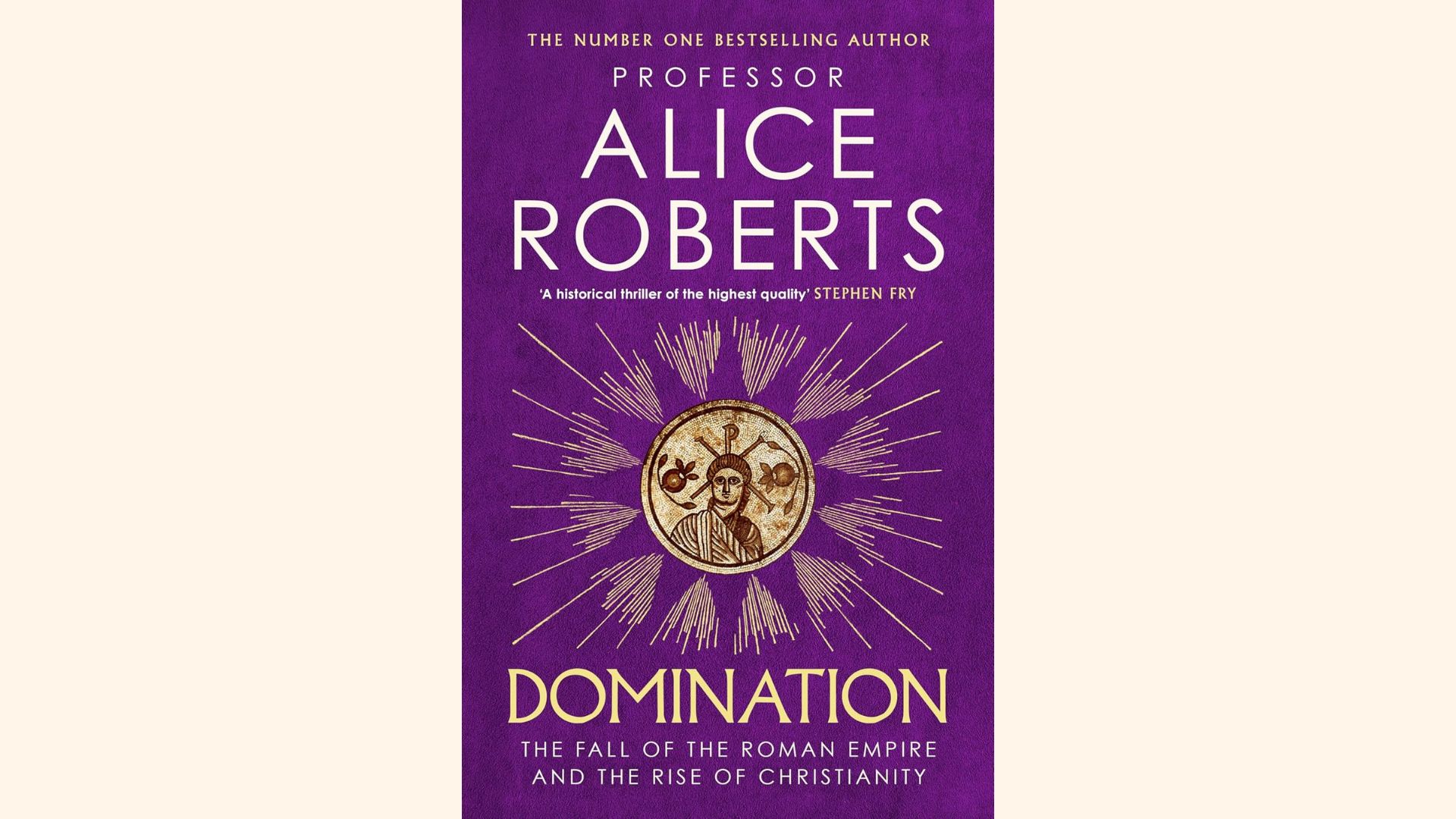
The history and spread of early Christianity, and its impact on European history, has been much written about lately, from Catherine Nixey’s Heresy to Tom Holland’s Dominion. There has also been plenty of ink-split in rather poorly judged criticism of authors, suggesting that the specific author’s belief might qualify or disqualify them from writing on the topic. That is a disservice to books that, while they present very different views, use the available evidence to back up arguments in good faith. Alice Roberts’ Domination is no different.
There is something of Roberts’ scientific, anatomical, background to how she approaches the topic. Starting from a detailed analysis of early Celtic (the term and its issues are discussed but like Roberts I’ll stick with it as the best, if problematic, term there is) ecclesiastic centres, Domination moves like a pathologist might using points of evidence to build a picture of how each organ of the Roman Empire changed as Christianity developed.
One aspect of this that I loved was the use of linguistic evidence, paired of course with some material culture evidence, to extrapolate beyond the few archaeological data points (for many are likely inaccessible being buried under modern settlements) to chart the spread of those ecclesiastic centres, and so by proxy the spread of Christians, as such centres needed either significant numbers of Christians or for Christianity to have been adopted by the local elite.
It is worth mentioning that, as with Roberts’ previous books on history, such as Crypt and Buried, Domination is aimed at the general reader, so don’t expect long discussions of textual criticism or arguments about minute theological disagreements – for that consult the references. It is equally worth mentioning, that like Crypt and Buried, Roberts writes in engaging prose that is able to dig into the specific details without muddying understanding. Soon terms like “foederati”, “Romanitas” and “Christianitas” become par for the course.
What is more important than how terms are used or explained is the focus on what words mean. Roberts is careful, consciously at points, to avoid the all to easy vague idea of ‘the Church’ acting when it is the action of individuals. It is equally important that Roberts keeps a tight focus, describing the movement of people rather assuming religion spreads as an entity with its own agency.
However, Domination could be a tad longer, as that would have given Roberts space to give a little more context to the social and religious systems that changed as Christianity developed. For instance, the ‘cursus honorum’ (the sort of ideal Roman career ladder) is mentioned, but without the level of detail that lets you understand how it developed, from even before Rome had an empire, it is hard to see how the later developments related to its early history.
Similarly, for a book about the rise of Christianity, it is surprisingly light on discussions of how Roman religion changed over the centuries. Roberts is good to note the issues of terminology, with pagan originally being a denigrating term used rather changeably, and considering the complex web of difference between polytheism, henotheism, monolatry and monotheism. But it would have helped to briefly sketch out the way religion had developed in the past, and how the Roman state had reacted. For example, going into some details of how the early senate tried to ban Bacchic festivals might have been a useful comparison when considering the later political persecution of Christians.
Yet that is, arguably, just a personal view point. It is vital not to let orthodoxies of thought dictate how history is examined. Domination does a valuable service of bringing a view point often absent from the history of early Christianity, and so of a major part of post-Roman history, into the public consciousness. Even if you disagree, and perhaps specifically if you do disagree, with Roberts’ argument you should celebrate any book that brings focus to this crucial period of history. Domination brings together an anatomically minded approach with linguistic and economic theory that is disappointing lacking in many other narrowly focused histories of early Christianity.
Words by Ed Bedford
Want more Books content from The Indiependent? Click here