
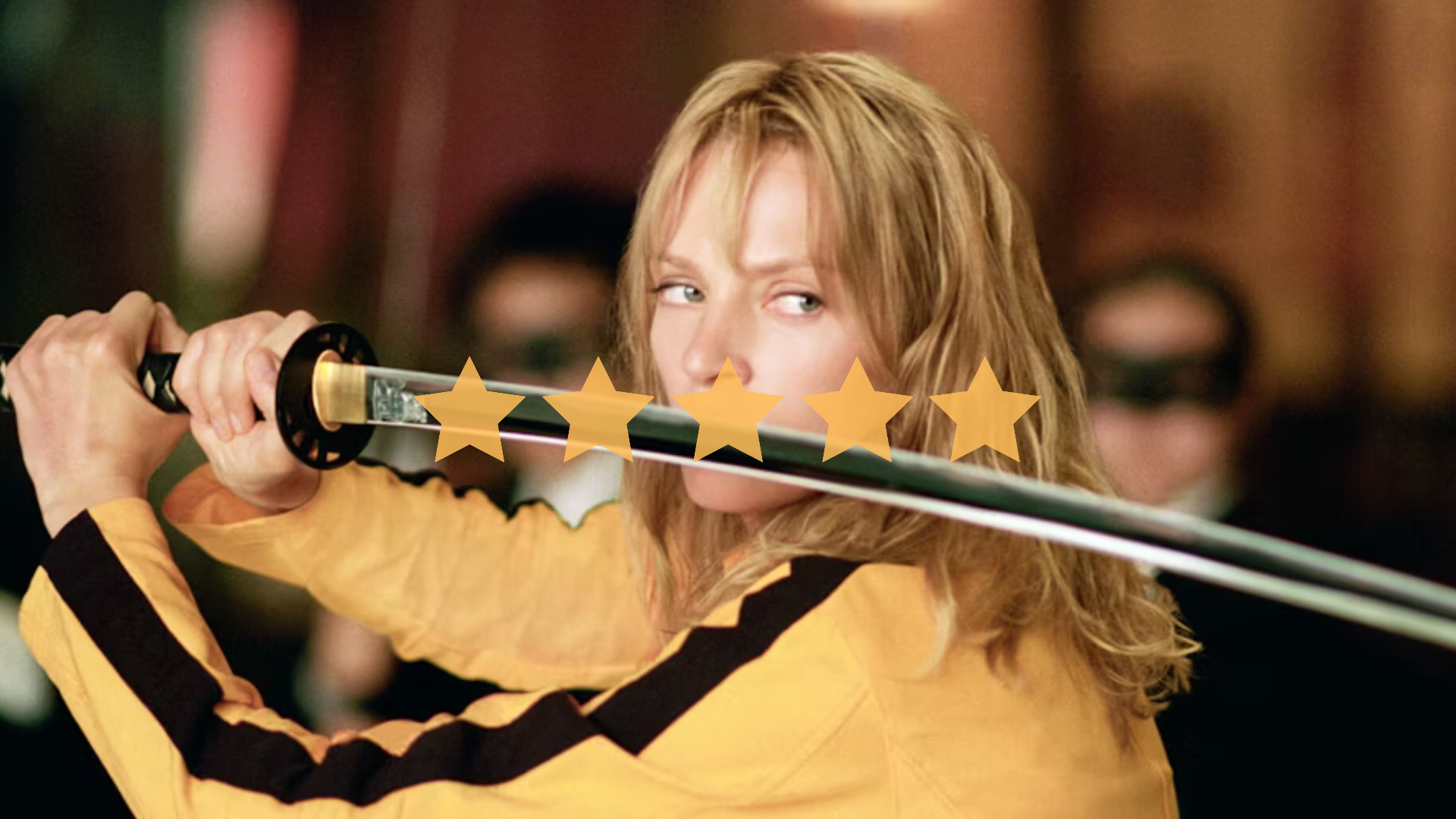
Kill Bill Volume 1 & 2 were originally conceived as a single film, but due to their length, they were split into two parts. Now, director Quentin Tarantino has re-edited the film into a lively 275-minute cut that combines both, telling the whole bloody affair as intended.
★★★★★
The fourth film from Tarantino, Kill Bill, revolutionised the public’s perception of his movies. Prior to this, he had made the middling Jackie Brown (1997), which, although it has its fans, is considered one of his weaker works. For Tarantino to bounce back and produce a film as strong as this is outstanding.
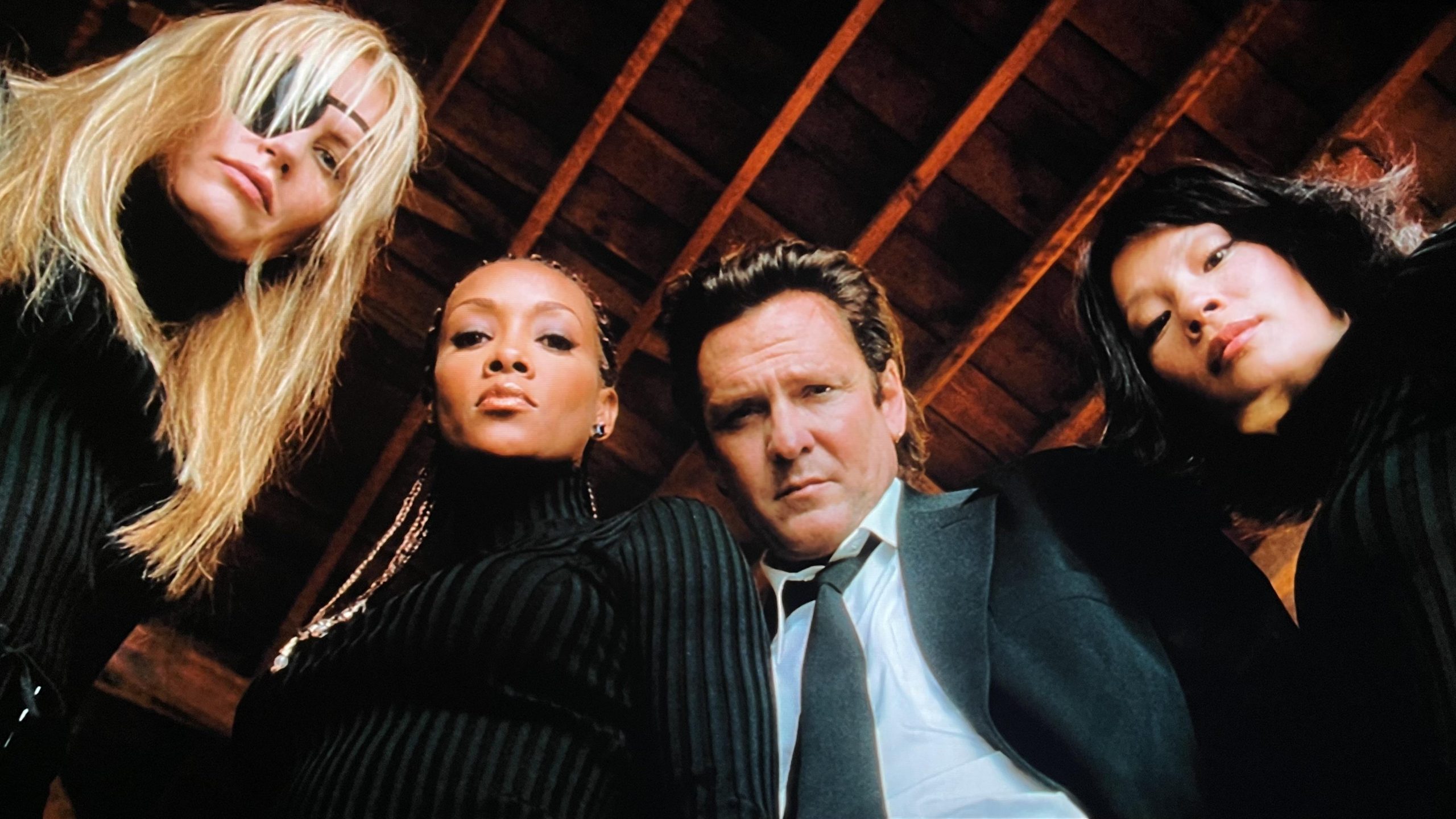
The Bride (Uma Thurman) is murdered at the altar by the Deadly Viper Squad, which includes O-Ren Ishii (Lucy Liu), Vernita Green (Vivica F. Fox), Elle Driver (Daryl Hannah), and Budd (Michael Madsen). The Bride was previously part of the group and had a romantic affair with their leader, Bill (David Carradine). When The Bride wakes up from a four-year coma, she embarks on an international journey of bloody revenge, tracking down each Deadly Viper member and killing them for murdering her unborn child.
While the two films do combine together seamlessly, The Whole Bloody Affair still feels like watching a double feature of two separate films, due to the intermission separating Vol. 1 and Vol. 2. There is no merging of the two films, which makes sense given the notable difference in storytelling style—the first half being more action-focused, and the second more emotional. It’s not a cut you need to desperately seek out, but it is an incredibly enjoyable way to spend 4.5 hours of your time.
It’s easy to forget how monumentally amazing the first half of the Kill Bill saga is. Everything from the costume to the narrative to the cinematography is effortlessly perfect. It introduces the story simply enough to draw the audience in, and before you realise it, you’re on the edge of your seat watching a perfectly choreographed fight scene between The Bride and Vernita Green. Through Tarantino’s non-linear storytelling, we see The Bride train, prepare, and carry out her revenge in such dramatic fashion. It’s undoubtedly one of Tarantino’s finest works, proof that you can take influences from film history and still craft something that feels uniquely your own.
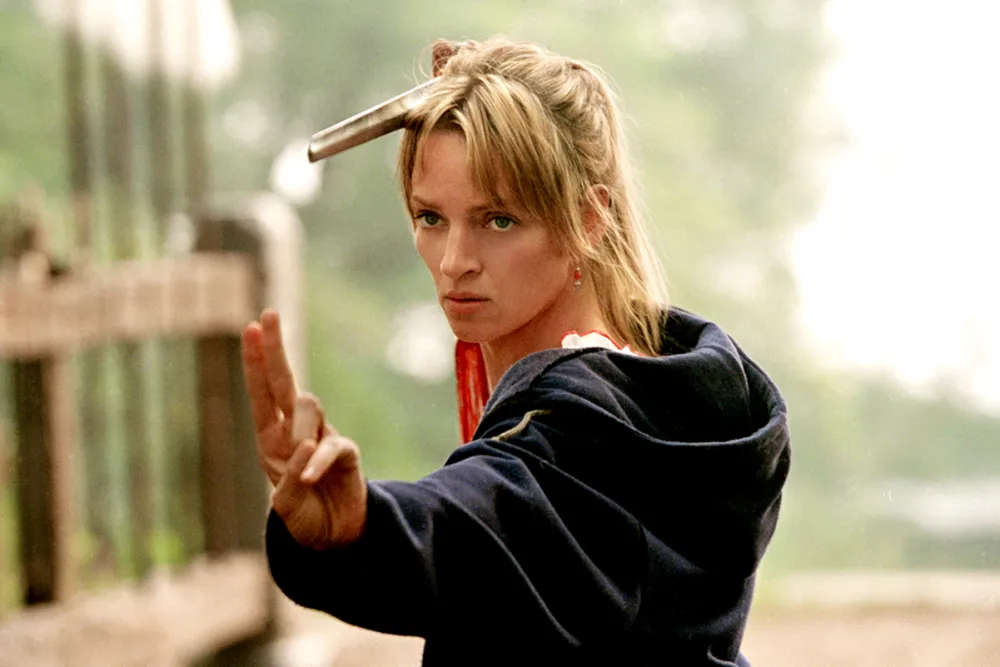
The highlight of the entire runtime is the fight between The Bride and the Crazy 88 yakuza. It is an inch-perfect display of fight choreography, ‘Chanbara’ sword-play, and blood-showering practical effects. Every time a limb is cut off (basically every 5 seconds), a violent blood spurt adds to the chaos and fun of the scene. Watching one woman versus 88 guards is a brilliant concept, and makes for a scene that may go down as one of Tarantino’s greatest directorial achievements.
The second half is much more subdued, focusing on failure and training leading up to the big titular showdown with Bill, which is more talkative and emotional than you might expect. It is effective simply because of the brilliant dialogue and the two captivating central performances by Thurman and Carradine. Although a good part of the dialogue feels like you can hear Tarantino saying it himself, it works with these actors because they embody the characters so well. There is no doubt in your mind that Bill is ruthless, or that The Bride will do anything for revenge. In an ideal world, the two of them would have received a significant amount of awards for their roles, but the controversial nature of the two volumes most likely cost them that chance.
The technical quality in Kill Bill is astonishing. Cinematographer Robert Richardson crafts some of his best shots, especially his use of silhouettes, which make every fight scene much more engaging. The use of licensed music creates iconic moments that wouldn’t have been as impactful with only an original score. The editing in the first half is very smooth, and although that doesn’t quite carry over to the second half, making a film this lengthy without ever feeling slow is a remarkable achievement. It is very sad that the original editor, Sally Menke, died in 2010, because she had such skill in the editing room.
The Verdict
This combined edit of the two Kill Bill movies highlights how stunning the action scenes are in the first half and how emotionally tender the second half becomes. It doesn’t seem like a necessary cut to watch if you want to be introduced to the film for the first time, but for dedicated Tarantino fans, The Whole Bloody Affair offers a brilliant glimpse of what the director originally envisioned for his fourth film.
Words by Jordon Searle
Support the Indiependent
We’re trying to raise £200 a month to help cover our operational costs. This includes our ‘Writer of the Month’ awards, where we recognise the amazing work produced by our contributor team. If you’ve enjoyed reading our site, we’d really appreciate it if you could donate to The Indiependent. Whether you can give £1 or £10, you’d be making a huge difference to our small team.