
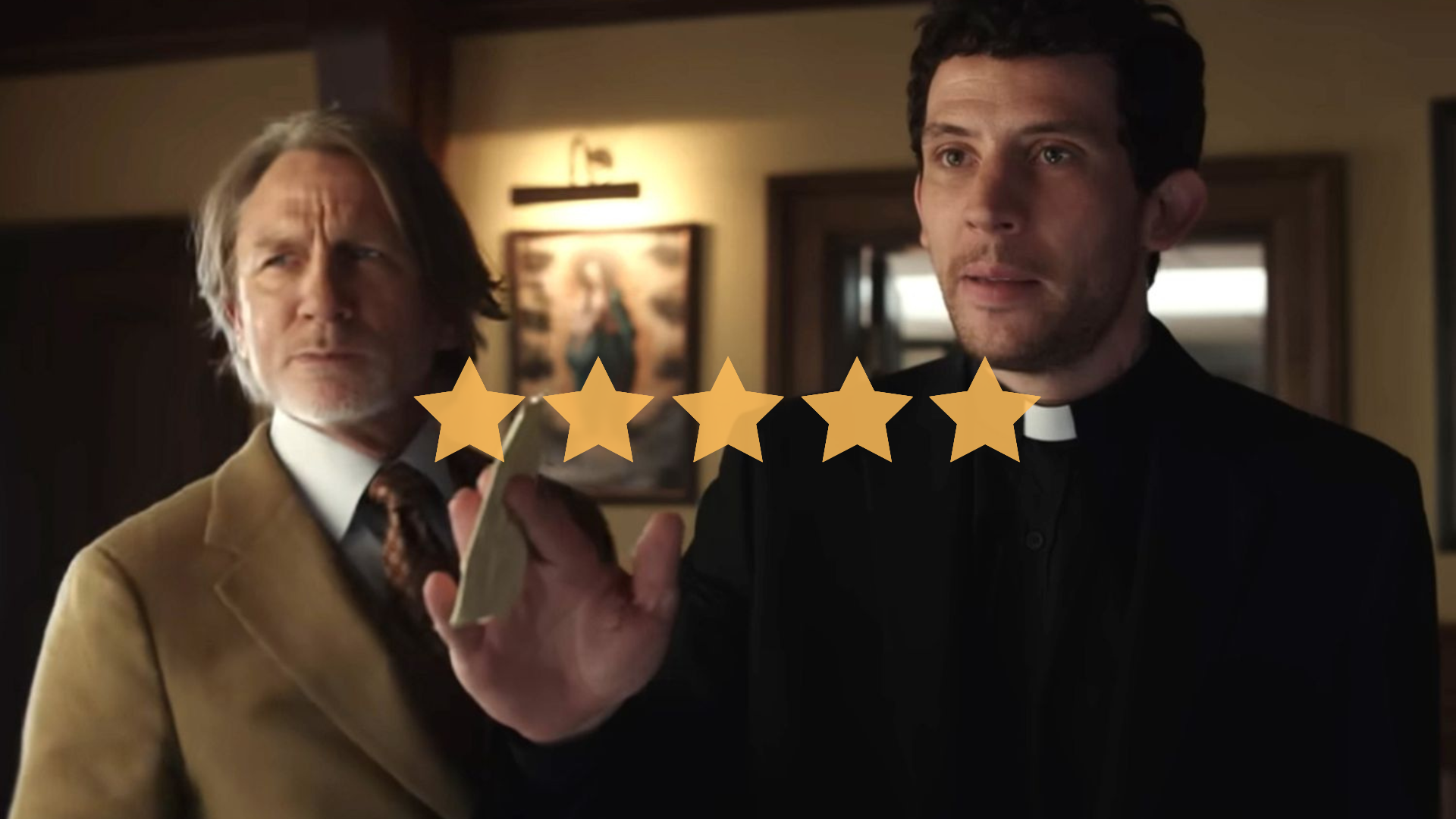
Wake Up Dead Man: A Knives Out Mystery is Rian Johnson’s most audacious sleight of hand yet. He smuggles a meditation of faith, fanaticism and moral exhaustion into the chassis of a Friday-night whodunnit, and somehow, the engine still purrs. What begins with a corpse on a church floor becomes, by degrees, a study of how communities metabolise violence—sanctifying it, denying it, or finally, choking on the truth.
★★★★★
Midway through the third Knives Out instalment, Johnson stages an outrageously bold Good Friday service. In Our Lady of Perpetual Fortitude, a frightening church in upstate New York, Monsignor Wicks (Josh Brolin) delivers a sermon that sounds uncomfortably like contemporary rhetoric echoing through pulpits and podcasts alike, while Father Jud (Josh O’Connor) hovers at the margins, visibly torn between reverence and revulsion.
It’s a scene that serves as the film’s fulcrum: an extended, queasy, set-piece in which ritual, spectacle and barely contained fury collide, arriving only after we’ve learned enough about this haunting parish to feel its fractures. This mid‑film liturgy becomes more than a plot engine; it’s a pressure‑test for an audience steeped in culture‑war discourse. The sequence crystallises the film’s core concern: not simply whodunnit, but a painfully blunt questioning of who benefits from a narrative that tidies horror into destiny.
On the surface, the machinery is familiar. Local law enforcement anoints Jud as the obvious culprit—volatile, theologically oppositional, with a history of violence that photographs well in a tabloid sidebar. But, as is to be expected from Johnson, all is most definitely not as it seems.
When Blanc appears in this moody parish town, parachuted in to help, he is unsettled by the ease in which the town condemns its own priest. He begins to map an intricate web around Wicks: the housekeeper Martha, whose piety has long been weaponised as labour; the groundskeeper Samson, who tends both graves and secrets; the fractured congregation, who either deify Wicks or quietly resent his empire. What follows is a symphonic series of crossed alibis and moral rot, finally concluding with a twisted ending as intricate as anything in Johnson’s earlier work.
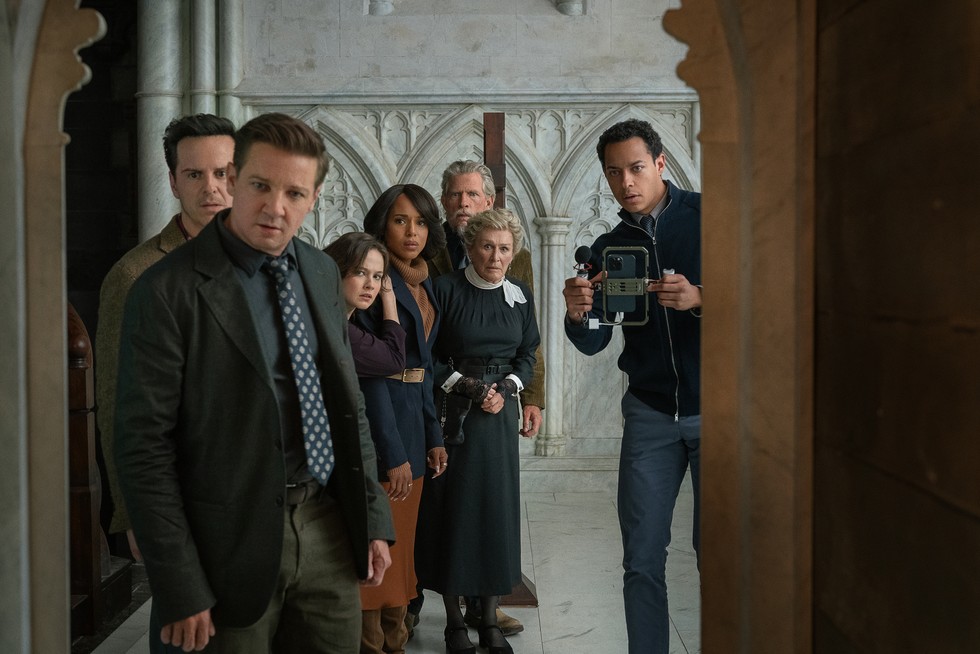
From a technical standpoint, Wake Up Dead Man is faultless. Cinematographer Steve Yedlin leans into a palette of bruised stone and tarnished gold. Day scenes in the church have the overexposed clarity of a police photograph—everything is visible, yet nothing is quite understood. Night sequences, by contrast, are velvety, almost expressionist, punctured by the harsh geometry of torch beams and stained-glass reflections. The church itself becomes a kind of moral mausoleum, storing not only relics but unspoken compromises. Candles look less like symbols of hope than tiny, guttering protests against an encroaching darkness, the nave becomes a proscenium where power is performed, contested and ultimately dismantled. Tonally, the film walks a tightrope above an abyss. There is humour, but it is barbed, and these moments of levity feel less like comic relief than like the nervous jokes told in the darkest moments. Nathan Johnson’s score underlines this instability perfectly, weaving familiar melodies into dissonant progressions that refuse to resolve.
The screenplay is laced with theological language that Johnson weaponises rather than worships. Talk of “shepherds” and “flocks” is constantly undercut by the film’s visual insistence that institutions devour their most vulnerable. Wicks’s sermons, heard in fragments on old recordings, are meticulously written to be both plausible and chilling, the kind of rhetoric that flatters injury into righteousness.
But Johnson resists the cheap move of equating faith with fascism. His interest lies in the gap between belief and its management—in how a human longing for meaning can be channelled into obedience, or into courage. This is where Father Jud becomes one of the franchise’s most complex creations. O’Connor plays him with a volatile tenderness, twitchy and coiled, like a man who has spent years trying to domesticate his own capacity for harm by pouring it into a vocation. His hot-headedness is not a bug but the very trait Wicks initially exploits: a bruiser turned bouncer for the gates of heaven. Scenes between Jud and Blanc thrum with a wary, almost filial energy. Blanc, a self-professed outsider to organised religion, is both exasperated by Jud’s guilt and unexpectedly protective of his sincerity. Their uneasy alliance gives the film its emotional ballast; this is not simply detective and suspect, but doubt and faith learning to share the same frame.
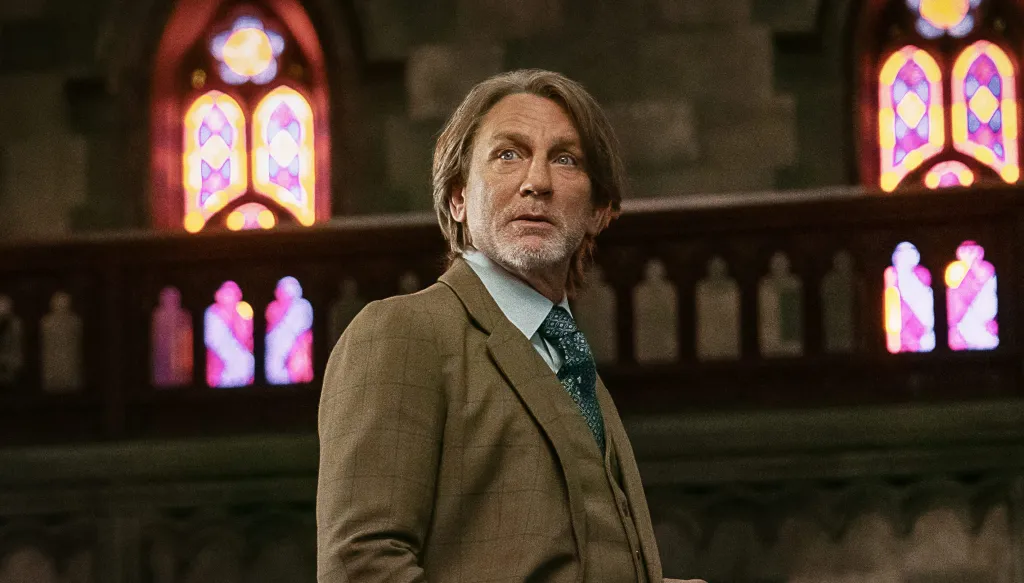
Craig, for his part, continues his quiet campaign to make Benoit Blanc less an affectation and more a person. The molasses drawl remains, as do the baroque metaphors, but in Wake Up Dead Man, they’re tempered by an unmistakable fatigue—perhaps even vulnerability. We glimpse this in small ruptures: a stiffening when he sees Wicks’s charisma deployed like a weapon, the helplessness scarred across his face as he watches a frail individual destroyed by guilt slip away from the world—a rare moment in the series where his vaunted intellect feels palpably insufficient.
In the end, Wake Up Dead Man functions as both a ruthlessly entertaining mystery and a critique of society’s darkest desires—for power and for pain. Beneath the twists lies a call for accountability, perfectly timed within the tumultuous sociopolitical landscape across the globe.
The Verdict
Wake Up Dead Man is the rare franchise expansion that grows its universe inward, deepening rather than merely decorating its central concepts. Formally elegant, thematically thorny and anchored by magnetic performances from its entire cast, it turns a parish murder into the ultimate parable about how we choose our saints.
Words by Sophia McHardy
Support the Indiependent
We’re trying to raise £200 a month to help cover our operational costs. This includes our ‘Writer of the Month’ awards, where we recognise the amazing work produced by our contributor team. If you’ve enjoyed reading our site, we’d really appreciate it if you could donate to The Indiependent. Whether you can give £1 or £10, you’d be making a huge difference to our small team.