

Fresh from claiming the prestigious Golden Bear for Dreams, the second installment of his Oslo Stories Trilogy that explores the intricate landscapes of human connection, The Indiependent talked with Norwegian director Dag Johan Haugerud during this year’s Glasgow Film Festival, where his film made its UK premiere.
Haugerud speaks with a disarming frankness about his approach to filmmaking, revealing the organic process behind his deeply resonant storytelling.
The Oslo Stories Trilogy, comprising Sex, Dreams, and Love, unfolds as an intimate triptych examining sexual identity, first experiences of love, and the complex emotional territories that exist between human beings. What emerges in conversation is a filmmaker whose trust in the power of dialogue and human interaction forms the cornerstone of his artistic vision.
“One of the ideas behind the whole trilogy was to get the opportunity to work with different actors that I had been working with before, to write parts for them”, Haugerud explains, noting that his creative process often begins with the performers themselves rather than abstract concepts. For Dreams, he reunited with actress Ella Øverbye, whom he had previously directed when she was just 11 years old. “That was a very pleasant working relationship, so I wanted to revisit her, and see what kind of parts I could do right now that would be relevant for her, at her age. She was 16 then, when we shot it”.
Though the trilogy appears neatly titled, Haugerud is candid about the almost arbitrary way those labels were assigned. “I think that was quite… I shouldn’t use the word random, but it is quite random, because I wanted, you know… As a title, I think that Sex, Dreams, Love is better than Sex, Love, Dreams, or Dreams, Sex, Love. If you know… it sounds better”. At one stage he even considered simply calling them all the same: “My first idea was to call all of them Sex, Dreams, Love. Like, you know, Sex, Dreams, Love 1 and 2 and 3”.
The trilogy’s unusual release pattern on the festival calendar, with Sex premiering at last year’s Berlinale in the Panorama section, Love making its world premiere in competition at Venice later that year, and Dreams debuting in competition at this year’s Berlinale, did not follow the thematic sequence suggested by its title but instead came about through festival programming rather than artistic intention. “If you have the opportunity to show a film at the Venice Film Festival in competition, you say yes”, Haugerud reflects with pragmatic candor. This shuffle created a situation where different territories are releasing the films in various orders. “In Italy, they want to premiere Dreams first, and then Love, and then Sex. And in some other countries, they want to start with Love.” Rather than feeling frustrated by this disruption, Haugerud finds unexpected value in the reordering: “I think it’s quite interesting that different orders can give different things to the trilogy as a whole. So it probably doesn’t matter”.
When discussing his approach to crafting dialogue, particularly the naturalistic conversations that form the emotional backbone of his work, Haugerud’s process reveals itself as intuitive rather than calculated. “This sounds maybe a bit stupid, but I just write the lines”, he says with simplicity. “I try to achieve a flowing, everyday conversation. And I read the lines in my head, you know, and I read them out loud”. The subsequent table readings with actors become crucial moments of refinement, where he listens carefully to determine if the dialogue sounds “quite realistic”.
Questions of authorship and perspective inevitably arise when a male filmmaker writes in detail from a young girl’s point of view, but Haugerud roots these moments in his own personal history. “It’s based, you know, on my own memories of my first love. Because I remember it quite well. I remember it quite vividly, how it was to experience first love when I was maybe 17 or 18, when I really fell in love. And all these memories are part of the script. And when I had written it, I showed it to the actor. And then we talked about it. And she recognizes herself in the lines. So I think it is from my perspective, even if it’s told through her perspective. So it’s a kind of collaboration”.
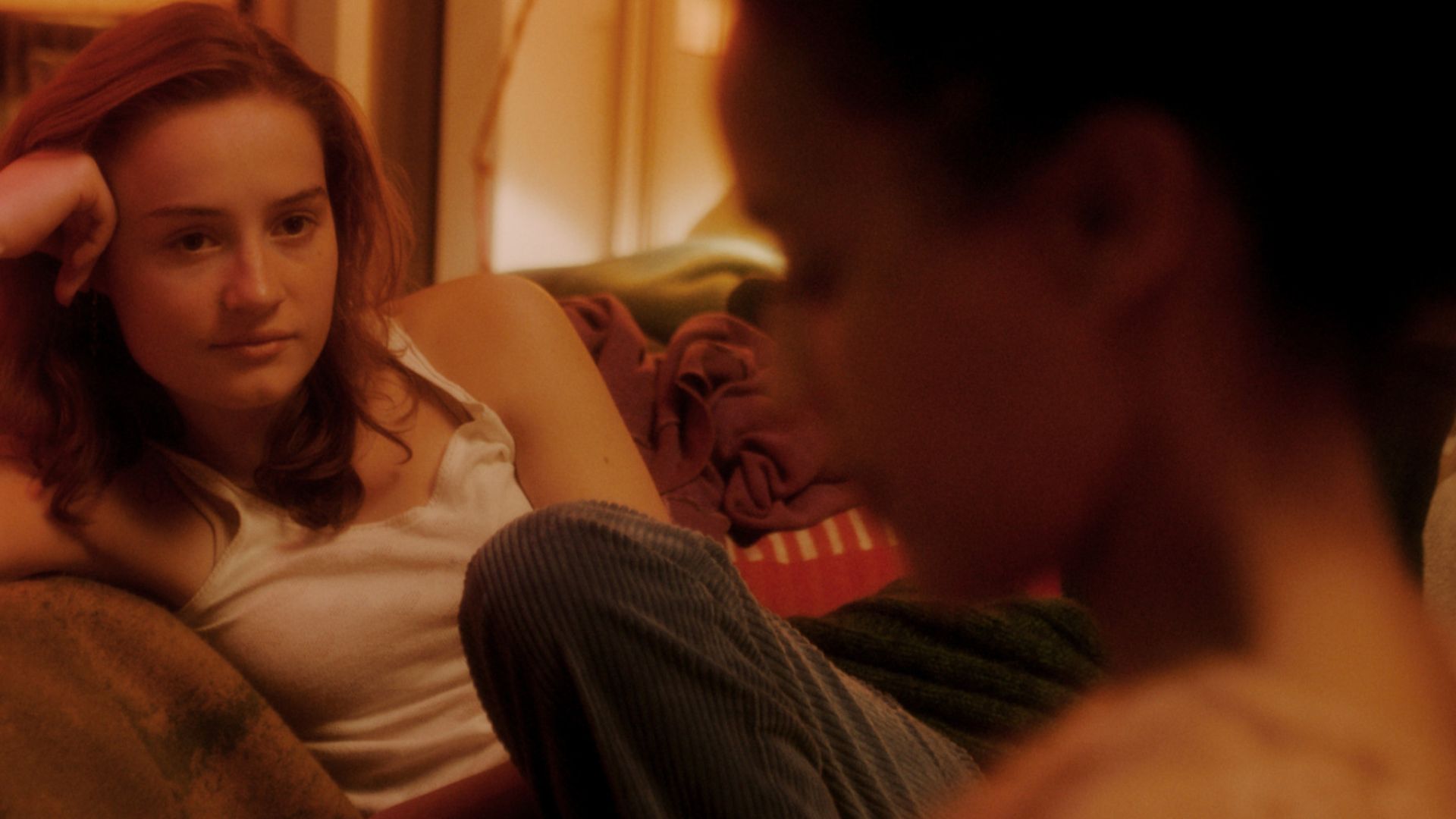
Dreams also stands out for its complex narrative structure, employing multiple layers of voiceover and temporal shifts that weave together varying points of view. This complexity emerged organically during the writing process, despite initial concerns from his producer, Yngve Sæther, about its potential complications. “On paper, it used to be… complicated, maybe, because you don’t really know where the here and now moment in the film is.”
“I really tried to make as much voiceover as I could and tried to use it in different ways”, Haugerud explains in detail, “it’s a confessional voiceover where she’s telling about her feelings and what she’s thinking about. But there is also some kind of voiceover that comes from dialogue, that develops to voiceover, where she’s telling her mother about what’s happened. And then we see, that back then, dialogue became voiceover. And it’s also some kind of a god-like voiceover, where she goes into scenes where she’s not part of and she even stops the film and… yeah. So I thought that would be interesting to see how many levels of voiceover I could come up with”.
The persistent presence of literature and writing as themes throughout the trilogy reflects Haugerud’s own background as a novelist and his belief in the power of words alongside images. “I have often been told that film is, first of all, about pictures, and I can agree with that. But I also think it’s about words”, he asserts. This duality informs his artistic perspective: “My life is so filled with literature at every moment… I want to write characters who have a relation to books and literature and who are inspired from that”.
When addressing the contemporary emphasis on visual stylization, particularly in festival cinema, Haugerud acknowledges its importance while maintaining his commitment to conversation-driven storytelling. He and his director of photography, Cecilie Semec, devote significant pre-production time to finding varied ways of photographing dialogue scenes “to give it some visual aspects and also to try to do it in a way that it doesn’t get boring”.
As this conversation draws to a close, Haugerud offers advice to aspiring filmmakers that echoes the quiet assurance of his own artistic path: “If you know that you have something that you want to express, you should try to take control of that, not try to get other people to make you do things that you don’t want to do… You have to try to understand what’s important for you in your life and try to take control of that”.
In this brief encounter, Haugerud reveals himself as a filmmaker whose strength lies in his attentiveness to human interaction, both on screen and in his creative process. His trilogy stands as testament to the enduring power of thoughtful dialogue and emotional authenticity in cinema, qualities that transcend the constraints of conventional narrative and visual spectacle.
Words by Mátin Cheung
Dreams released in select UK cinemas on 1 August.
Support the Indiependent
We’re trying to raise £200 a month to help cover our operational costs. This includes our ‘Writer of the Month’ awards, where we recognise the amazing work produced by our contributor team. If you’ve enjoyed reading our site, we’d really appreciate it if you could donate to The Indiependent. Whether you can give £1 or £10, you’d be making a huge difference to our small team.