
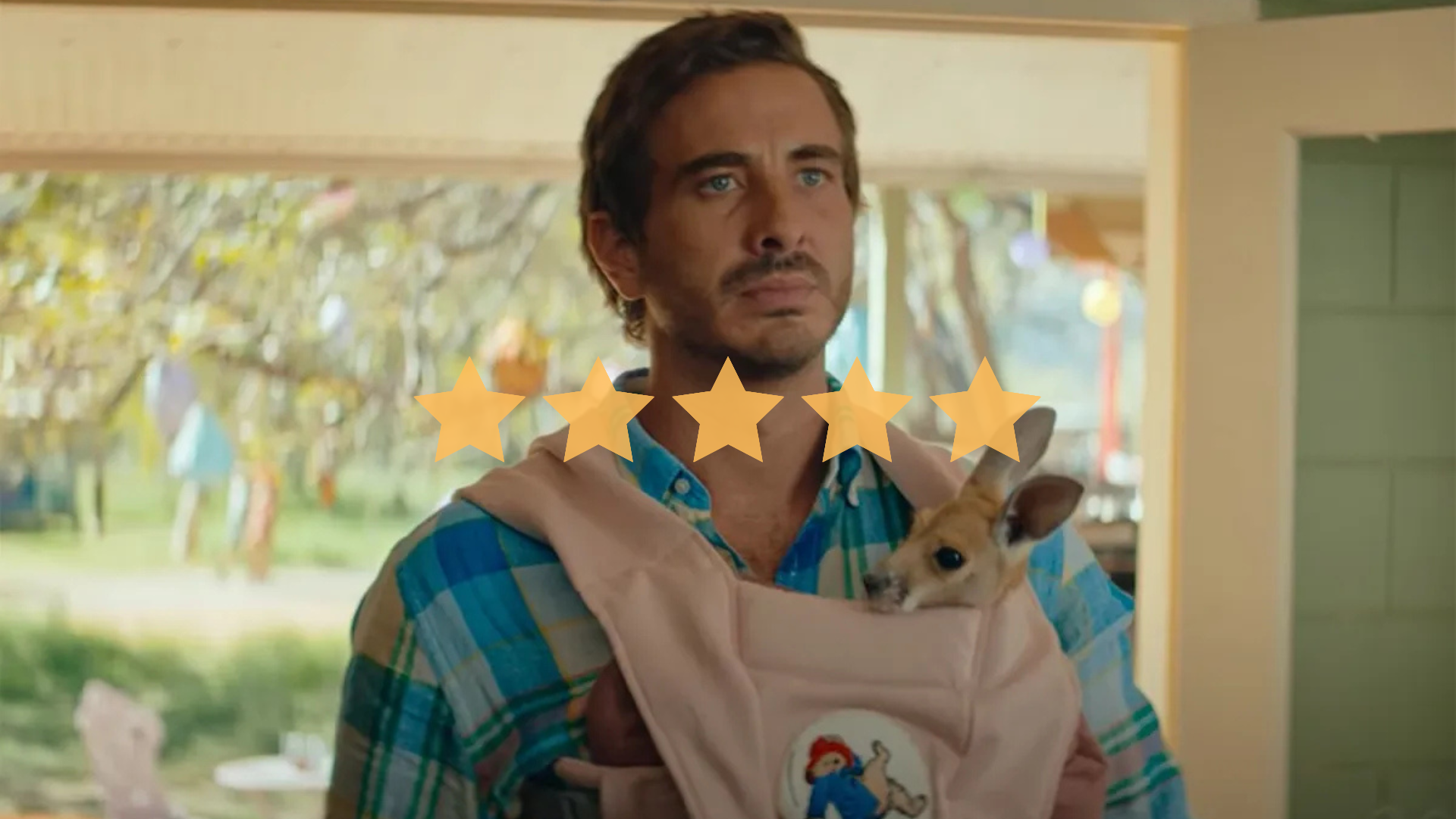
Set against the red centre of Alice Springs, Kangaroo arrives loaded with travel-ad expectations. What it delivers is a story about loss and belonging, and a masterclass in why familiar narratives still work.
★★★★★
It would be easy to film lingering shots of Uluru, sunsets over red earth hills with baby kangaroos—joeys—gazing wistfully into camera like Zendaya in Dune, then cobble it together with a tick-box script and distribute it as a thinly disguised advert for the Aussie Outback. The involvement of Tourism and Events Northern Territory, who partnered with Studio Canal on the film, hints that Kangaroo will be just that. But while it has all the tropes and all the gorgeous scenery, this movie manages to be more than a story-cum-travel-commercial.
Inspired by the book Kangaroo Dundee, which tells the real-life story of kangaroo sanctuary saint Chris Barns, Kangaroo follows disgraced weathercaster Chris Masterman (Ryann Corr) traipsing into backwater town Silver Gum after hitting a kangaroo with his sports car, killing it, and orphaning its joey. He finds a chance at redemption in the forms of the joey and local Indigenous girl Charlie (Lily Whitely), recently bereaved of her father. Charlie is adrift, just as Masterman is struggling with being cast adrift from his cushy TV job and comfy city life. Through caring for a growing number of needy roos—and each other—and overcoming the antagonists of ego and attachment to the past, Chris and Charlie each find belonging.
Landscape certainly features as a character in director Kate Woods’ paean to backwoods wit, weirdness, and weathered ruggedness, but this is no Koyaanisqatsi. The tropes are certainly front and centre; child with dead parent, stranger coming to town, refusal of the call, it’s all there. But Kangaroo is more than the sum of its film school techniques. It shows you the red earth of Alice Springs at sunset, but only in passing. The joeys are cute, but more than eye candy they’re a metaphor for being out of place, estranged from family, in need of support—like Charlie and Chris. And while the script is occasionally by-the-book (“I’m starting to forget what he looked like,” Charlie says of her dad, staring into the void of the outback) it has enough jokes, enough empathy, and enough curve balls to make a thoroughly enjoyable movie. Take Melvin, the First Nations barfly who pours scorn on our hapless hero. Melvin, the laconic bartender tells us, is a Rhodes scholar, and we see him later tutoring the town kids in history and Shakespeare. The bartender herself has a Cordon Bleu chef qualification on her wall (which Masterman mocks, making an enemy he’ll need to raise many roos to win over).
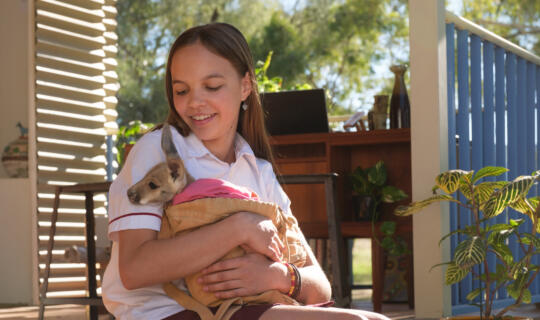
Special mention goes to Lily Whitely, aged thirteen during filming. Surrounded by well-known faces from Australian screens, Whitely does more than just hold her own. In her debut screen role, she exudes wit and presence, stealing scenes from the experts with a fully inhabited character. Awards are surely forthcoming.
Kangaroo could have veered into white saviour territory, Masterman as the sophisticated city bloke come to show backwards backwoods folk—most of whom are First Nations people—how to care for their country. But in fact, it’s this joyous, thriving community who are modern, educated, and capable, despite their lack of internet signal and sophisticated surroundings, that rescues him, shows him what he really needs, and gives him a place to be a version of himself worth living as.
The Verdict
If the team set out to make a commercial for the Northern Territories with this movie, they’ve accidentally created something more than the sum of its parts. Kangaroo’s characters are flawed, fickle, and fun to spend time with, and the film is moving and witty. More than that, it has a point. In a country where kangaroos are regarded as pests and hunted for ‘sport,’ this movie is a timely reminder of the value of compassion, both toward the natural world, and toward each other. That it achieves this while evoking both laughter and tears in the audience is tribute indeed to what could have been a trite kids’ film.
Words by JD Murphy
Support the Indiependent
We’re trying to raise £200 a month to help cover our operational costs. This includes our ‘Writer of the Month’ awards, where we recognise the amazing work produced by our contributor team. If you’ve enjoyed reading our site, we’d really appreciate it if you could donate to The Indiependent. Whether you can give £1 or £10, you’d be making a huge difference to our small team.