
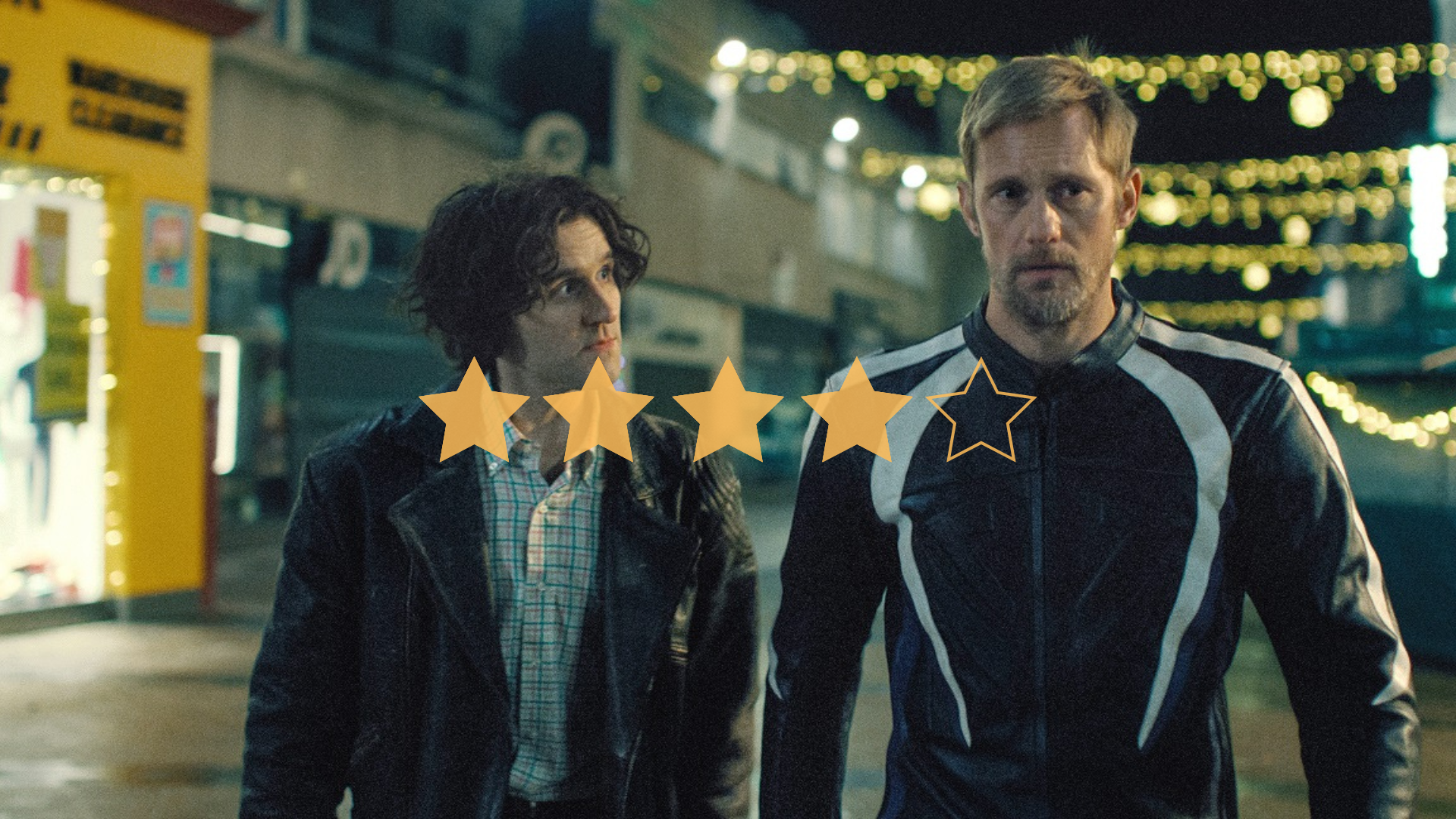
Harry Lighton’s BDSM romance explores power and vulnerability with a surprisingly gentle touch.
★★★★☆
Every once in a leather-clad while, a trickle of BDSM seeps into the mainstream. From 1995’s Crash to Belle du Jour, 9 ½ Weeks, Secretary and yes, the juggernaut of all billionaire-kink erotica, 50 Shades of Grey. It’s regularly billed as something intrinsically underground–a hidden niche for a naughty fringe–but maybe the world of kink, thrumming through the nucleus of the everyday, is a more ordinary interest than we realise. It’s certainly culturally irresistible, since time and again, audiences are inclined to dip a curious toe into the topic, even if the water is murkier than our comfort zone is accustomed to and features a jockstrap or two.
Pillion, the debut feature from writer-director Harry Lighton, is just such a film, thrusting this sexual subculture from the shadows onto the silver screen. Harry Melling plays Colin, a mild-mannered traffic enforcement officer and part-time barbershop quartet singer, who falls for dominant alpha male biker Ray (Alexander Skarsgård). Following their initial Christmas Day hookup outside Primark (yes, it’s arguably a Christmas film), the two begin a tryst that’s anything but equal. Before long, Ray has Colin doing odd jobs, cleaning, cooking, and sleeping over, not in the bed but on the floor at his featureless Chislehurst abode. Colin sheds his old life with unnerving speed, shaving his head and donning a symbolic padlock round his neck to secure Ray’s approval and fit in with his equally kink-driven biker ensemble, much to the alarm of Peggy and Pete, his painfully suburban parents.

The casting of the film is razor-sharp. Melling is better known to audiences as Harry Potter’s obnoxious cousin in that renowned eight-film saga. Dudley-Does-Domination is a key selling point here, and Melling shows he’s more than just a franchise actor in a role you’d never expect him to take on. But it’s Skarsgård that’s the revelation, swaggering his way in skintight biker attire through every scene. Yes, it makes sense to cast one of the best-looking men on the planet in this role (no poll conducted for that, but let’s face it, this would be the result) but it’s his star status that highlights the point Lighton’s trying to make. Ray looks hilariously out of place strolling around Bromley High Street beneath the tatty Christmas lights, or perched awkwardly in Colin’s dining room among his disapproving family and their net curtains. It’s reminiscent, oddly, of Jonathan Glazer’s Under The Skin, both for the avid use of motorbike straddling and the way in which these films play with our preordained concept of celebrity and where these stars belong. What could be more alien than seeing ScarJo wandering round a Glaswegian Debenhams? What is this Swedish demigod doing in Kent?
What Pillion gets so right is how aware it is that this story could be cookie-cutter. A shy, meek protagonist coming out of their shell through encountering a charismatic stranger is as tried and tested as Cinderella. But Pillion drives deeper. Ray isn’t some manic pixie dream biker, he’s a fully-fledged character who’s frequently an asshole. His treatment of Colin is consistently flawed but refreshingly real. “Our son is going out with an attractive creep!” Peggy laments in one scene. When she tells him, “I don’t like the way you talk to my son,” his deadpan response is, chillingly, “That’s fine. It’s not for you to like.” But as the plot progresses, Colin’s own strengths over Ray are revealed. Colin’s a strong singer, Ray palpably isn’t, as seen in one excruciating scene where he attempts a few lines in front of some bewildered passersby. Crucially, Colin’s main forte over Ray is his capacity to love; the moment romance rears its head in their relationship, it’s Ray’s turn to panic, the brittle bravado collapsing. You wind up feeling a level of pity for Ray that you’d never imagine during the film’s opening scenes.

In lesser hands, the use of BDSM would be a brief dalliance for the protagonist, a temporary toy to be discarded once the journey from bashful to confident is complete. Colin’s path is less clear-cut, and his enlightenment comes not from abandoning kink but realising he wants more from it, perhaps beyond the finite parameters his tryst with Ray can offer, and on his own terms. During their initial encounter, Ray asks Colin: “What am I going to do with you?” and his reply is “Whatever you want.” But over the course of the film, that open surrender has vanished, and we see him flourish into someone who knows exactly what he will and won’t allow. It suggests a strength in submission when it’s chosen rather than ceded. This is a hero’s journey you rarely see, and the film deserves its plaudits for portraying kink with such unabashed, kitchen-sink realism.
The Verdict
Pillion, ultimately, is a film about power—how casually we surrender it, how easily we surrender to it in others, and the importance of retaining it in whatever relationship we embark on. Lighton guides the story with tenderness and bite, and the result is a BDSM coming-of-age that’s both surprisingly touching and unmistakably its own creature.
Words by James Morton
Support the Indiependent
We’re trying to raise £200 a month to help cover our operational costs. This includes our ‘Writer of the Month’ awards, where we recognise the amazing work produced by our contributor team. If you’ve enjoyed reading our site, we’d really appreciate it if you could donate to The Indiependent. Whether you can give £1 or £10, you’d be making a huge difference to our small team.