
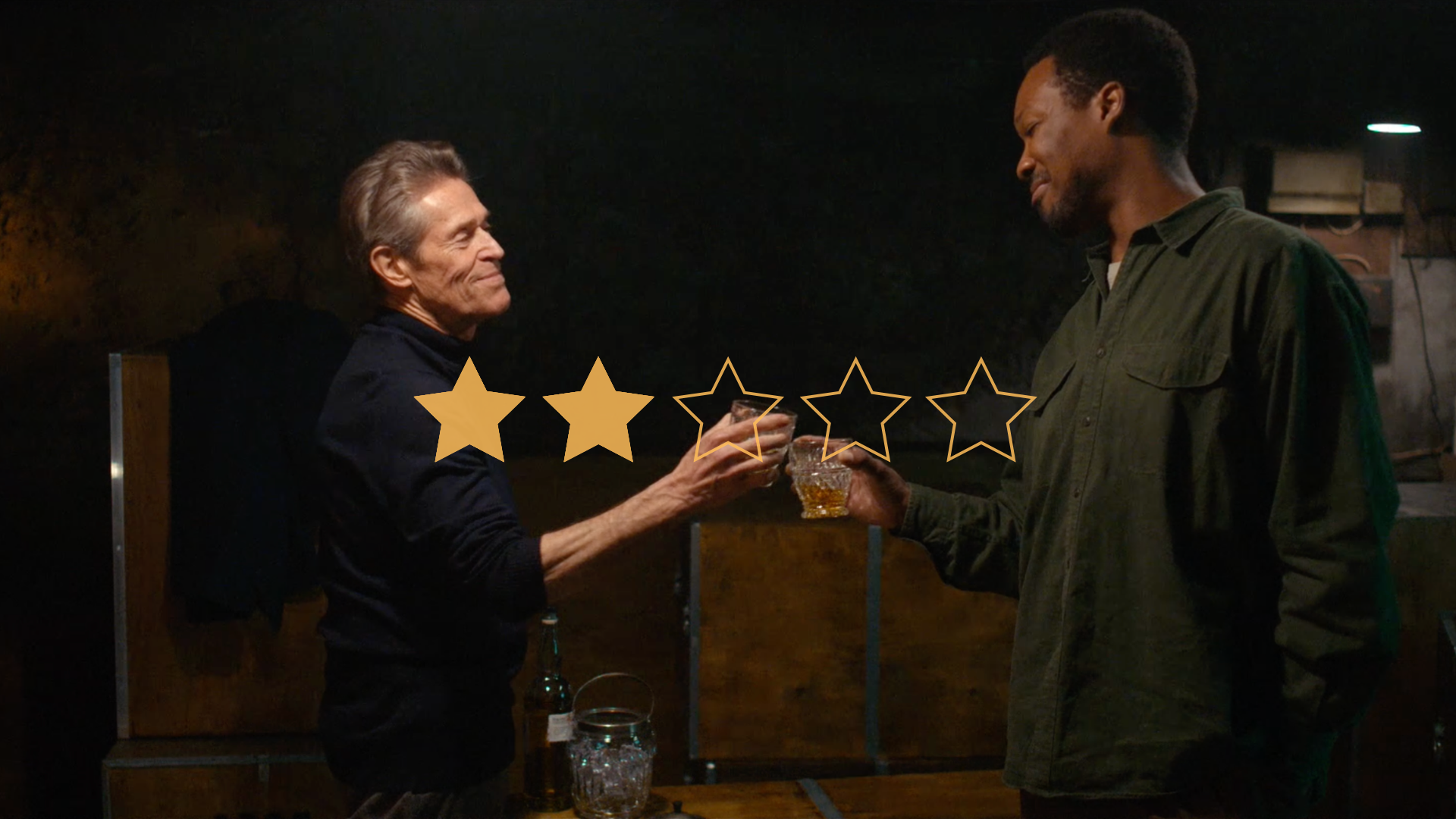
This debut feature from theatre director Nadia Latif, adapted by Walter Mosley from his 2004 novel, struggles to fully live up to its own sense of its ideas.
★★☆☆☆
From Sexy Beast (2000) to mother! (2017), there’s an argument to be made that some of the most genuinely disquieting ‘home invasion’ movies of the last 25 years have been those where undesirable house-callers, far from having to break down the front door, have instead been welcomed in with (albeit tentatively) open arms. It’s a choice that their hosts will invariably come to regret—particularly quickly in The Man in My Basement, this intriguing if ultimately befuddling thriller from first-time filmmaker Nadia Latif.
Corey Hawkins plays Charles Blakey, a troubled and somewhat irritable African-American man mourning the recent death of his mother. We’re introduced to him during a laid-back evening poker game, which quickly threatens to collapse into a fist fight after he relentlessly goads a friend who has the audacity to question whether it might be a good idea for him to finally get himself a job. After all, Charles is in dire financial straits—the stately if unloved house which he proudly claims to have been in his family for “eight generations” is at imminent risk of being repossessed, unless he can quickly rustle up enough cash to repay the mortgage.
Enter Willem Dafoe’s oily Anniston Bennet, who shows up at the front door one morning with an offer that seems too good to be true. He’s willing to pay Charles $65,000 (fittingly, about the sum of his debts) to rent his basement for two months: no questions asked, no explanations given. Charles is initially reluctant, but backed into such a corner such that he has no real choice but to go along with things. The anxiety only heightens when, shortly after moving day, he discovers that Bennet has erected a large cage in the basement, intent upon locking himself inside for the remainder of his stay and handing over the only key to his bewildered new landlord.
There’s more than a hint here of the antsy social horror of Jordan Peele’s Get Out (indeed, a particular scene involving a roadside collision with a deer can’t help but feel like a pointed homage). As in that film, unstressed racial tensions hang in the air from the outset, apparently more palpable for the black characters than its only white one. When Charles angrily questions what the police might conclude if they discovered this unconventional tenancy agreement, Bennett calmly replies that “they will find a man willingly here”: however much the expected power dynamics seem, on the surface, to have been reversed, it’s still uncomfortably clear who’s calling the shots.

True to the literary source material, there are also references to an older American canon: the drama plays out in Sag Harbor, a historic whaling town, so Moby Dick is naturally afforded a nod. There’s less overt echoes, too, of another Melville work, ‘Bartleby, the Scrivener’. That most peculiar of short stories centres around a character (the titular Bartleby) who dispassionately responds to every request asked of him with exactly the same line: “I would prefer not to”. There’s something of the scrivener to Dafoe’s Bennet; when questioned about his precise motivations for this bizarre self-imprisonment, he tends to offer only eerily gracious non-sequiturs and platitudes in response. He might be on the run from the law, on a kind of spiritual crusade, both, or neither.
Bartleby’s refrain gained a new lease on life in the 21st century during the Occupy Wall Street Movement, and there is much gestured towards here about the complex valences of power and property, particularly in a country where racialised slavery continues so forcefully to haunt the popular imagination. It’s a shame, then, that gesture is about as far as Latif and Mosley allow things to go. Intellectual threads are spun, tied together in ever more convoluted knots, and in the process, the film itself is almost entirely smothered.
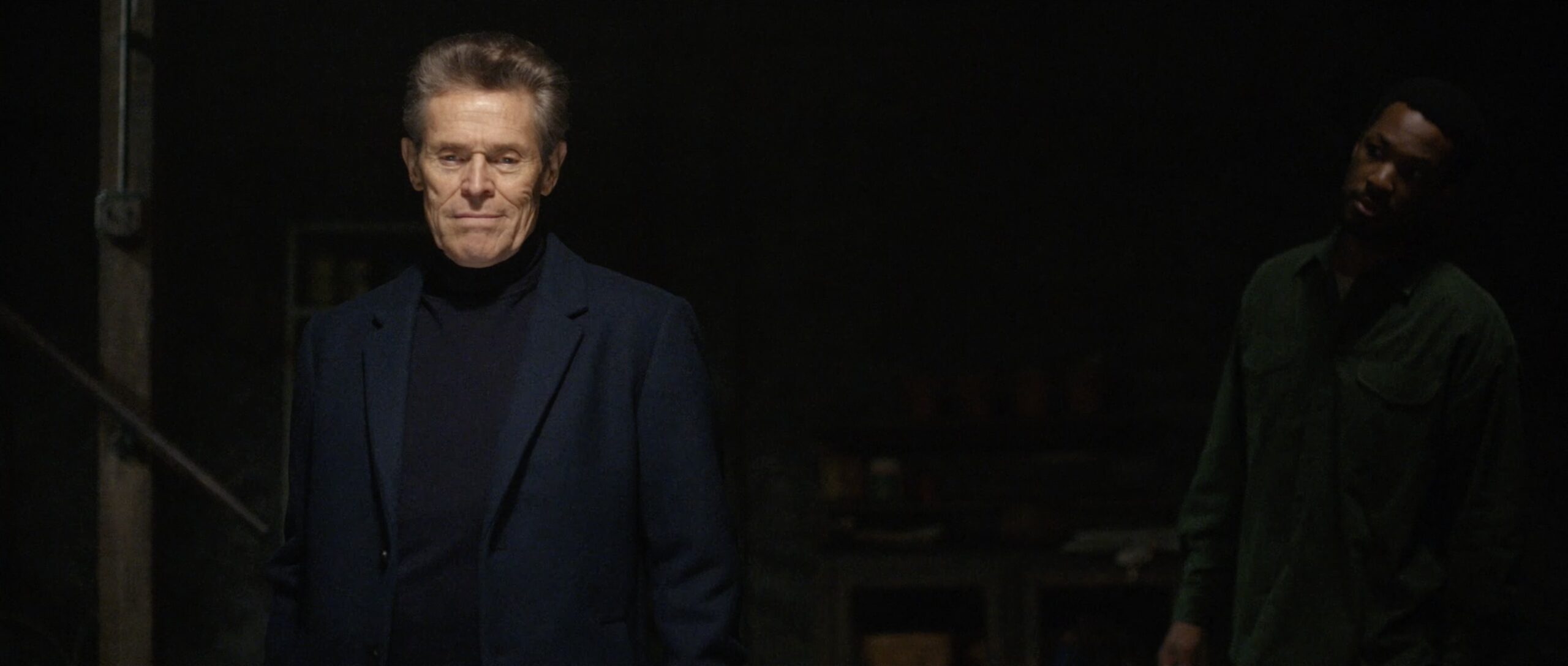
The ambiguity which is initially the principal allure of The Man in My Basement winds up being its greatest drawback. There can be a distinct elegance to the unexplained and enigmatic, but it starts to seem as though Latif may not be a sufficiently adroit storyteller, at least at this stage in her career, to properly strike the balance. A fairly unimaginative visual language is occasionally livened by psychedelic dream sequences, where Charles encounters some possibly supernatural presences—skeletons from his own closet, and ghosts of a wider cultural past (there’s a particularly unsettling moment involving a West African mask which used to belong to Charles’ mother). These scenes are not exactly badly composed, but begin to feel reiterative where they should be gradually illuminating. Much the same is true of the entire third act, far too reliant on lengthy monologues which feel at once portentous and oddly weightless. The whole thing is not without moments of insight, mostly courtesy of two expectedly strong lead performances, but you’re left in anticipation of a greater synthesis of ideas (à la Peele and some of his better imitators) that never quite occurs.
There have been whispers here of an uneasy production process (Hawkins was a late addition to the cast, after Jonathan Majors, also an executive producer, was dropped from the project following a domestic abuse scandal) and it’s hard not to notice that the film has been rather unceremoniously dumped onto Disney Plus with next to no fanfare, following a vanishingly short theatrical run. All of this is to say that it seems unlikely, at this point, that the film will gather a tide of new viewers any time soon—saving a lot of people, I suspect, a lot of headaches.
The Verdict
Despite committed performances and an arresting premise, The Man in My Basement talks itself into a corner and could do with a clarity of purpose befitting its influences.
Words by Isaac Jackson
Support the Indiependent
We’re trying to raise £200 a month to help cover our operational costs. This includes our ‘Writer of the Month’ awards, where we recognise the amazing work produced by our contributor team. If you’ve enjoyed reading our site, we’d really appreciate it if you could donate to The Indiependent. Whether you can give £1 or £10, you’d be making a huge difference to our small team.