
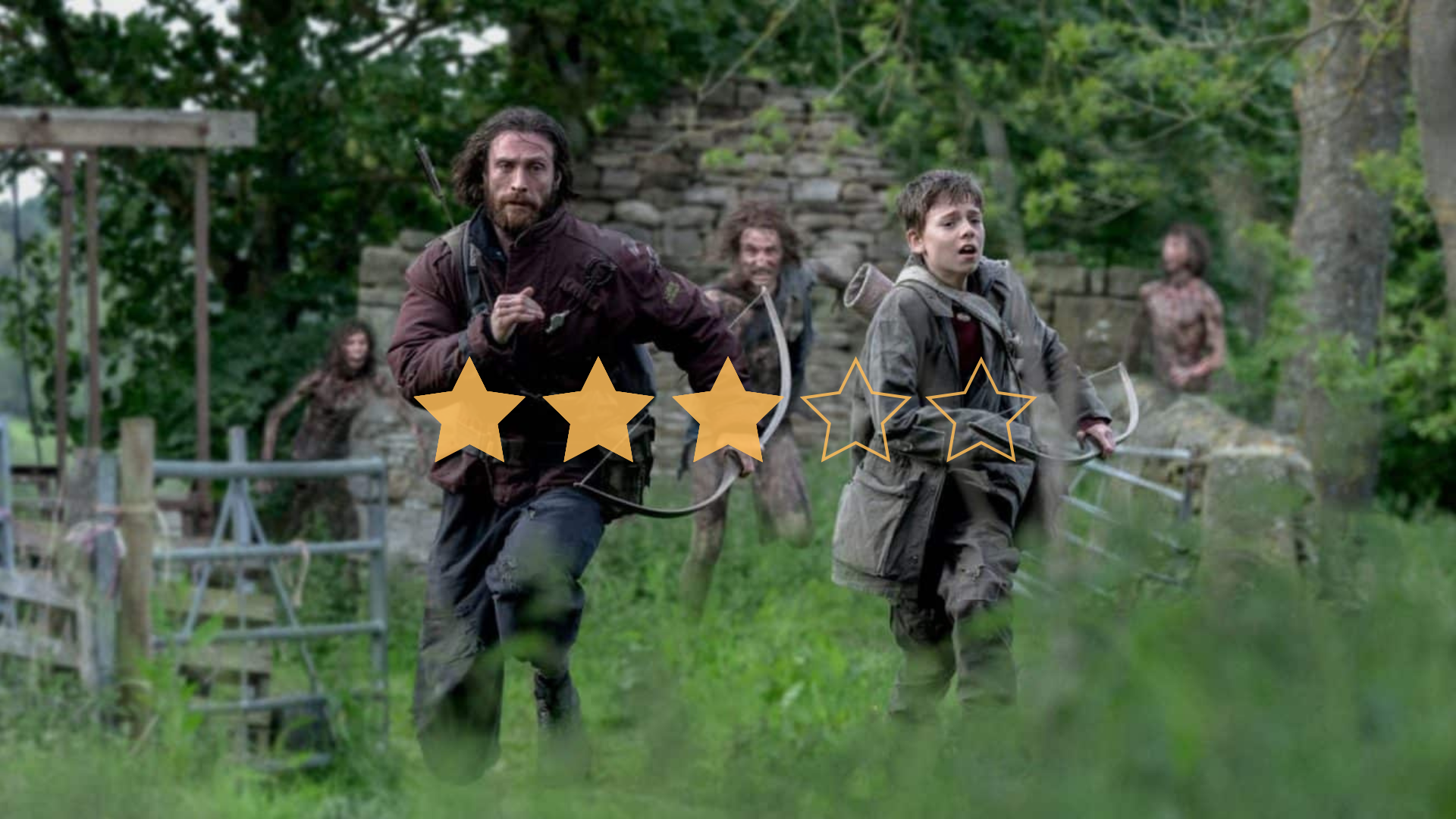
More than twenty years after the release of Danny Boyle’s cult zombie classic, 28 Days Later (2002), and its sequel 28 Years Later (2007), comes the highly-anticipated third installment of the franchise: 28 Years Later. The post-apocalyptic zombie horror’s threequel is a darker take on the end of times than its predecessors, placing death and its very human byproduct of grief, at its core – as well as some terrifyingly gruesome killing scenes.
★★★☆☆
Acclaimed British director Danny Boyle teams up with his long-term collaborator Alex Garland, whom he’d previously worked with on 28 Days Later and Sunshine (2007). Garland more recently stepped into the spotlight by directing sci-fi thriller Ex Machina (2014), Annihilation (2018) and last year’s dystopian A24 blockbuster Civil War (2024). His work is a recurring study on variations of bleak and barren post-human wastelands, where the mostly unlucky survivors are left to fend for themselves, in quarantined, infected environments. This time, he takes the genre to even gloomier heights, letting the theme of death seep into every corner of the writing.
28 years after a group of eco-terrorists broke into a facility that housed some infected apes, the highly infectious ‘rage virus’ has been normalised as every effort to contain the infection across the British Isles has dramatically failed. The film opens up in a remote house in the Scottish Highlands, with a group of terrified-looking children watching the equally terrifying Teletubbies (1997–) show on TV. Background noises signal the imminent arrival of the infected off-screen and everyone in the house gets zombified, except for one boy, Jimmy, who manages to escape. The story then jumps 28 years in time and introduces a seemingly unrelated family: Jamie (Aaron Taylor-Johnson) and his son Spike (Alfie Williams) who live on the self-sufficient tidal island of Lindisfarne, off the coast of Northumberland. Upstairs in bed, lies Spike’s mysteriously ailing mother Isla (played by a terrific Jodie Comer). The family all belong to a small community of survivors, somehow stuck in time, who persist through fishing, foraging and carefully travelling to the mainland at low-tide to chop wood. Spike is nervously preparing for his first trip to the mainland with his father, a rite-of-passage experience that all teenage boys have to go through, in order to kill their first ‘infected’. Both (soon-to-be) men set out with their bows and arrows and that’s when the film properly kicks off.
This first act of Boyle’s latest is definitely its weakest, telling a very banal coming-of-age tale of an alpha-type father, leading his frightened teenage son into the wilderness, for no other sake than to kill and prove his manliness. Jodie Comer being bed-ridden feels like a crying shame. The camera work is shaky (apparently shot on iphone), the colours are grey and desaturated and the zombie killing scenes are filmed from different angles to create a dynamic “bullet time” effect. It sometimes feels like you’re playing a First-Person Shooter video game, with an exaggerated emphasis on the playful side of killing, which Jamie is hopelessly trying to pass on to his son. The zombies have somehow managed to evolve and two new variants are introduced: the Slow-Lows, worm-eating crawlers, who are terrifying in appearance but too slow to be truly threatening, and the Alphas, upon which the virus has acted like some kind of steroid, rendering them huge in every aspect and far more frightening. Some scenes are pretty terrifying, especially those shot with an infrared camera, unveiling the horrifying things the infected get up to at night in the woods – including an Alpha ripping the heads off humans and animals alike, with the spinal column still attached (just writing this is making my skin crawl).
After very narrowly escaping death by an Alpha, Jamie and Spike make it back in time to the island. And this is where the story gets interesting. Spike rejects his father and longs for his ailing mother, begging Jamie to return to the mainland and find a doctor who lives there, Kelson, who could properly diagnose her. Jamie refuses, resulting in Spike kicking him out and dragging his mother out of bed and back onto the mainland at low-tide. This second trip into the wild is when his true coming-of-age occurs, not escorted by his father but guiding his beloved mother to safe port. The colours are no longer desaturated and everything looks more vibrant. Through her pain, they still manage to share moments of complicity, something that never happened with Jamie. Isla’s symptoms include bouts of confusion, causing her to hallucinate and mistake Spike for her dead father. A beautiful scene occurs when the two of them are walking through a field of buttercups and suddenly stumble upon the majestic Angel of the North popping out from over the flowers: a monument to bygone human days, still standing strong. Isla recalls her first memory seeing it as a little girl, again, with her late father.
Because, as the film unravels and gathers in texture, it becomes clear that the theme of grief is central to it. A third act is even introduced, when, as Isla and Spike are being chased by a terrifying Alpha, Kelson, the doctor (an incredibly refreshing Ralph Fiennes), appears and shoots a morphine-laced blowdart at it. Kelson’s skin is covered in iodine, a repellant against the infected, giving him a slightly terrifying orange appearance. However, both his character and acting end up offering a huge sense of relief. 28 Years really comes together in this final segment, while also paving the way for the film’s sequel, due next year, 28 Years Later: The Bone Temple. Isla finally gets her devastating diagnosis, as Kelson leads them to his majestic “bone temple”, a sky-high and eerie monument made out of all the skulls and bones of the many deceased. Far from being a clichéd sacrificial-like temple, he has dedicated his life to remembering and celebrating the dead. The film climaxes in a highly emotional scene in the temple, where Spike finally proves himself through one of life’s most potent lessons, which Kelson repeats to him: memento mori;”remember that you die”. 28 days after, Alfie crosses paths with Jimmy Saville lookalike, Jimmy (a perfect Jack O’Connell), the child from the opening scene – an arguably controversial finale, with critics and viewers alike questioning the choice of referencing one of the UK’s most infamous public figures in recent history.
The Verdict
Despite some weak points and loopholes in the film’s narrative, 28 Years Later’s real strength lies in its clever take on our relationship with death—and some really scary zombie scenes.
Words by Laetitia Collier
Support The Indiependent
We’re trying to raise £200 a month to help cover our operational costs. This includes our ‘Writer of the Month’ awards, where we recognise the amazing work produced by our contributor team. If you’ve enjoyed reading our site, we’d really appreciate it if you could donate to The Indiependent. Whether you can give £1 or £10, you’d be making a huge difference to our small team.