
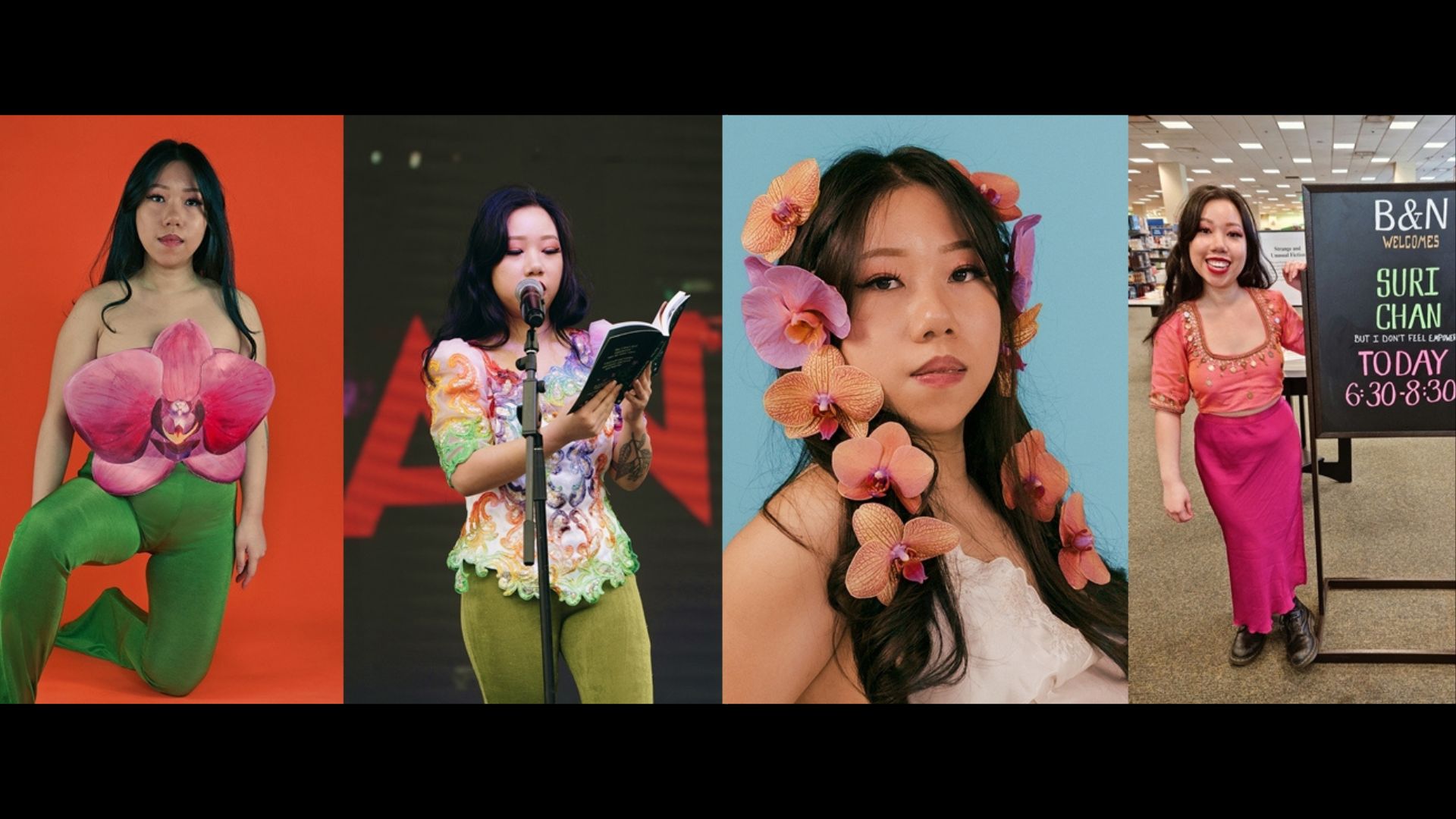
There is a quiet violence in vulnerability. It scratches at the polished surface of poetic tradition—tears a little at the wallpaper of lyrical convention. In But I Don’t Feel Empowered, Suri Chan’s collection of free-verse poems and plaintive, whimsical illustrations, that violence hums beneath each line: the violence of being looked at, mislabeled, misread, and the more insidious violence of trying to speak and be understood anyway.
These are not poems that perform beauty, though they are often beautiful. They resist aestheticization in the way an open wound resists decoration. At their core, they are skeptical of poetry itself—of language’s capacity to heal what it has also wounded. One senses Chan circling her own voice, uncertain whether speaking is confession or betrayal. The voice—sometimes sly and sidelong, sometimes fractured and suddenly intimate—never seeks to seduce. It invites, uncomfortably, into the folds of shame, heartbreak, memory.
“I’m really inspired by mundane, small things,” Chan told me. “One of the poems in the book is inspired by an ant’s death spiral.” The image is startling, and quintessentially Chan—an elegant horror distilled from the smallest of tragedies. It’s that offhand attention to overlooked phenomena that structures her best poems. There is an intuitive surrealism at work—fragments floating on the page like ash after a fire. But what is remarkable is that it never feels stylized for its own sake. The surreal emerges as a byproduct of emotional honesty, not abstraction.
Her form—restless, scattered across the page, often eschewing punctuation—recalls the dislocations of Ocean Vuong or Eileen Myles, though her sensibility is uniquely her own: arch, melancholy, allergic to self-pity. The poems read like diary entries never meant to be found, or perhaps only half-meant to be found. There’s a poetry of sabotage here—of resisting the urge to wrap a poem neatly. Often, the last line of a piece refuses the reader a conclusion, pivoting into ambiguity or silence. This refusal is itself a kind of statement: I don’t owe you a lesson from this pain.
This is not a political book in the traditional sense, but it cannot escape politics. It has become fashionable to call queer or Asian or female work “political” merely for existing, and Chan is wary of that pigeonholing. “People do tend to read it differently when it’s labeled as queer Asian poetry,” she tells me. “Focusing too much on specific parts of my identity.” This is a book that contains queerness, that moves through Asian identity—but it resists being reduced to those things. “I feel like my book touches on lots of universal topics,” she adds, almost hesitantly, “the heart of it is someone looking for love and belonging.”
Still, she does not dilute the specificity of her lens. These are poems born from the body: a queer Asian woman’s body, a body both politicized and invisible, a body tender with memory and exhausted by vigilance. One poem describes the fear of walking home at night, not in hyperbole, but in measured, brutal simplicity. “I get that superwoman tropes are meant to be empowering,” Chan says, “but they often feel shallow and patronizing because the regular woman often would be scared to walk home alone.” This line might well serve as a thesis for the entire book. Empowerment, in Chan’s telling, is not glitter or muscle or righteousness. It is complexity. It is contradiction. It is the courage to say: I feel weak. I feel stupid for caring. I feel real.
The collection is further distinguished by its illustrations—drawn, it seems, in a state of half-sleep, delicate and childlike but never naive. Figures with elongated limbs, animals in unlikely poses, small talismans of whimsy that serve both as counterpoint and commentary. They extend the poems visually, expanding their texture while resisting the “Instagrammability” that threatens to consume contemporary poetry. There is no aestheticization of pain here, only the raw strangeness of surviving it.
Perhaps most astonishingly, But I Don’t Feel Empowered never capitulates to redemption. There is no capital-E Ending here, no resurrection, no revelation. There is simply a woman, queer and alone and full of yearning, writing into the dark. And that, Chan seems to insist, is enough.
And still—it is more than enough. The book has been called a “breath of fresh air” by early readers. But more accurately, it is the kind of breath that follows sobbing—shaky, full of salt, edged with relief. It does not clear the lungs. It remembers why they were full.
Suri Chan has given us not a collection, but a reckoning. A book that doesn’t want to fix you. Only to say, I see you. I broke, too.
Words by Cassandra Fong
Want more Books content from The Indiependent? Click here
Support The Indiependent
We’re trying to raise £200 a month to help cover our operational costs. This includes our ‘Writer of the Month’ awards, where we recognise the amazing work produced by our contributor team. If you’ve enjoyed reading our site, we’d really appreciate it if you could donate to The Indiependent. Whether you can give £1 or £10, you’d be making a huge difference to our small team.