
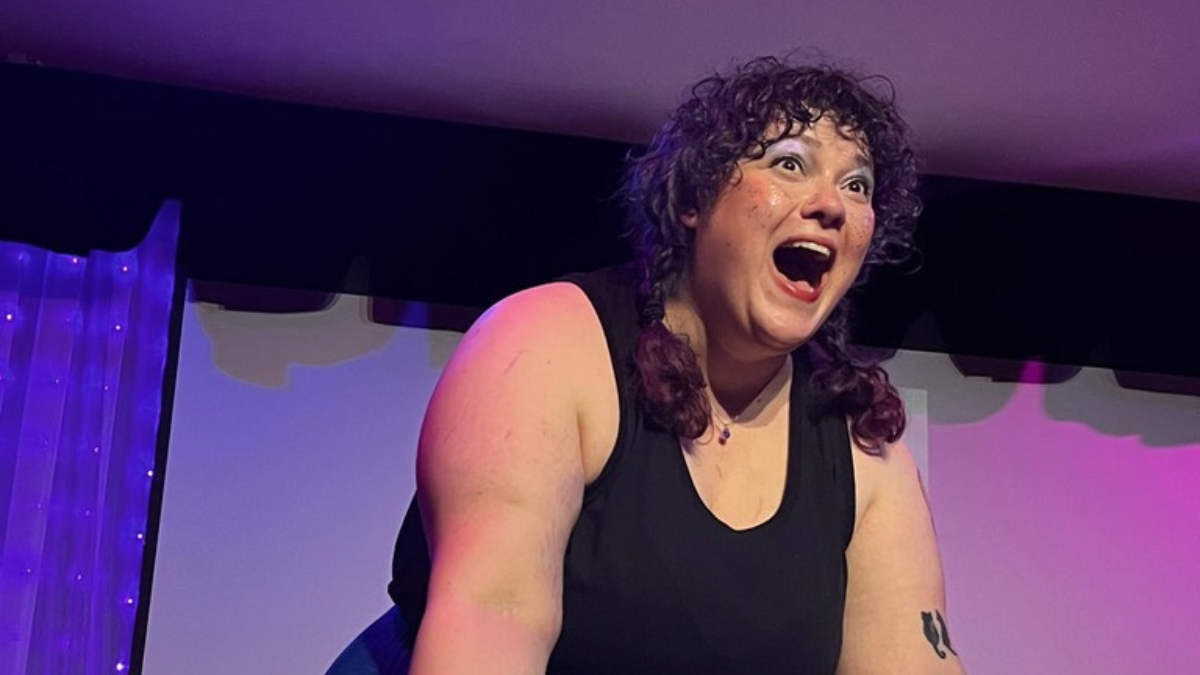
A coming-of-age comedy exploring mental health and drama school trauma, Maria Mainelli-Ajmo’s play Fly Trap is currently being performed at Camden Fringe, marking its UK premiere. The Indiependent spoke to Maria to learn more about it.
The Indiependent: For audiences discovering you through Camden Fringe, how would you introduce yourself?
Maria Mainelli-Ajmo: I think I’d introduce myself as a recovering theatre kid turned comedian. My identity was wrapped up in theatre and my world as an actor for a long time and it was hard to give that up, despite knowing it wasn’t quite right for me. Once the pandemic hit and that world shut down, it allowed me to take a beat and really determine what I wanted my next identity to be, as weird as that sounds. So I found comedy writing and storytelling and standup and reconnected with improv and I’ve never been happier.
You’ve described Fly Trap as “a piece of your heart”—a reclamation of memory, voice, and identity. What first compelled you to sit down and write it? Can you walk us through the soul of the piece, and how your grandmother’s “honey-and-vinegar” wisdom found its way into the bones of the story?
Originally, I wrote this show just to prove to myself that I could do it. I had no intention to ever get back onstage, especially not doing something vulnerable that would open up that vital part of me to criticism. But in the show, I wrote about how the young girl I once was deserves better than what I let the world do to her, I wrote about finding a way to love and embrace the bitter and spicy and raw parts of my life, and how I taught myself how to make my own honey. My grandmother’s advice always stuck with me in a weird way, maybe because it made sense for who I was but it sticks with me now because I’ve redefined the phrase for myself. Yeah, I can be sweet and catch some flies. But I’d rather be complex and confusing and real. And if people are attracted to that, great. But I’m content knowing that not everyone will be. Because I’ll be me.
Has living inside Fly Trap night after night changed how you relate to the story it tells, or the version of you it came from? What have you learned about yourself, your voice or your audience along the way?
The thing I’ve learned the most about is myself, especially how my art and my humanity are so interconnected. Every time I perform it, I find some new truth that I’d hidden in there for myself, I find healing in my own words, and I find so much joy in the fact that other people see themselves and their stories in this show. So many people have come up to me afterwards simply to say “thank you, I didn’t know I needed this” and it’s the best thing I’ve ever heard. I find myself accepting the harsh parts of myself every night, healing the hurt parts, and finding new ways to connect with my audience.
What is it about solo performance that appeals to you over other theatrical forms? Was there a part of making the show that felt the most rewarding or fun?
I think the thing I love about solo performance is that it’s all up to me. That can be intimidating and scary but at the end of the day, it’s the best way to tell my story. Writing this show was so incredibly rewarding simply because I learned so much about myself and who I want to be. It started out as a very different idea but in writing it, I began to find pieces of myself that I felt I’d lost. And when I was able to dust off those pieces and hold them and see them and thank them for waiting for me to find them again, I began feeling like a whole human again, which was hard. This show is not just a reclamation of my identity, it’s a rediscovery of it too.
Humor can be a soft landing for hard truths or a shield. Has it always come naturally in your voice, or is it something you’ve learned to wield over time? What role does it play in navigating the weightier parts of your story?
I’ve always been something of a clown. From the time I was a kid, I used humor as a shield and as a way to get people to like me. But as I’ve gotten older, I’ve learned how to harness that and make it something more powerful. There’s nothing more important to me than being able to laugh through the tough stuff because I think that’s the only way to really let yourself heal. Once you can laugh about something, it’s easier to face it. For example, when I was diagnosed with bipolar disorder, it took me a long time to accept my diagnosis. But as soon as I saw other bipolar people laughing about their experiences, I found myself being able to laugh at the parts I used to cringe at and hide from. Now I’m proudly outspoken about it because I want someone else to have that same feeling of “oh, she can joke about it and be okay… maybe I can be, too”.
You’ve been candid about living with bipolar disorder. Has that shaped how you revisit your earlier work or life, especially in terms of self-censorship or the desire to be “likable”? Are there aspects of your creative voice that feel more certain or unapologetic now?
My bipolar diagnosis totally changed the direction of my life, especially my creative life. I look back at who I used to be and I just see someone in pain. I always had this feeling that something wasn’t quite right with the way I processed the world but I didn’t realise how much it was holding me back. I needed to be liked because if I was liked, people might not notice that I was hurting, ignore that I was manic and not sleeping, people might laugh at my jokes instead of asking if they meant I needed help. I felt so deeply unlikeable because I felt out of control of myself, of my emotions, and of my life. I got diagnosed at my absolute lowest point and while there have been setbacks, I’ve never looked back. Not only has my creative voice become more unapologetic, more sure, my entire person has as well. I finally feel like a whole person who understands their brain and understands what they deserve. It’s weird that I had to get diagnosed with a disorder most people have extremely negative views on to finally view myself positively. But it’s part of who I am and I like me. So that’s what really counts.
You seem fluent in both cringe and catharsis. When telling such personal stories, how do you decide what to offer the audience and what to hold close? Is there power in revealing the rawest parts, or restraint in protecting them?
I’m a fairly open book with my audiences. I think with the kind of art I’m making, it needs to be honest and sometimes brutal for it to make the impact it needs to. And usually the best way to do that is to tell the truth. But there are still pieces of these stories that I hold for myself, parts of my identity that I’m still figuring out, and things I don’t know how to express yet. The balance, for me, is somewhat dependent on my own mental health. If I haven’t worked through it in therapy, it probably shouldn’t go in a story yet.
Are there moments in the show that still catch you off guard?
I find myself getting caught off guard by the ending every single time. It’s just an emotional journey of a show, with me growing up onstage and losing myself and when I feel like I find myself in the end, it feels like the first time all over again. I always feel this rush of “Maria, you’re really okay now” and it gets me every time.
What has it been like bringing the show to London? Have UK audiences responded differently than those in the U.S.?
Bringing the show to London is such a dream. I’ve always wanted to perform internationally and getting the chance to do it with a show I wrote about my own journey, with my husband running tech, is incredible. I was obsessed with BBC programming growing up so this feels like a nod to the Doctor Who obsessed 12-year-old me who was foaming at the mouth to go to London. But I think this show is universal. Yes, many of the details are uniquely American (growing up in the middle of a cornfield might not be familiar to some folks here) but the messages, the heart, and the journey are all things that are just human. My goal was to write a show that doesn’t need a specific audience to be impactful and I think I’ve achieved that.
Now that Fly Trap has taken flight, what’s next?
My next move is a new solo storytelling show! I’m currently writing it and it is a doozy. It’s about my bipolar disorder and the grief that came with my diagnosis. I think the humor might be a little darker, the stories a little heavier, but I don’t believe in bumming people out. I want to use this show to say “hey! I have bipolar disorder and I’m still an incredible person”. Because bipolar is so stigmatised and negatively viewed, I want to bring audiences a different view on it. A view from the inside of a manic mind, a depressive episode, and how life feels when the world thinks you’re crazy. And maybe I am crazy. But I’d rather be crazy than boring.
Fly Trap will be performed at Barons Court Theatre until 2 August.
Words by Khushboo Malhotra
Support The Indiependent
We’re trying to raise £200 a month to help cover our operational costs. This includes our ‘Writer of the Month’ awards, where we recognise the amazing work produced by our contributor team. If you’ve enjoyed reading our site, we’d really appreciate it if you could donate to The Indiependent. Whether you can give £1 or £10, you’d be making a huge difference to our small team.