
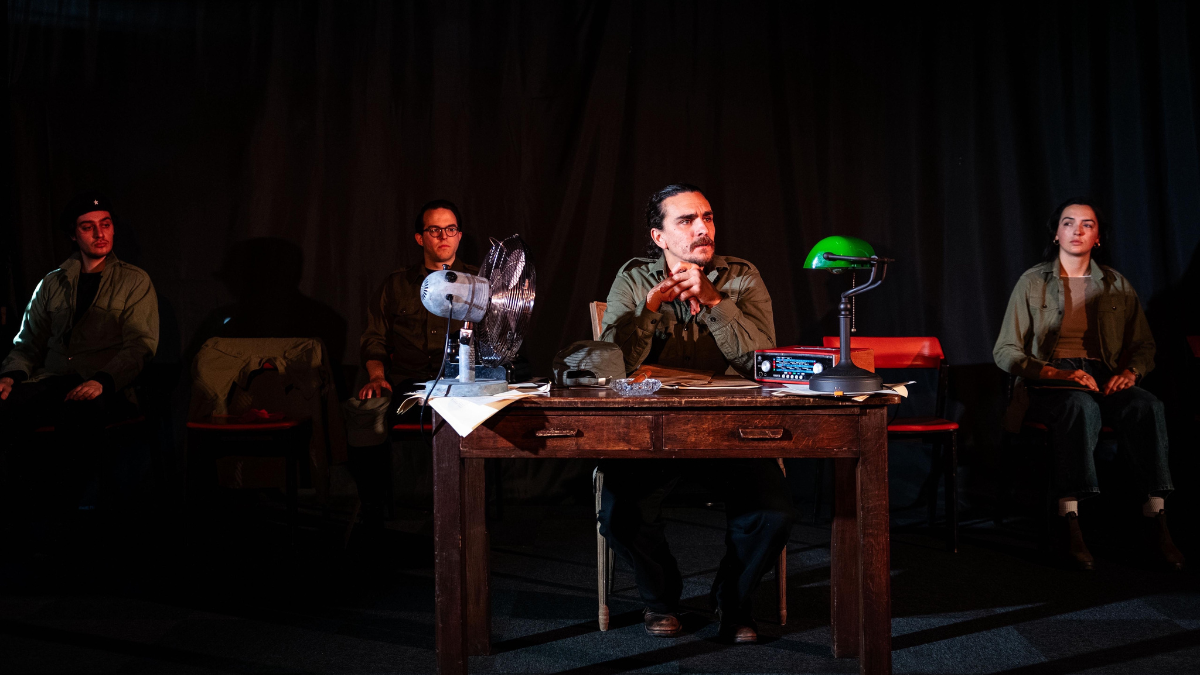
Patria O Muerte is an exciting piece that crosses language barriers, dramatising the infamous rise of Cuba’s most important figure, Fidel Castro.
Patria O Muetre, written by Leo Oliva, directed by Gus Hodgson, and produced by Elissa Gerrand, debuted a preview on 23 November, at Riverside Studios, River Room. The play follows the story of Fidel Castro (Leo Oliva), his rise to power alongside his brother Raúl Castro (Diego Zozaya), and the revolutionary Vilma Espin (Natalia May) and the infamous Che Guevara (George Steane).
Lasting 30 minutes, the piece presents Fidel Castro’s unrelenting ambition, the infighting taking place within his closest circle, and the execution of Che Guvera.
The performances are strong all around. Each actor is enigmatic, amplifying the imagined intensity of what would have taken place in Cuba from 1953-1967. All actors are bilingual Spanish speakers performing in a play that includes both English and Spanish speaking parts. One might have course for fear, but the emotionality brought by the actors transcends language barriers, so meaning is not lost in translation.
The set and costume design by Kezi Furgurson is minimal due to the small size of the stage. In the centre stands a wooden desk equipped with all the materials to change an entire country’s world history: Fidel’s seizure of power, the executions of traitors and an alliance with the USSR. Smaller embellishments like Cuban cigars bring the world to life. Taking on a Brechtian approach to set design, you are imbued with the core of this story, which is both deeply political and human. In a Q&A after the performance took place, Oliva highlighted wanting to adapt the stage play into a screenplay.
The pacing gradually crescendos within this piece, allowing for tension to mature despite the shortened time frame. The sound design by Velia De Nicola emphasises this growing tension: sounds of gunshots, balls bouncing on the floor, highlight the fragility of power uncontained.
The play is developed from Leo Oliva’s thesis project for his MFA in Classical Theatre and is inspired by Macbeth, where Shakespeare’s tale serves as an allegory for power and ambition during Cuba’s revolution. Of Cuban American descent himself, Oliva draws on his own personal history to convey the story of Fidel Castro from his perspective.
The most compelling part of the preview is how the play questions the idea of power. What is the greater good? Is the greater good for the people or for the self?
Ultimately, it is a well-done performance, and makes audiences curious to see how a full-length play would be executed. Though nothing is concrete yet, there is hope to have a two-week run of the stage production; however, no date has been announced.
Words by Ayomide Asani
Support The Indiependent
We’re trying to raise £200 a month to help cover our operational costs. This includes our ‘Writer of the Month’ awards, where we recognise the amazing work produced by our contributor team. If you’ve enjoyed reading our site, we’d really appreciate it if you could donate to The Indiependent. Whether you can give £1 or £10, you’d be making a huge difference to our small team.