

Tulsa King began as one of Taylor Sheridan’s most refreshing creations; relaxed, witty, yet also grounded, the show’s first season carved out a charming identity amid Sheridan’s increasingly hard-edged catalogue. But much like its protagonist, the series has started to feel old-hat.
★★★☆☆
Back in 2022, the series started with a clear, compelling engine: Dwight Manfredi (Sylvester Stallone), a worn-out mafioso, searching for a new home and a sense of belonging in the last place anyone (least of all him) expected. Along with gunfights and gangland bouts, Tulsa King smoothly sauntered onto Paramount+ with a playful sense of humour in its fish-out-of-water framework.
However, much like season two, the third season falls back on familiar beats and presents a storyline that feels more circular than evolving. Once again, Dwight finds himself fighting a war on two fronts: dealing with Tulsa’s politically domineering, God-fearing tyrant Jeremiah Dunmire (Robert Patrick) while fending off Mob boss Quiet Ray (James Russo) back in New York. Adding to that, the FBI are forcing Dwight into hunting a serial killer. Suddenly, the show feels less like a tight crime drama and more like a juggling act with too many pins in the air.
One of the season’s most noticeable setbacks is how the writing and tone have drifted toward something frivolous rather than the grounded nuance that defined season one. What once felt like an unexpected, character-driven crime drama has gradually morphed into a looser, more exaggerated version of itself. It’s as if Stallone (serving also as head writer) is repeating the tonal trajectory of the Rocky franchise. Say that the show’s early sincerity resembled the first Rocky’s grit, season three lands closer to the broad, sometimes goofy energy of Rocky III and IV, where larger-than-life beats overshadow emotional grounding.
The chintzy, out-of-touch energy that once gave Dwight charm now plays like a gimmick. There are only so many times you can watch Stallone’s ageing legend sit in his four-by-four grousing about modern society, before it begins to feel like filler instead of flavour.
Still, the season didn’t start this way. The opening three episodes are some of the show’s most entertaining to date, thanks largely to Robert Patrick’s stellar presence. Patrick once again proves himself one of the most reliable villain actors working today, right up there with Mads Mikkelsen. His Dunmire is a toxic, swaggering plague on Tulsa’s political landscape, whose influence is so pervasive that it almost borders on farcical that Dwight hadn’t crossed paths with him sooner. Beau Knapp also shines as Dunmire’s conflicted son, Cole. The archetype is familiar (the heir slowly awakening to the sins of his father), but Knapp brings enough nuance to give the trope some bite.
Unfortunately, that early momentum steadily deflates into a scattered middle stretch. Compared to the sharper storytelling of Sheridan’s other Paramount+ entries this year (Mayor of Kingstown season four or Landman season two), Tulsa King feels oddly diluted, as if it lost confidence in its own identity.
Characters drift in and out with little acknowledgement. Bevilaqua (Frank Grillo), who was central to several early-season arcs, disappears entirely after episode six. Quiet Ray all but vanishes after a major turning point in episode nine. The most disappointing casualty is Cleo Montague (Bella Heathcote). After suffering a personal tragedy from Dunmire in the season premiere, she seemed primed for a vital revenge arc. Instead, she evaporates from the narrative until a brief check-in during episode eight’s aftermath. Her absence is all the more glaring considering the show’s desperate need for a strong female presence on Dwight’s gang’s frontline.
Meanwhile, the returning characters feel creatively frozen. Tyson (Jay Hill) is still playing dress-up in the mob world. Bodhi (Martin Starr) still cracks the pessimistic quips while being dragged along for the ride. And Dwight’s romance with ranch owner Margaret (Dana Delaney) continues to drain energy as Delaney and Stallone simply lack chemistry, especially compared to the snappy, friction-filled spark he shared with Agent Stacy (Andrea Savage) in earlier seasons.
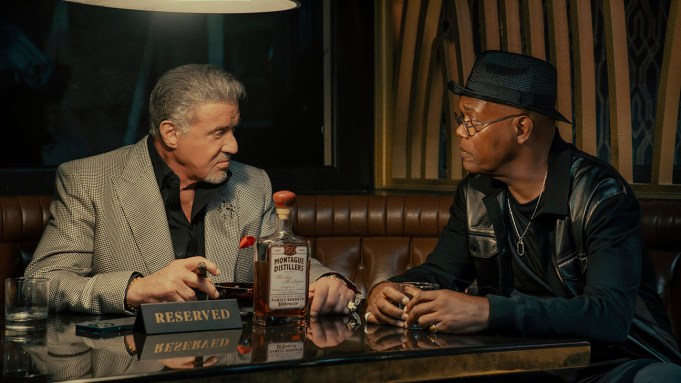
The back half does manage to regain some traction, especially once Samuel L. Jackson enters the picture in episode nine as Russell Washington, a hitman from Dwight’s past. Jackson doesn’t simply show up for a glorified buddy cameo; he radiates the same cool, lethal composure that made Jules from Pulp Fiction iconic. His presence injects the season with badly needed momentum and, with a spin-off already announced, his character feels like a welcome long-term addition to the Tulsa King universe.
Unfortunately, the finale squanders much of this revived energy. For a season-ender, it’s surprisingly low on stakes or tension. The first half plays like a checklist: Dwight, Mitch, and crew calmly planning their inevitable showdown with Dunmire, complete with purchasing illegal weapons in broad daylight. Cole’s betrayal of his father is delivered with a level of convenience that borders on shameless, and the climactic confrontation lands with less weight than the build-up promised.
The Verdict
Season three ultimately suffers from a tonal imbalance, veering unpredictably between camp and brutality, leaving the show feeling rhythmically unregulated as well as narratively unsure of itself. There’s still life left in Tulsa King, but season four will need to trim the excess, commit to a clearer identity, and rebuild organic tension if the series wants to regain the sharp, grounded appeal that made its early years so compelling.
Stream season one to three of Tulsa King on Paramount+.
Words by Joseph Jenkinson
Support The Indiependent
We’re trying to raise £200 a month to help cover our operational costs. This includes our ‘Writer of the Month’ awards, where we recognise the amazing work produced by our contributor team. If you’ve enjoyed reading our site, we’d really appreciate it if you could donate to The Indiependent. Whether you can give £1 or £10, you’d be making a huge difference to our small team.