
“All art is propaganda” was a claim made by the American sociologist and author W.E.B Du Bois in his controversial essay The Criteria of Negro Art. George Orwell made a similar claim in his collection All Art is Propaganda. These statements, at least when superficially viewed through the literal-minded eye of most modern readers, perhaps seem rather extreme.
The point here is not to wade haplessly into a debate regarding the nature of art and its relationship with propaganda. For now, just for the sake of argument, let’s take this statement at face value. All art is propaganda, however it is surely far less controversial to say that even if all art is propaganda, surely not all propaganda can be considered a work of art. After all, most art (at least to me) barely seems to pass for art, these days. We are a culture dominated by unoriginal hacks and grubby, gutless philistines; groping for the next remake, or sequel, or re-quel, or reboot, or re-boot-quel to slop out to the easily-impressed masses, as our species slowly circles the drain into a state of complete and utter cultural bankruptcy.
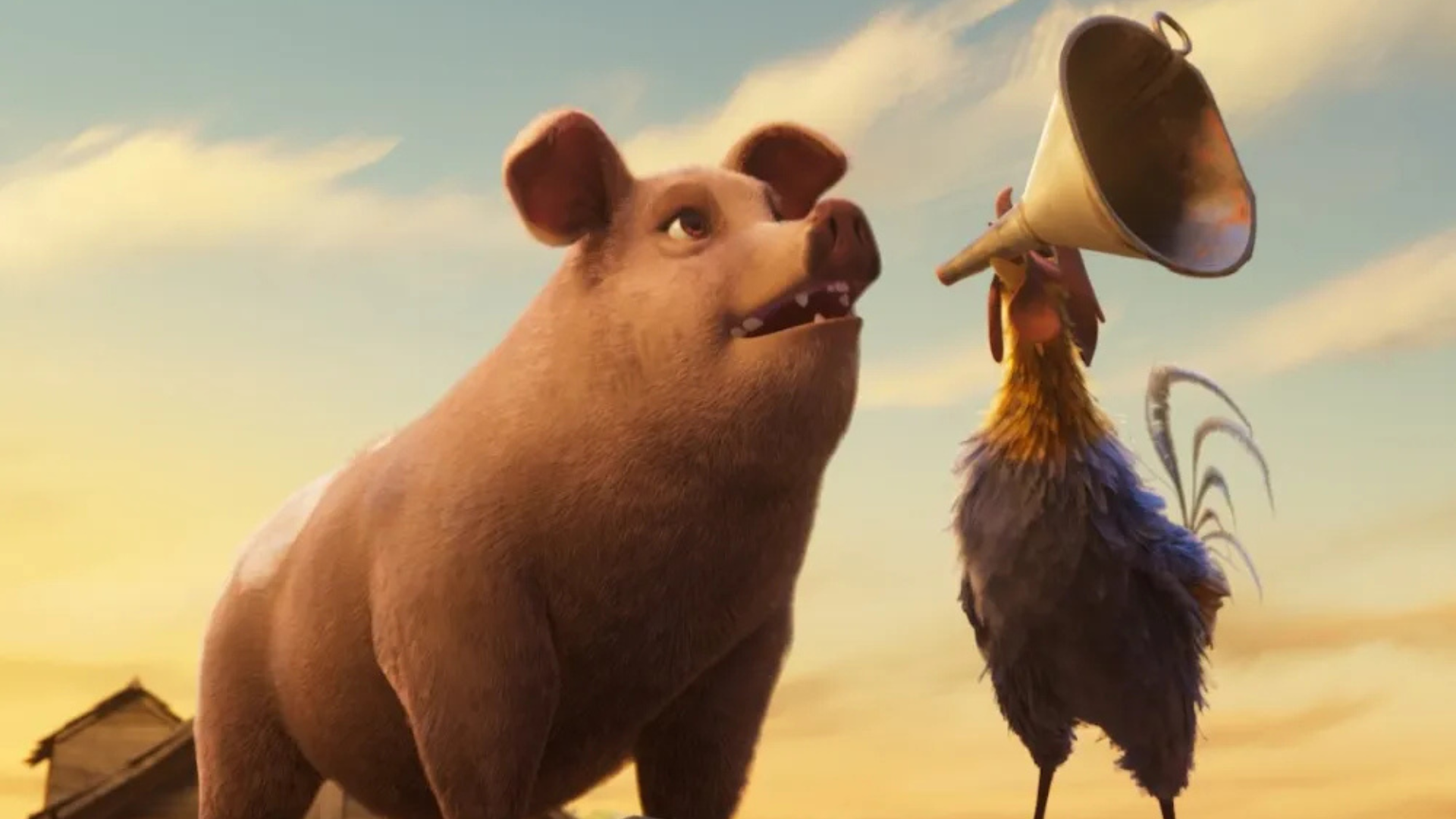
In his essay, The Frontiers of Art and Propaganda, Orwell claimed that the period from 1930 to 1941 did “a great service to literary criticism” by reminding us “that propaganda in some form or other lurks in every book, that every work of art has a meaning and a purpose–a political, social and religious purpose.” Then again, Orwell never lived to see our blighted century. If he did, perhaps he would feel obliged to rewrite or even scrap this entire essay. After all, what possible purpose–political, social, religious or otherwise–what absurd and hideous motivation can be used to justify the existence of Andy Serkis’ Animal Farm?
On the 12th December, a trailer for this new adaptation of Orwell’s political satire was released on YouTube. As of the writing of this article, it has amassed nearly seven-hundred-thousand views and a total of five thousand likes. Due to YouTube’s current (cowardly) policy of obscuring the number of dislikes from unwelcome eyes, it is impossible to know for certain just how badly this trailer has been ratioed, but from a quick glance at the comment section, the optics aren’t great. Numerous content creators have already eviscerated this trailer for its (apparent) failure to faithfully adapt one of the most famous novellas of the twentieth century, so there is probably very little need to summarise exactly what makes one’s gorge rise mere seconds into this CGI travesty. Maybe it’s the invention of an entirely superfluous villain, some weird tech-girl boss in a silver jacket who looks more like a rejected member of the Despicable Me rogue’s gallery than anything to do with George Orwell. Perhaps it’s the childish jokes and crude Americanisation of some of the most iconic literary villains in history. I mean, they cast Seth Rogen as Napoleon for goodness sake! What’s next? Jack Black as Snowball? Jonah Hill as Old Major, slapping one trotter against another and injecting an f-bomb into every other syllable of dialogue? Why not go the whole hog (pun intended) and get Rob Schneider to voice Boxer?
There is far more that could be said about this newest adaptation of Animal Farm. Entire dissertations could be written, lambasting every single frame of this ghastly trailer, but I suspect that that would become boring after about ten pages. It’s demoralising enough having to watch the trailer once, let alone read about it. Instead, it is necessary to consider exactly why this is (most likely) going to be an abysmal failure of an adaptation. On the other hand, how successful have the other attempts been, really? When one takes a closer look at what has gone on before, it becomes apparent that every attempt (so far) to adapt Animal Farm into a film, have been failures. Yes, failures–though not, it must be made clear, due to any lack of talent or determination on the part of the filmmakers. Instead, these failures have stemmed from a fundamental (and, quite possibly, deliberate?) misunderstanding of Orwell’s central narrative.
The original text was a satirical allegory of the 1917 Russian revolution, and the new regime’s ultimate collapse into Stalinist persecution, authoritarian control and the destruction of the values and beliefs that inspired the initial rebellion against Tsarist rule. Each character, human and animal is a symbolic representation of a historical figure or a social group. Farmer Jones, who is the original tyrannical owner of the novella’s central farm, is a stand in for the ousted Tsar Nicholas II. Napoleon is a darkly comic, though equally bloodthirsty representation of the dictator, Stalin. Anyone familiar with the original story is probably rolling their eyes right now, and waiting for me to get to the point, but it is crucial to remember this point: every character in the novella is, first and foremost, an allegorical representation of someone, or something, far larger. Once you remember this detail, the failures of previous film adaptations become clear.
Animal Farm was first adapted to film in 1954. In many ways, this is a fine adaptation. The majority of the story is incredibly faithful to the text, and the high quality of the animation, coupled with several moments of appropriately dark humour, capture both the tragic and comic elements of Orwell’s original satire. The recreation of Boxer’s death is a perfect example of this; the depiction of the noble stallion being carted off to a glue factory after a lifetime of service to Animal Farm and Animalism, followed immediately by the gluttonous pigs drinking “to Boxer’s memory, with the whisky they had bought with Boxer’s life.” It’s a haunting scene, one that perfectly captures one of the major themes of the original Animal Farm, the absolute corruption at the core of the counter-revolutionary Stalinist regime.
There is, however, a significant alteration that takes place within the 1954 adaptation. In the concluding chapter of the original novella, a group of human farmers, amongst them Mr Pilkington, who represents the British and American ruling classes, praises Napoleon’s brutal suppression of his fellow animals on the farm, insisting, half-jokingly that “if you have your lower-animals to contend with…we have our lower classes!” Napoleon echoes this sentiment, claiming that his sole wish is to live “at peace and in normal business-relations with their neighbours.” Moments later, when a quarrel over a game of cards erupts between the humans and the pigs, the rest of the animals (who have been watching the whole interaction through the window of the manor house), discover that they are no longer able to tell the difference between the pigs and the humans: “Twelve voices were shouting in anger and they were all alike…it was impossible to say which was which.” In the 1954 film adaptation, the humans are entirely absent from the final scenes. Instead, Napoleon invites a group of dignitaries; pigs from neighbouring farms (which rather confuses the whole allegory) in order to propose an alliance. When this is discovered, the beasts of Animal Farm once again rise up in rebellion and overthrow the pigs. The 1999 adaptation is even more bizarrely optimistic. It concludes with a group of animals that previously fled the totalitarian farm returning to find that Napoleon and his allies have (conveniently) all died offscreen and a new family of super-nice human farmers have purchased the dilapidated farm. So, erm, all’s well that ends well?
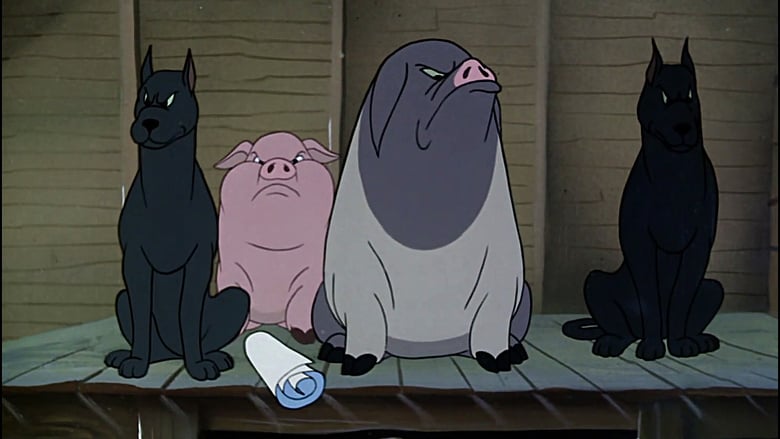
Both of these adaptations, for all of their many strong points (well, not so many for the 1999 adaptation) are curiously skittish when it comes to the ending of the original text; neither one of them wants to paint the human farmers as complicit allies to the dictatorial pigs. Why is that? Well, again, we must return to the realm of symbols. It is an uncomfortable fact that the Allies, including the Western nations of Great Britain and the U.S.A, chose to ignore the brutality of the Soviet Union during the Second World War. This is one of those difficult facts of history that nobody really likes to pay much attention to. The 1954 adaptation was funded by the Office of Policy Coordination, a branch of the CIA that was dedicated to using culture as a means of combating communism. In other words, the 1954 adaptation was produced, at least in part, as a propaganda weapon against the Soviet Union during the Cold War. This goes some way to explaining the altered ending—it would no doubt have been rather awkward for the CIA to draw any obvious parallels between the exploitative, Capitalist regimes of the West and the exploitative, Communist regimes of the Soviets.
The various film adaptations have always shied away from a key component of Orwell’s political satire: the complicity of the Western, pro-capitalist ruling classes in the rise of the authoritarian, Stalinist regime. They opposed the Communists in the immediate aftermath of the 1917 Revolution, fearful that their own “lower classes” would start getting ambitious, but were more than willing to turn a blind eye to Stalin’s political violence when Russia became a major ally against the Axis powers. It is far easier to perceive the text as a simple anti-communist tirade and to tack on a happy ending that absolves the western political and business elite of any guilt. At the very least, the 1954 version emphasises the importance of struggling in order to protect one’s liberty, of defiance in the face of political oppression; the 1999 adaptation devolves into little more than a liberal fever dream. All the nasty pigs have died off-screen and a nice new ruling class have stepped in to fill the awkward void left by the fallen porker despots.
It seems that, with each adaptation, we are spiralling further and further away from Orwell’s original cautionary allegory—until we are left with Andy Serkis’s tone-deaf interpretation of Orwell’s masterpiece. If you want to imagine what the future of any Animal Farm adaptations looks like, imagine Seth Rogen’s grating laugh, blasting through your ears—forever.
Words by Rhys Clarke
Support the Indiependent
We’re trying to raise £200 a month to help cover our operational costs. This includes our ‘Writer of the Month’ awards, where we recognise the amazing work produced by our contributor team. If you’ve enjoyed reading our site, we’d really appreciate it if you could donate to The Indiependent. Whether you can give £1 or £10, you’d be making a huge difference to our small team.