
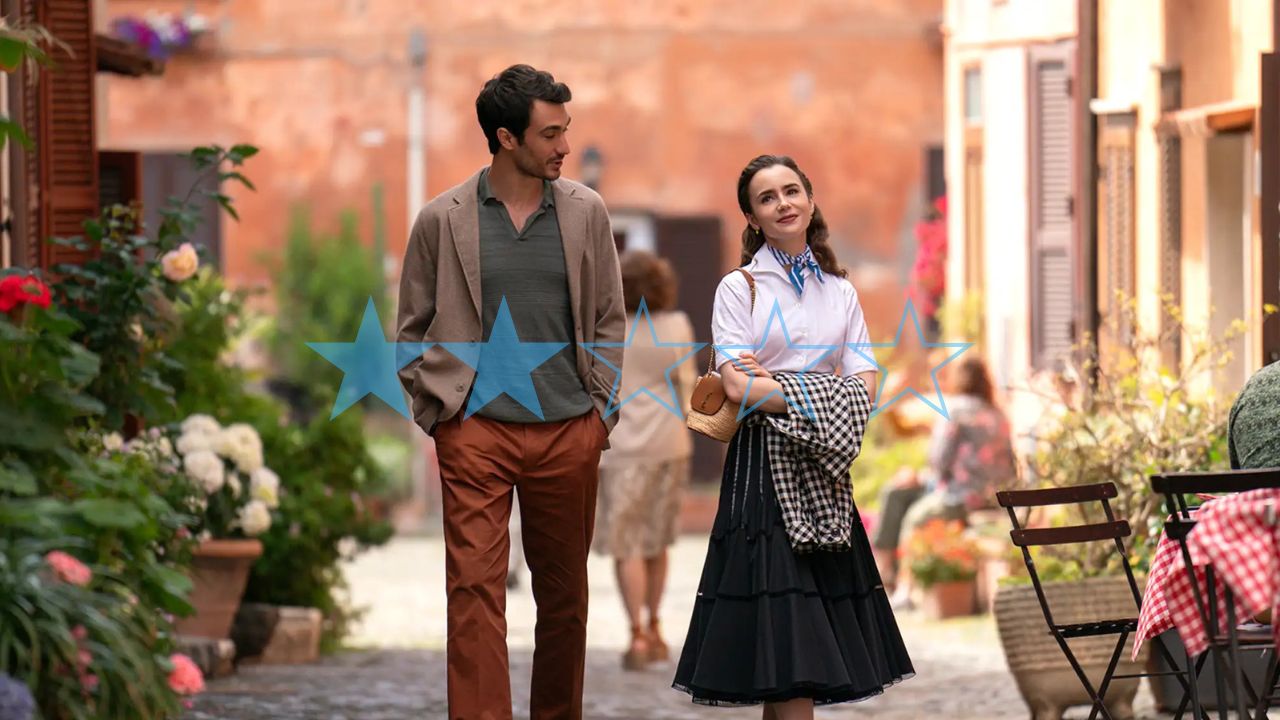
Emily’s European fantasy may finally be losing its sparkle. When Emily in Paris first premiered, it thrived on fantasy: couture wardrobes, Parisian streets, and a messy love triangle that kept viewers hooked. Four seasons in, that formula had begun to feel stale, and season five promised reinvention. Instead, it feels like confirmation that the show has lost the magic that once defined it.
★★☆☆☆
There are spoilers ahead!
By the end of season four, the series seemed ready to evolve. Emily Cooper (Lily Collins) was finally choosing herself, leaving behind Paris and her emotionally draining relationship with Gabriel (Lucas Bravo) in favour of Rome, a promotion, and a seemingly stable new relationship with Marcello Muratori (Eugenio Franceschini). Season five had the perfect opportunity to reinvent the show. Instead, it feels like confirmation that Emily in Paris has lost the magic that once defined it.
Season five opens in Rome, exactly where we left Emily: optimistic, ambitious, and ready for a fresh start. She has her own office, a new city to explore, and the promise of professional independence. Within minutes, however, the show undermines its own premise. Sylvie (Philippine Leroy-Beaulieu) abruptly takes back Emily’s promotion, effectively stripping Rome of its purpose.
This decision raises an immediate and frustrating question: why is Sylvie even there? This is a woman who has consistently prioritised career above all else, yet we are asked to believe she would stall her professional ambitions to chase a rekindled romance. The result feels less like character development and more like narrative convenience.
There are brief moments where the season seems to find its footing. With Gabriel absent for much of the season, Emily’s relationship with Marcello is allowed to take centre stage, and surprisingly, it works. Their relationship is calm, adult, and refreshingly free of constant chaos. Real challenges emerge without unnecessary drama, making their dynamic feel more believable than anything Emily has had before. Instead, the emotional mess is shifted onto Mindy (Ashley Park). The love triangle with Mindy, Alfie (Lucien Laviscount), and Nico (Paul Forman) feels forced, detracting from Mindy’s character rather than developing her. It ultimately feels like filler rather than a meaningful subplot.
The series also struggles with balance this season. The show introduces many new characters but fails to give them enough depth to matter. They move in and out of the story with little continuity, making it difficult to feel invested in their arcs. At the same time, the characters we’ve grown attached to over the years are noticeably sidelined. Julien (Samuel Arnold) and Luc (Bruno Gouery) have such little presence that one might forget they also work at Agence Grateau. They exist mostly as witnesses to chaos instead of being active parts of the various plots. Their absence is especially noticeable given how much screen time is devoted to Marcello and other newcomers. Sylvie, while still a “girlboss”, feels oddly flat. She hasn’t evolved much, and without meaningful challenges or consequences, her scenes begin to blur together.

That’s not to say the season is entirely without merit. There are moments that briefly recapture the show’s old spark. The awkward proposal or a high-profile launch going disastrously wrong are surprising and fun, and bring back some of the show’s dramatic charm. We also get a few wholesome moments of friendship such as Mindy-Emily, or Emily-Jake (Bryan Greenberg), even if they are bizarrely strung together.
Unfortunately, these moments are handled haphazardly. Characters are written off abruptly, storylines are resolved or forgotten too quickly, and emotional beats rarely have time to breathe. That said, I hope we get to see more of Jake in future seasons.
Despite its beauty, Emily in Rome lacks the magic of Emily in Paris. The city itself never becomes a character in the way Paris once was. Storylines feel engineered to force familiar faces into the same spaces rather than arising organically from the setting. As a result, Rome feels more like a backdrop than a world.
One episode’s reference to “La Belle Époque”— a period in French history marked by cultural flourishing, optimism, and relative peace—is unintentionally revealing. The episode mirrors this idea by inviting the characters to pause, reflect on their own beautiful eras, and briefly live within those moments before moving on. Emily in Paris once had its own version of this: a time when the show felt light, charming, and emotionally engaging without trying too hard. Season five suggests that era may be behind us. While there are moments of sincerity and reflection, they’re often undercut by reversals that refuse to let the story move forward, leaving the series caught between offering closure and clinging to the dynamics that once defined it.

Still, the season doesn’t end without promise. The tease of a potential season six, possibly an Emily in Greece, reintroduces a sense of excitement, even if it comes with familiar frustrations. The thought of Emily and Gabriel being pulled back into each other’s orbit once again risks feeling repetitive, but a new setting offers some hope. If the show can learn from the Rome chapter and allow its characters to genuinely evolve, perhaps it could mark the beginning of a new Belle Époque, one that captures the joy, confidence, and magic that made us fall in love with Emily’s world in the first place.
Words by Anushka Kulkarni
Support The Indiependent
We’re trying to raise £200 a month to help cover our operational costs. This includes our ‘Writer of the Month’ awards, where we recognise the amazing work produced by our contributor team. If you’ve enjoyed reading our site, we’d really appreciate it if you could donate to The Indiependent. Whether you can give £1 or £10, you’d be making a huge difference to our small team.