
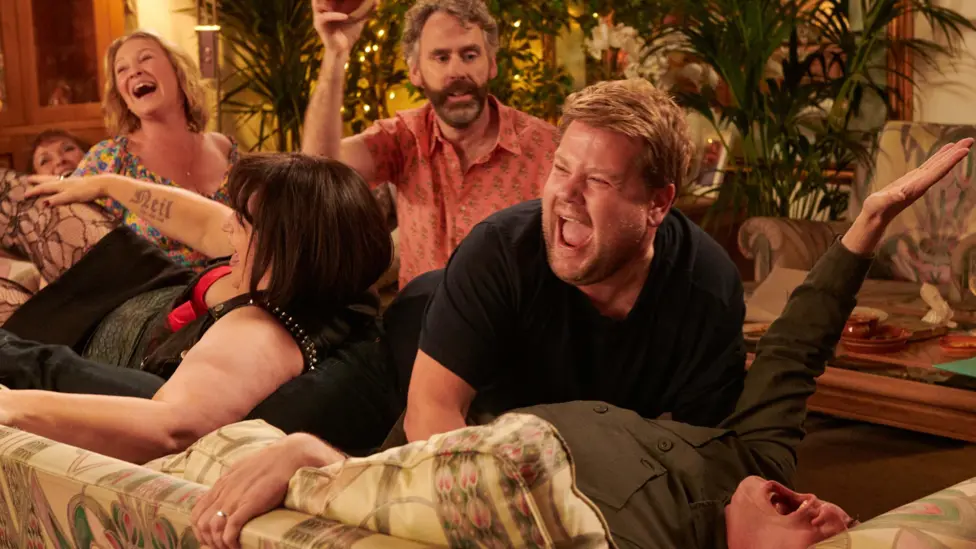
It’s been more than a year since Gavin & Stacey’s Christmas 2024 finale, an event that felt less like a TV broadcast and more like a national gathering, as Britain collectively returned to Barry Island for the last time. But with the tinsel long packed away and the emotion settled, the question remains: does the finale still hold up, or did it ultimately fall into the sitcom traps the show once avoided?
To call Gavin & Stacey a cherished comedy during its original run from 2007 to 2010 would be a monumental understatement. The BBC breakout was both a critical and commercial success, earning a raft of nominations at the 2007 British Comedy Awards and winning the BAFTA Audience Award and Best TV Comedy in 2008. Its cultural staying power was cemented in 2019, when Radio Times readers voted it the 17th greatest British sitcom of all time.
That same year, writers James Corden and Ruth Jones (who also played the iconic Smithy and Nessa) surprised audiences with a Christmas special that became the most-watched comedy broadcast in 17 years, pulling in 18.49 million viewers. Five years later, the 2024 finale surpassed even that, attracting 19.3 million viewers and becoming the most-watched scripted programme in over two decades.
Clearly, the story of two families and two cultures colliding still holds a great deal of meaning. And in many ways, the finale delivered exactly what fans wanted.
There is no shortage of crowd-pleasing moments. The familiar ensemble gets gloriously drunk and dances to Mamma Mia; Smithy’s stag-do descends into chaos; Dawn and Pete (Julia Davis and Adrian Scarborough) bicker as only they can; and Gwen’s (Melanie Walters) affair with Dave Coaches (Steffan Rhodri) adds an unexpected twist.
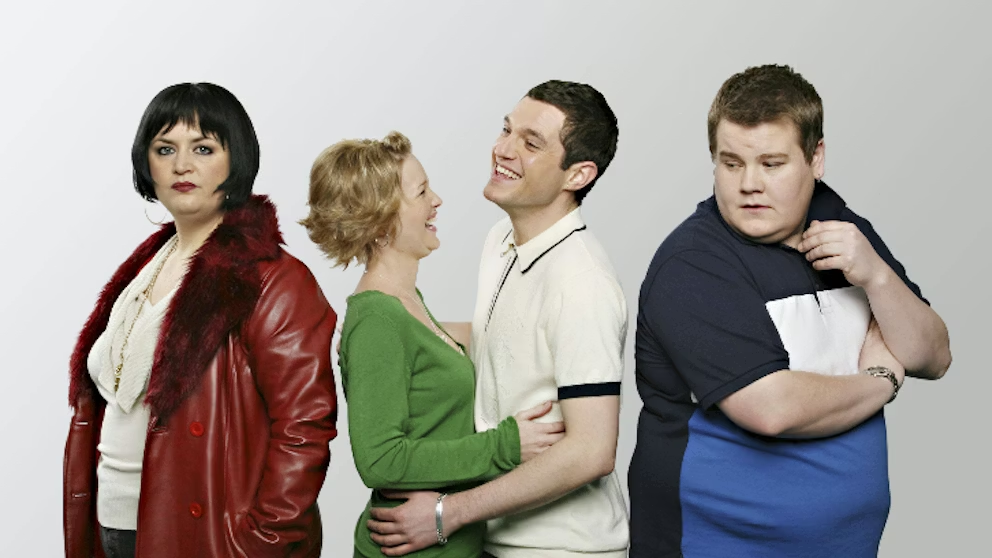
However, amidst the laughs was plenty of warmth. The final special provided closure on the unconventional romance between Smithy and Nessa, one that surpassed even the titular Gavin and Stacey. The previous special ended on an audacious cliffhanger where Nessa proposed to him. Five years later, the finale paid things off with an epic showdown at the wedding, where Smithy, encouraged by the other characters, decided not to marry his fiancée, Sonia (Laura Aikman), and instead finally chose Nessa.
The payoff is undeniably satisfying. Seventeen years after their misadventure in Leicester Square, Smithy and Nessa are finally paired. The final montage of their wedding, soundtracked by a full version of Stephen Fretwell’s Run, is engineered to tug relentlessly at the heartstrings, and they, for sure, succeed.
So, where does the unease for this grand finale come from?
The first issue is one the show has been grappling with for years: Gavin & Stacey is no longer about Gavin and Stacey. What began as a cross-cultural romance slowly transformed into a Trojan horse for its supporting cast, particularly Smithy and Nessa. By the time of the 2019 special and even more so in the 2024 finale, Matthew Horne and Joanna Page became sidelined almost entirely. Ruth Jones’s Nessa even bluntly tells Stacey, “You and Gav are boring,” a line that feels less like character dialogue and more like the writers favouring their own characters.
While most viewers are unlikely to mourn this shift, it does feel faintly transgressive for the show’s creators to push their original protagonists so aggressively into the background. In doing so, the finale becomes emotionally rich but narratively weaker, drifting away from the grounded storytelling that once defined the series.
That weakness stems largely from how that 2019 special’s cliffhanger backed the 2024 one into a scriptwriting corner. If Smithy had accepted Nessa’s proposal outright, the finale would have lacked momentum. Not much would happen except for getting to a wedding. But the alternative of having him proceed with marrying Sonia right up until the vows results in a rather predictable outcome. There is never any real doubt that Smithy will choose Nessa. Even Corden and Jones admitted in the documentary A Fond Farewell that “there was never any question” of whether Smithy would end up with Sonia.
This predictability stands in stark contrast to the series three finale. Back then, Nessa’s impending marriage to Dave Coaches carried genuine tension because Dave actually made sense for her. He mirrored her emotional reserve, her stoicism, and her pragmatism. Smithy, her polar opposite, won out not because the alternative was unbearable, but simply because their connection, strange and chaotic as it was, felt irrefutable.
Sonia, by contrast, is a stock sitcom obstacle. She has little in common with Smithy, raising the question of how they ended up together at all. Worse still, she is written as increasingly unpleasant, stripped of the relative realism she had in the 2019 special. The show tries so hard to make her distasteful that the emotional scales tip unfairly, removing any lingering ambiguity. Laura Aikman performs the role impeccably, but the character herself becomes a one-note antagonist rather than a believable rival.
This feeds into a broader issue: the finale’s reliance on sitcom clichés. Specifically, the last-minute dash to confess true feelings is a well-worn trope. Friends had Ross racing to the airport for Rachel. Here, Smithy rushes to stop Nessa, except not at an airport, but at a dock. Still, the mechanics remain the same.
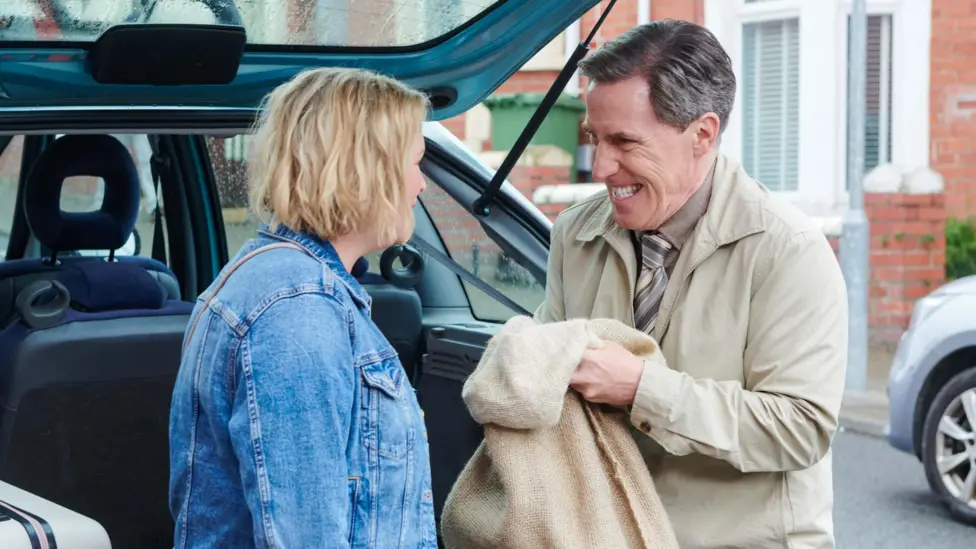
What makes this especially jarring is that Gavin & Stacey has never been a show that leaned heavily on such devices. Its originality lay in its mundanity. Gavin and Stacey’s own wedding goes off without disaster; love is portrayed not as spectacle, but as something quietly negotiated amid families, cultures, and compromise. James Corden has spoken that he based the idea on a friend’s real-life romance, and that authenticity always anchored the series.
The original 2010 ending exemplified this ethos. True, Smithy stops Nessa’s wedding, but he doesn’t deliver a sweeping declaration of love. Instead, he admits that parts of her “repulse” him, a feeling she openly shares. They don’t ride off into romantic bliss, but instead choose something messier, more realistic: co-parenting their son Neil, referred to as “The Baby” (Oscar Hartland). They become a unit not because everything is resolved, but because life demands it.
That ending was subversive, grounded, and quietly profound. The 2024 finale, by contrast, opts for emotional maximalism. It gives fans closure, catharsis, and a fairytale resolution. There is nothing inherently wrong with that; as a Christmas event, it succeeds spectacularly. As a piece of storytelling, however, it trades the show’s unique realism for familiarity.
So, does the finale hold up a year on? Emotionally, absolutely. Structurally, less so. It doesn’t reach the sharp ingenuity of the show’s heyday. In opting for closure over subversion, the finale may sacrifice a little of the show’s original sharpness. Still, it gains a sense of warmth for fans in a generous, celebratory goodbye to characters who have meant so much to them. A fitting, if slightly softer, farewell.
Words by Joseph Jenkinson
Support The Indiependent
We’re trying to raise £200 a month to help cover our operational costs. This includes our ‘Writer of the Month’ awards, where we recognise the amazing work produced by our contributor team. If you’ve enjoyed reading our site, we’d really appreciate it if you could donate to The Indiependent. Whether you can give £1 or £10, you’d be making a huge difference to our small team.