
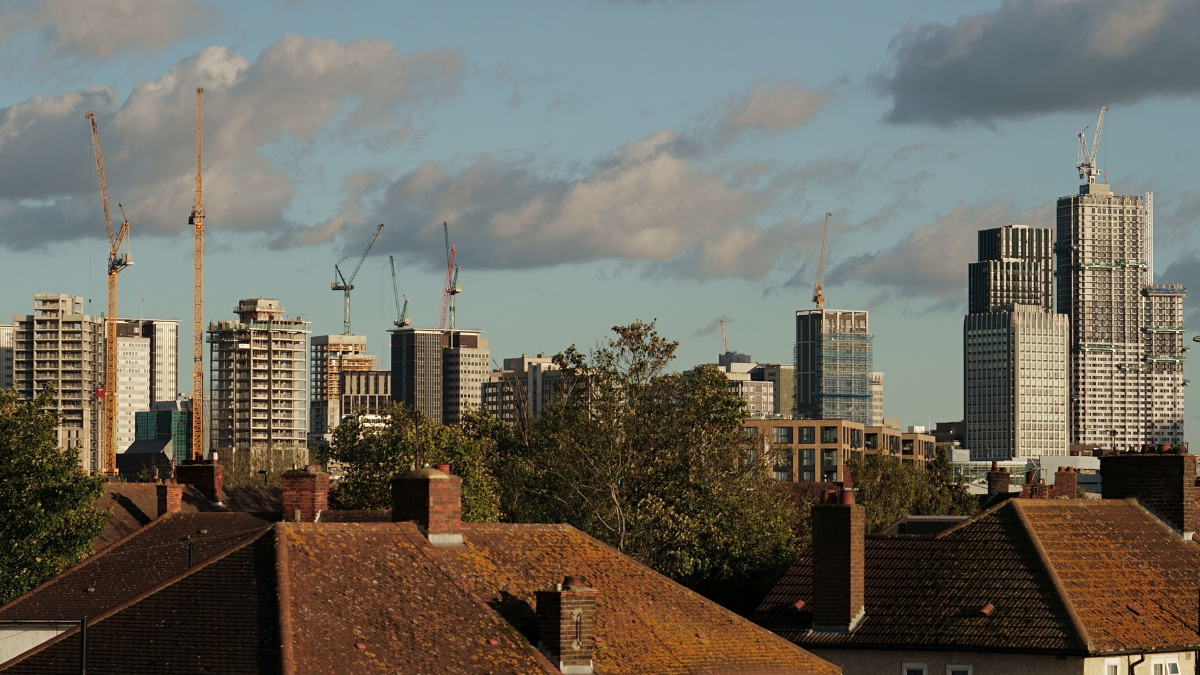
What’s wrong with Croydon? That was the first question which jumped to mind when I saw signs outside my local train station reading ‘Stop the Croydonisation of Redhill’.
These posters and placards were placed by the Redhill Residents Action Group (RRAG) in response to urban developer Solum Regeneration’s proposal to build a fifteen-storey tower block on the current car park of Redhill train station. Backed by over 2,000 residents, RRAG successfully halted the project’s development, citing concerns over its impact on nearby conservation areas, the Redhill skyline, and accessibility at the station.
#Located just south of the M25 on the edge of the green belt, Redhill is a key commuter town that connects Surrey with central London, while also servicing holidaymakers travelling to and from Gatwick Airport. With its 45-minute journey to London Bridge, the station and the surrounding town are undeniably attractive to developers. Other than its rail connections, however, Redhill’s identity feels somewhat underdeveloped.
A walk through the town centre reveals many characteristics of a typical South London suburb, namely an inconspicuous high street complete with chain retail shops, supermarkets, and a Wetherspoons pub. The high street never seems to be bustling with people, nor does it ever look completely deserted. It always seems to have a steady trickle of people going about their day.
So when RRAG spokesperson, Jan Sharman, spoke to the BBC, complaining that the building of the residential tower would be “out of character” for Redhill, one is compelled to ask: what character? Through no fault of its residents, Redhill resembles a liminal space, clinging to the idea of the past while still attempting to step into the present.
Like many South London suburbs, such as Balham and Tooting, Redhill was subjected to rapid post-war reconstruction, producing a town that was functional but faceless. When Sharman speaks of the identity of Redhill as a “rural market town”, the claim feels less like historical accuracy and more like a strategic appeal to nostalgia, a means to resist change rather than explain Redhill’s confused identity. Redhill has been as much a part of London’s suburban sprawl as Croydon has, ever since the arrival of the railway in the town in 1841.
So with that in mind, what does ‘Croydonisation’ really mean? Presumably, it refers to Croydon’s high-rise landscape: dense housing, concrete towers, and large estates such as New Addington and Fieldway. Originally envisioned in the 1930s as a green garden idyll of over 4,400 homes, New Addington was only partially completed before the war. Development resumed in the 1960s with the addition of tall concrete blocks characteristic of that era’s planning ethos.
Over time, the New Addington suburb, like many large post-war estates, has experienced significant social and economic deprivation, fuelling a negative reputation. This reputation is reinforced by online sensationalism. A quick Google search of Croydon produces a flood of YouTube videos by self-styled urban explorers conducting vox-pop interviews with residents who, judging by their expressions, would rather be left alone. Titles such as ‘Surviving Croydon: London’s Worst Postcode’ and ‘Is this really the most dangerous town in England?’ clutter the screen – descriptions which are often slapped on other English cities like Luton, stressing the apparent meaninglessness of such sensationalist titles. These videos shape public perception in the name of views and content before any meaningful engagement with the place itself.
This, no doubt, is the image RRAG invokes when it warns against Croydonisation. Yet to use Croydon as shorthand for failures in urban development and economic and social deprivation is to reduce a complex borough to a stereotype.
Croydon’s legacy is one of open arms. In the immediate post-war period, the borough welcomed families displaced by the Blitz, constructing large-scale social housing at speed. In more recent decades, Croydon has become synonymous with diaspora communities, welcoming the Windrush generation and its descendants, as well as a wealth of asylum seekers with its highly successful We Stand Together’ programme, funded by Comic Relief in 2018.
Is this perhaps what the RRAG is really scared of? If the group’s concern lies solely with urban overdevelopment, why not frame their opposition as ‘Stop the overdevelopment of Redhill?’ By invoking Croydon as a cautionary tale and a symbol of urban failure, RRAG draws attention not only to the infrastructure and planning policy, but also to the people associated with those spaces.
The phrase ‘Croydonisation’ carries an unmistakably classed and racialised undertone, suggesting multiculturalism and social housing (when taken as endemic consequences of socio-economic failure) are threats rather than necessities.
In resisting ‘Croydonisation’, RRAG is therefore participating in a wider discourse which extends beyond the impassioned debate over Solum’s proposed tower block. This is a discourse which treats certain kinds of development and certain kinds of communities as inherently undesirable. In contemporary planning debates, race and class are rarely named directly. Instead, concerns are reframed around ‘density’, ‘character’ or even ‘Croydonisation’, allowing exclusionary anxieties to be expressed without being stated outright.
Ironically, Solum’s proposed development would not be social housing at all, but luxury commuter apartments aimed at young professionals. Yet the language used to oppose it still functions as a shorthand for cultural exclusion, revealing a deeper discomfort with demographic change itself rather than with the building in question.
Words by Emeline Forton
Support The Indiependent
We’re trying to raise £200 a month to help cover our operational costs. This includes our ‘Writer of the Month’ awards, where we recognise the amazing work produced by our contributor team. If you’ve enjoyed reading our site, we’d really appreciate it if you could donate to The Indiependent. Whether you can give £1 or £10, you’d be making a huge difference to our small team.