
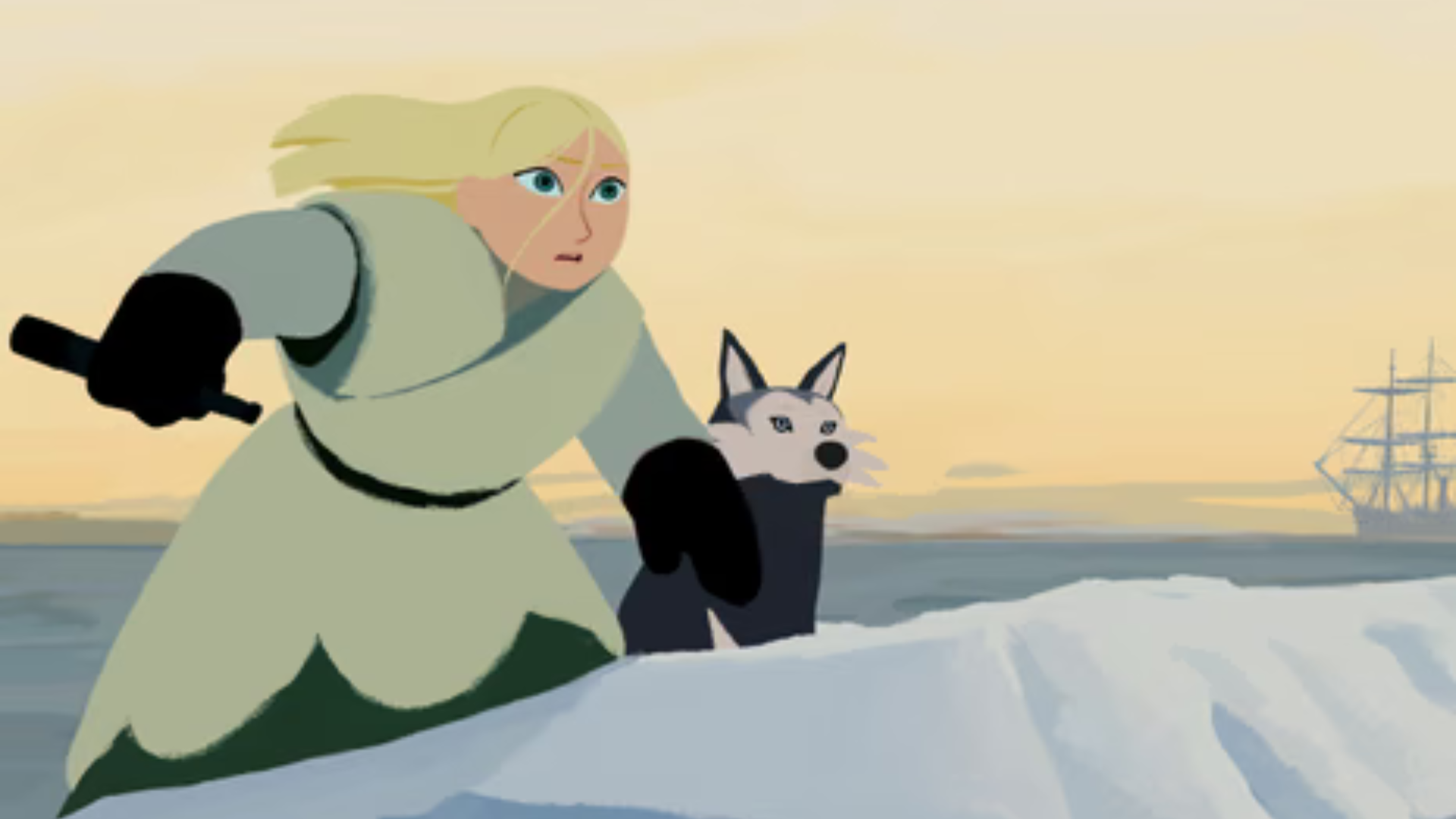
Long Way North is the directorial debut of Rémi Chayé, who has also worked on The Secret of Kells (2009) and the more elusive Calamity: A Childhood Of Mary Jane Cannary (2020). The film follows lonely young aristocrat Sasha, who feels lost in the absence of her grandfather, a prestigious explorer who disappeared a year prior on an expedition to find the North Pole. When she finds something in his study that might lead to his missing boat, she leaves her comfortable life behind to find answers.
In 2026, Long Way North seldom seems to come up in conversations about the art of 2D animation. Fans of the medium sometimes complain that it is becoming less common compared to 3D animation and live-action. However, this should be all the more reason to uplift outstanding examples of 2D as an art form. Long Way North, which this year celebrates ten years since its theatrical release in France, is one of these examples. Its lineless style and blocks of colour make every frame look like a painting. Every moment of it is a pleasure to watch, from busy Saint Petersburg streets to the stillness of the Arctic.
Some of this may be credited to the film’s budget, limited to an estimated six million euros—for comparison, this is around twenty five times less than fellow 2016 flick Zootopia cost to make. As a result, Long Way North features only limited lighting, kept mainly to action scenes. This, blended with the lineless style that captured Chayé’s interest, leads to a colour palette full of both high visual contrasts and shades that blend smoothly together, such as browns, creams and pale blues.
In an age of children’s media that at times feels sanitised and all too easy to swallow, Long Way North stands out as a film that does not talk down to the viewer, whatever their age may be. The melancholy course it steers does not waver—Sasha’s grief is not presented to overwhelm young audiences, but to let them into her life and feel for her all the more. The story’s emotional beats are lifted further by Jonathan Morali’s haunting score.
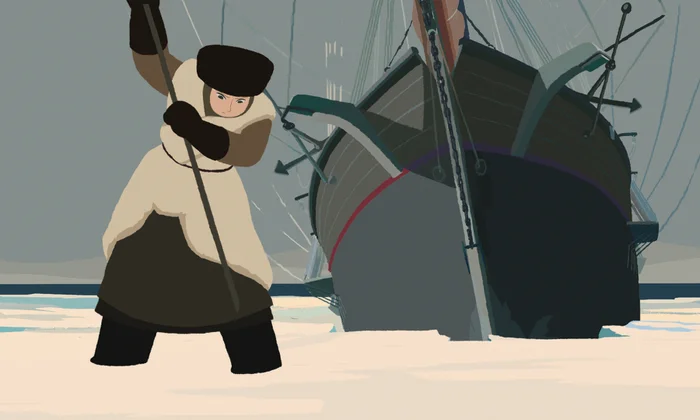
Also compelling are the richly-interwoven storylines. There is Sasha’s developing relationship with shipmate Katch, the search for her grandfather’s boat, and the ongoing rivalry between brothers Larson and Lund, whose ship Sasha finds herself aboard. It is a film that captures the complexity of many overlapping human lives in a confined, high-stress setting. No character is vilified in the survival scenarios that the crew of the ship find themselves in—they are all treated as people doing the best they can, and are allowed by the narrative to react realistically to trying circumstances.
It is somewhat satisfying to know that the film garnered some industry recognition, winning the grand prize at the Tokyo Anime Award Festival and the audience award at Annecy International Animation Film Festival, amongst other accolades. It will be better still if, a decade later, the film can be rediscovered and enjoyed anew by more young viewers and animation fans alike.
Words by Casey Langton
Support the Indiependent
We’re trying to raise £200 a month to help cover our operational costs. This includes our ‘Writer of the Month’ awards, where we recognise the amazing work produced by our contributor team. If you’ve enjoyed reading our site, we’d really appreciate it if you could donate to The Indiependent. Whether you can give £1 or £10, you’d be making a huge difference to our small team.