
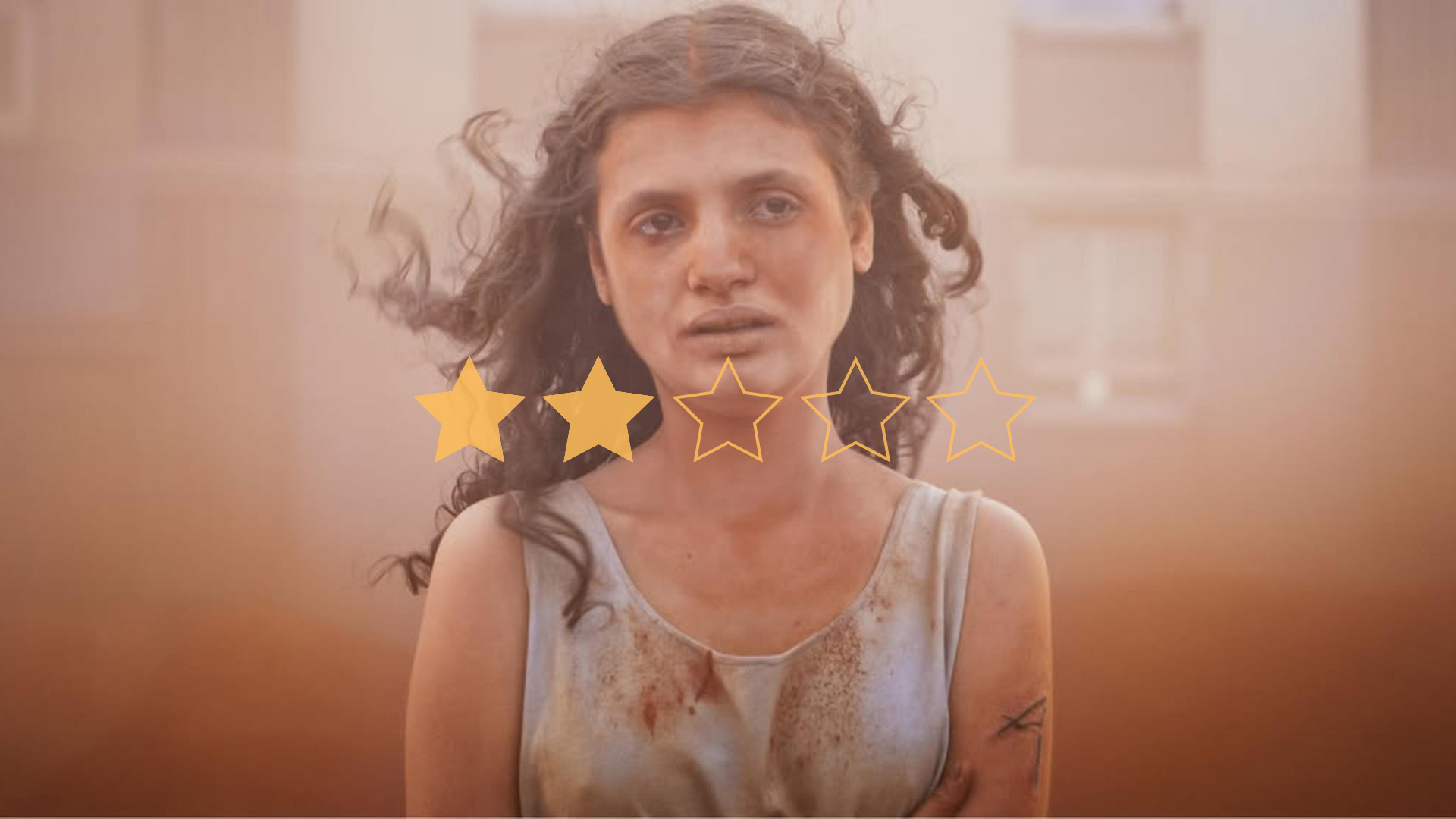
Julia Ducornau’s long-awaited first film since her 2021 Palme D’Or win lacks discipline and drive.
★★☆☆☆
A mere three feature films into her directorial career, and it already feels pretty safe to consider Julia Ducournau the uncontested doyenne of contemporary body horror—the closest thing we have to a 21st century David Cronenberg (still prolific, if somewhat past his prime). What the films of these two directors dish out in viscera, they also share in spirit: for every body graphically torn to pieces, there is invariably another to be caressed or embraced.
Ducournau’s breakout hit Raw (2015) used the trappings of cannibal horror to explore the tribulations of female adolescence; she amped up the gonzo for Titane (2021), a surprisingly poignant story of a homicidal car model with an erotic penchant for automobiles. Oft compared to Cronenberg’s own hot-rodding polemic Crash (1996), Titane succeeded where that film notoriously failed, with Ducournau becoming only the second ever female director to take home the top prize at the Cannes Film Festival. It should perhaps have been an early warning sign that we were in for something different, then, when her follow-up, Alpha, left Cannes empty-handed earlier this year.
We open to a woozy montage of a house party, the blaring drone of a Portishead track accompanying a moment of grotesquerie just as up-close and ear-splitting as we’ve come to expect from Ducournau. Before we even see the face of 13-year-old Alpha (newcomer Mélissa Boros), we watch her arm being crudely inscribed with a stick-and-poke tattoo: a bloody letter A, fitting to that ironic brand of brazen self-assertion typical of teenagers who are yet to feel quite at ease in their own skin. It might well be an intoxicated mistake, but Alpha is still relatively unphased when she returns home to a scuzzy apartment in a sandswept housing project on the French coast where she lives with her mother (Goldshifteh Farhani, in a standout performance). Her reaction couldn’t be more different: parental disapproval would hardly be unexpected, but Farhani’s wide eyes convey something closer to a deep-seated terror—Alpha has clearly implicated herself in something far more dangerous than run-of-the-mill adolescent waywardness.

It turns out that this world, a greyer, grimier version of our own, has been afflicted by an epidemic of a peculiar new bloodborne disease, about which everything, perhaps even its very existence, appears to be disputed. Alpha’s mother is a doctor at the local hospital, and every day finds her ward overwhelmed with patients who look as though they’re belatedly suffering from the tail end of an encounter with a Gorgon, coughing up dusty plumes, their skin gradually mottling to the point that it resembles marble. Now she must face the possibility that a tainted needle might have exposed her own daughter to this bizarre and deadly infection—a fact made all the more grievous considering that Alpha’s uncle Amin (Tahar Rahim), who has strangely reappeared in his family’s lives following nearly a decade’s absence, has already succumbed to the virus after years spent battling a heroin addiction.
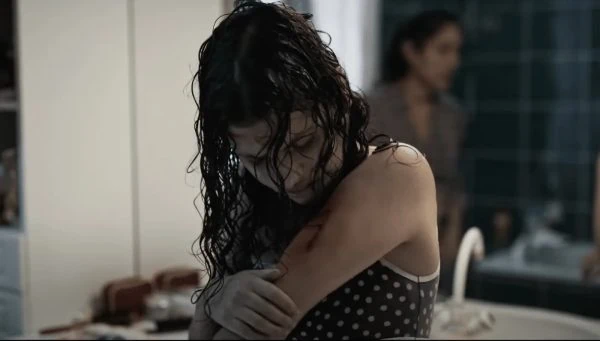
Palpable visual and political resonances with the HIV/AIDs crisis of the 1980s and 90s are certainly not lost on Ducournau; whilst the film is far from a full-throated allegory, it’s quickly clear that one of the main concerns here is social as much as bodily abjection, the manifold kinds of communal violence that arise from collective fear and ignorance, and inevitably wind up smiting the already marginalised. Rumours start to spread around Alpha’s school about her potential condition, and she becomes a social pariah in the eyes of her fellow students. This culminates in surely the most disquieting swimming pool scene since Bo Burnham’s Eight Grade (2018), an all-too-rare reminder of Ducournau’s usually keen eye for an assaultive visual set piece. Elsewhere, however, the sensory force of much of the imagery is dulled by some fairly perfunctory connotations (Alpha feels trapped: cue the walls of her bedroom literally closing in around her).
Where thudding obviousness is less of an issue, the plotting is comparatively abstruse, jumping erratically between different timelines which are mainly discernible by variations in the film’s colour grading (blood orange hues prove much more appealing to look at than the predominant ashen grey). By the time the (admittedly striking) final sequence comes around, these two chronologies appear to have merged, certainly figuratively and maybe literally—either way, it’s a risky narrative gamble which Ducournau the writer never quite manages to parse, on either a logistical or emotional level. At points, the unwieldiness of the film’s structure even seems to actively impede a more persuasive realisation of some of its most interesting ideas: a number of ultimately forsaken gestures are made, for instance, towards Alpha’s Berber heritage, to a mother tongue of lullabies and older relations she cannot understand, but which nonetheless might be an unspoken factor in her ostracisation.
It is the performances that come closest to saving things here: Farahani, who was so wonderful as a quirky counterpoint to Adam Driver’s sombre amateur poet in Paterson (2016), delivers a display of anguish more sensitively rendered than the script might have allowed for. Her relationship with Rahim’s Amin is particularly well-pitched, effectively becoming the story’s emotional fulcrum and, in the process, perhaps unwittingly confining Boros’s ostensible protagonist to the margins of our concern.
This is a film of increasingly frustrating contradictions: at once overwrought and underseasoned, relentlessly gruelling and curiously inert. For Ducournau, a filmmaker usually so adept at channelling high concepts towards small stories, it’s discouragingly apparent that here she has struggled to draw out an actual narrative from her conceptual chrysalis. It’s this director’s first, and hopefully final, misfire.
The Verdict
Strong performances aren’t enough to save Julia Ducournau’s Alpha: a sickness parable itself suffering from a case of severe structural malaise.
Words by Isaac Jackson
Support the Indiependent
We’re trying to raise £200 a month to help cover our operational costs. This includes our ‘Writer of the Month’ awards, where we recognise the amazing work produced by our contributor team. If you’ve enjoyed reading our site, we’d really appreciate it if you could donate to The Indiependent. Whether you can give £1 or £10, you’d be making a huge difference to our small team.