
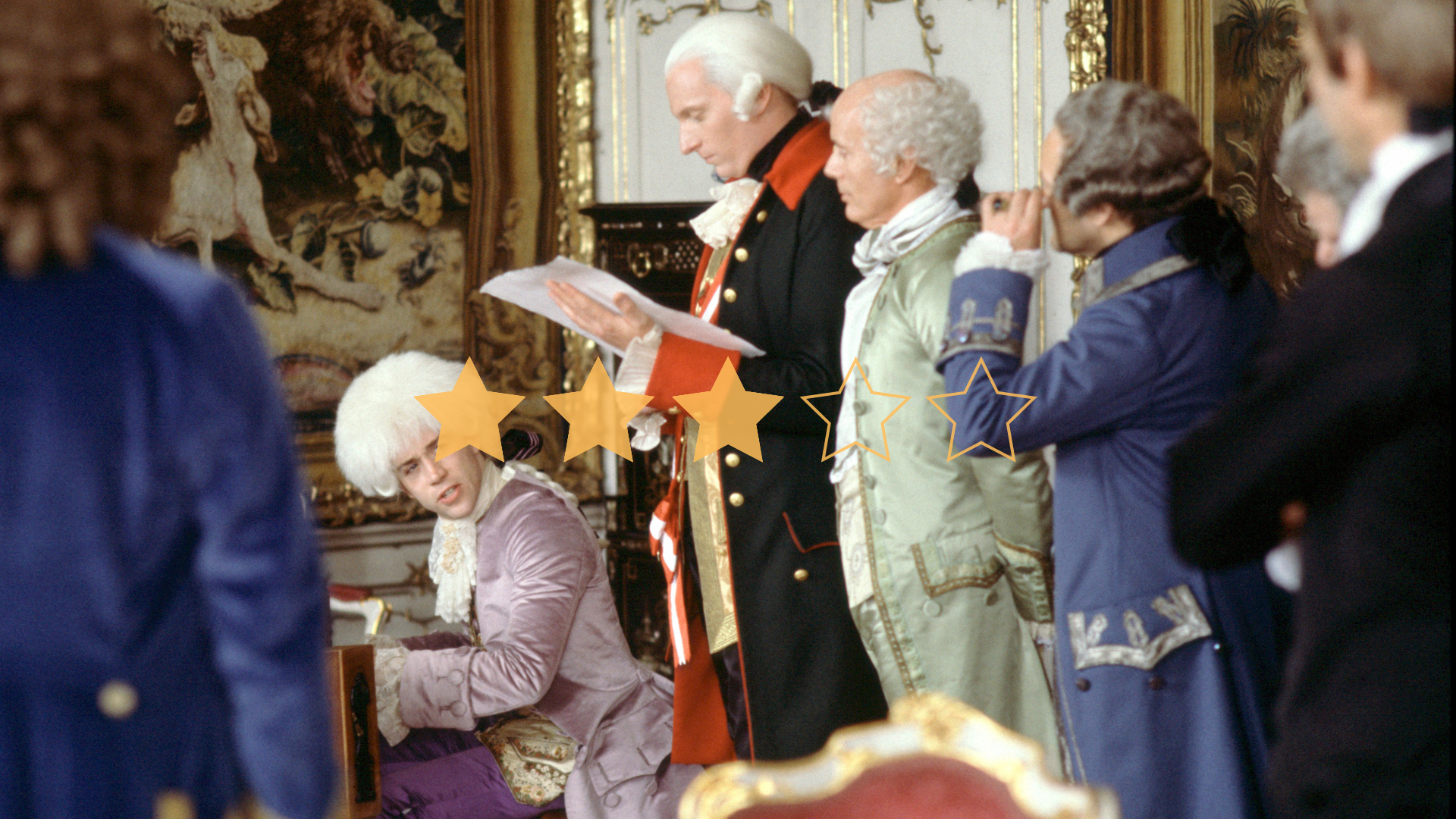
Directed by Milos Forman, Amadeus is an award-winning and critically beloved period biographical drama about none other than Amadeus Mozart. With a lavish period setting and some of the most famous pieces of classical music, the film takes viewers back to 1770s Vienna to learn more about Mozart and, perhaps more importantly, about the man who antagonised him his entire life: Salieri.
★★★☆☆
Set in Vienna in the mid-18th century, Amadeus follows its titular character’s rise to fame under the Holy Roman Emperor Joseph II (Jeffrey Jones). Amadeus Mozart (Tom Hulce) was a child prodigy, but as a grown-up composer in Europe, he struggles to get jobs and adapt to the rules imposed by the Roman Emperor over music and opera. This becomes evident when he attempts to adapt The Marriage of Figaro into a comedic opera and the harsh criticism he soon gets from it. The entire story is told by rival composer Antonio Salieri (F. Murray Abraham), who claims to have murdered Mozart. According to Salieri, their life-long feud led him to commission Mozart to compose a Requiem Mass and overwork himself in the process.
The framing of the story might very well be its most exciting element. As Amadeus begins, it becomes immediately clear that Salieri is an unreliable narrator, thus making the viewers always question his retelling of events. The use of flashbacks also makes the film especially compelling and interesting to watch.
The film’s high production value is visible in its beautiful costumes, which immerse the audience in the period setting.
However, the historical inaccuracies are far too numerous to be overlooked by anyone who is familiar with Mozart’s life and works. While this is clearly a dramatized version of the events with little interest for historical fact, it soon begins to feel like the film’s story is entirely fictional. While the real-life Mozart might have certainly had some level of rivalry with Salieri, overplaying the two characters’ antagonistic relationship with each other is not only a disservice to real events but also leans on traditional and overused plotline and tropes. Mozart himself does not come off very well in Amadeus, a film that wants the audience to believe that its main character may be a musical genius, but is equally an ignorant, obscene, and immature man.
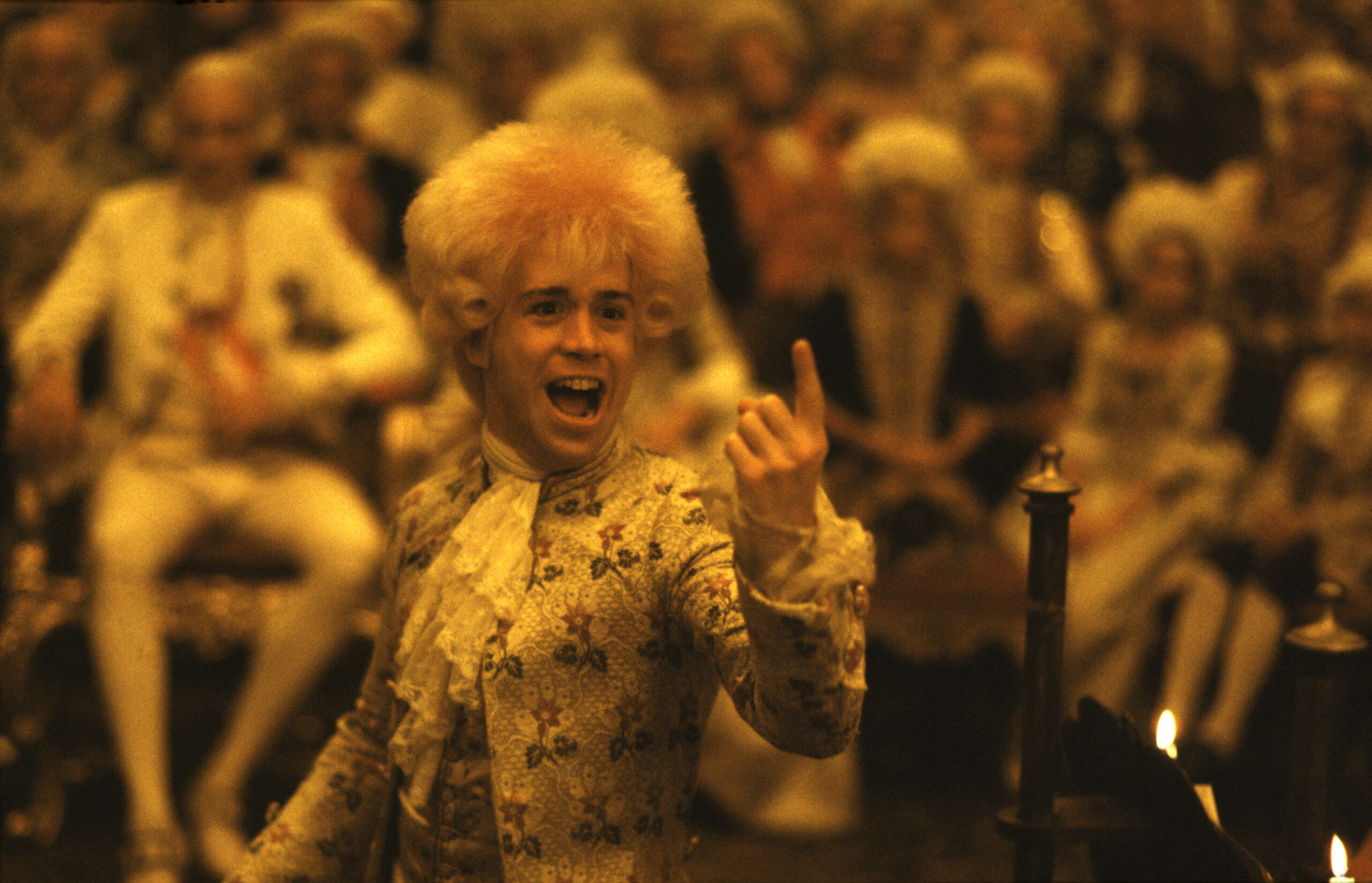
For a film about one of the most famous composers in the world, Amadeus features surprisingly little music from Mozart. Over the course of the three-hour movie, the audience barely hears one full opera aria, let alone gets an idea of Mozart’s impressively vast and varied body of works. Amadeus is at its very best when it lets the main character’s music speak for itself, which unfortunately does not happen very often. When viewers are allowed to hear some of Mozart’s operas, they’re sung in English rather than the original Italian and German. Perhaps unsurprisingly, this doesn’t really work and is a disservice to Mozart’s timeless compositions.
If the movie never had any intention of actually portraying Mozart’s life—or his music for that matter—then this begs the question: was it even worth making this about Mozart at all? Since so much of this story is fictional, maybe it would have worked better if it did not use any real-life characters, as so few of them actually make it into the screen.
The Verdict
Amadeus is a film that is filled with missed opportunities more than anything else, especially in the way that Mozart’s music feels incredibly underused. With its significant issues around character development and the many historical inaccuracies that plague this film, one cannot help but wonder why this film seems to be so universally beloved by both film critics and the general movie-going audience.
Amadeus will be re-released in UK cinemas from the 25th of July
Words by Clotilde Chinnici
Support the Indiependent
We’re trying to raise £200 a month to help cover our operational costs. This includes our ‘Writer of the Month’ awards, where we recognise the amazing work produced by our contributor team. If you’ve enjoyed reading our site, we’d really appreciate it if you could donate to The Indiependent. Whether you can give £1 or £10, you’d be making a huge difference to our small team.
A petulant, tendentious review. The writer obviously saw a different film than the one I savored in 1984. The film is about Salieri and his view of Mozart, not a Mozart biopic. And the brilliant playwright who created “Amadeus” drew from other historical and dramatized depictions, including Pushkin’s 1830s drama, “Mozart and Salieri.” And has the reviewer ever read Mozart’s letters? One must wonder. Furthermore, the brilliantly produced soundtrack played by Neville Marriner and the Academy of St. Martin’s In The Fields rebukes the reviewer’s condescending assertion about the film’s music. Overall, this is a poorly considered review of a great film. As composer Max Reger once wrote to a critic who’d written a simillar review of his music, “I am in the smallest room of my home. I have your review in front of me. It will soon be behind me!”
I’m disappointed with this review—it really doesn’t give Amadeus the credit it deserves. First, there’s no acknowledgment that this is a 40-year-old film, which naturally reflects some of the storytelling conventions of its time. It’s also crucial to point out that Amadeus is not an original screenplay but an adaptation of Peter Shaffer’s stage play: it’s not meant to be a historically accurate Mozart biopic, but rather a fictionalized, dramatic interpretation that blends truth with artistic invention.
What’s especially baffling is the lack of recognition for the extraordinary performances by F. Murray Abraham and Tom Hulce, as that doesn’t even count when reviewing a movie.
I do agree with the critique about some of the English-sung segments, which feel like an odd choice that I never understood. But to say there’s not enough of Mozart’s music in the film? That’s seriously off the mark. Amadeus isn’t a musical, in case you haven’t noticed, but it is saturated with Mozart’s compositions—used with such dramatic precision that they almost become a character of their own.
For anyone else reading this: watch Amadeus. It’s a magnificent and entertaining film. And if it inspires viewers to explore the truth behind the myth, then it has more than done its job—even with a few flaws.