
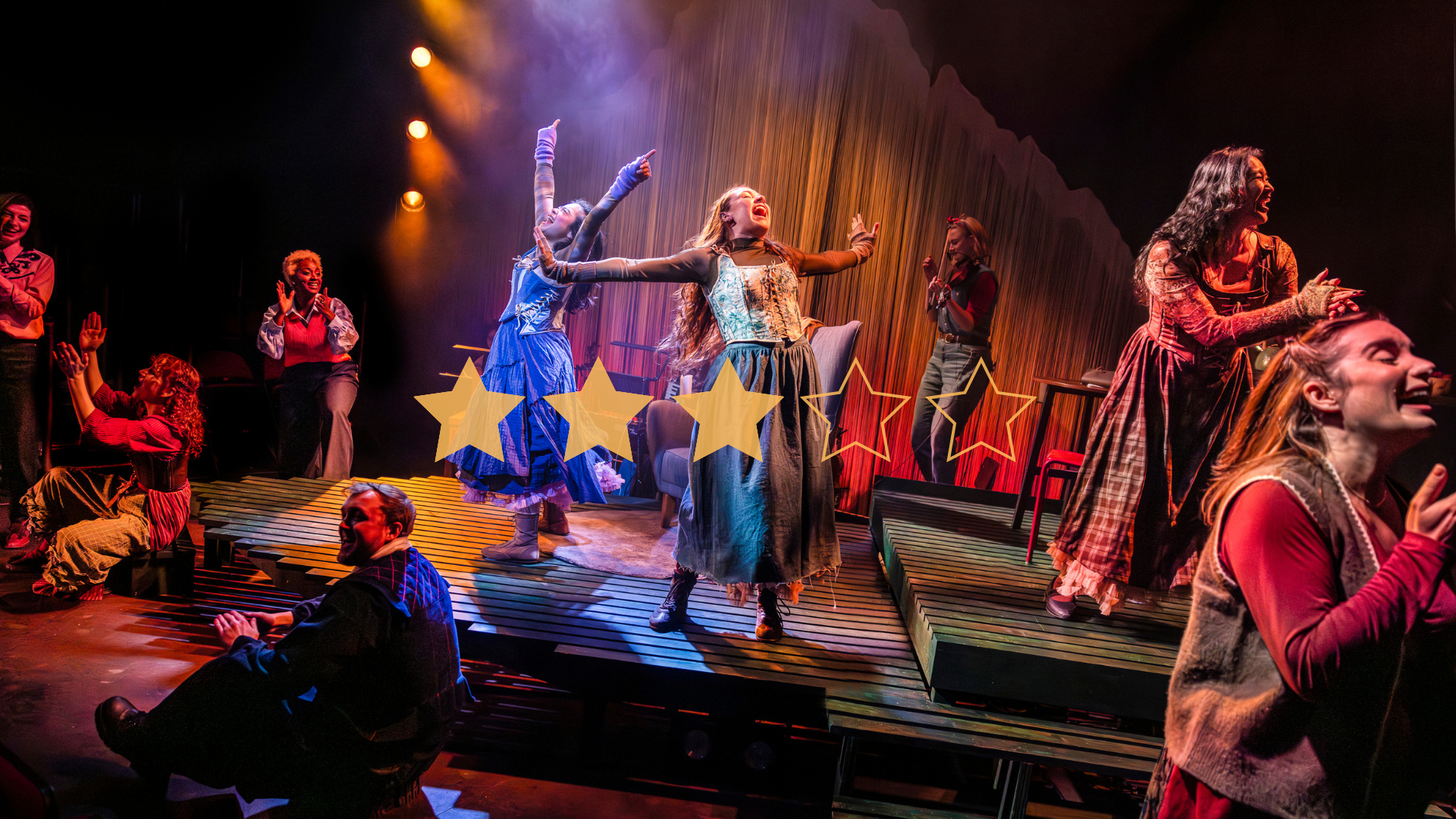
★★★
Ballad Lines has had a long journey to the London stage. From its initial origins at the Edinburgh Fringe, to a concert run in Stirling and the release of a concept album last year, like many “new” musicals, it has been a long time in the making. In that time, the music has certainly been honed beautifully but the narrative still struggles under the weight of its many threads. Ballad Lines is a complex tale following multiple timelines: we have Sarah in present day New York, and then her ancestors Cait and Jean in 17th & 18th century Scotland and Ireland respectively. The thrust of the story is Sarah receiving a box from her recently deceased aunt containing stories of her family history which then make her reconsider what she wants out of her own life.
The idea is an interesting one but the narrative is so stretched in different directions that it ends up lacking focus. Sarah feels the most developed out of the characters as the main protagonist, but even she isn’t fully fleshed out. The rest of the characters range from solely existing to serve the narrative and given no development of their own (Alix, Shona and Betty) to broad strokes and very surface level development (Cait and Jean).
It’s not a particularly large cast but the story is trying to do so much that it might be better honing in more on fewer characters. Alix’s lack of development is particularly frustrating as Sydney Sainte gives such a brilliant performance, but her function seems to be solely as the comic relief of the piece and later as a conflict for Sarah’s desire for motherhood. We barely learn anything about Alix as a person and it is constantly frustrating that she exists more as a plot device than anything else. Betty similarly suffers in being reduced solely to the narrator role and we learn very little about her until very late on: the flashback which reveals more of her and Sarah’s relationship feels out of place because the show lacks that depth of backstory up till that point. More of those kinds of moments throughout would help develop the characters more and allow the audience to understand their motives better.
The music is really where the show shines. Finn Anderson’s music is gorgeous and rousing, easily the strongest element of the show. At times in the first act, the music does drown out the lyrics slightly because it is so loud, however this evens out more in the second act. Some of the songs do feel a little overly similar at times, especially towards the end of both acts where there are lots of long, slow songs leading in to a big rousing finisher. The second act varies a lot more musically than the first. The actors do a great job on delivering the more emotional, slower material but the faster tempo numbers are where the show really shines.
The cast are excellent across the board, with Kirsty Findlay’s Cait, a vicar’s wife desperate to end her pregnancy, giving a truly affecting performance, especially with her song near the end of Act One, ‘Words Are Not Enough’. Yna Trasvelles as Jean is underserved by the narrative, but equally impressive. She perfectly captures the passion and quick wit of a teenage girl, but also delivers some beautiful emotional moments during the second act. It’s a shame that neither are really fleshed out enough as their stories are more engaging than the present day storyline. Frances McNamee delivers stunning vocals as Sarah, but her material is just weaker and less affecting than the others.
Tinovimbanashe Sibanda’s choreography is another highlight, with the creation of a physical form of the ballad lines with tape at one point being particularly impressive. The movement fits beautifully with the music and looks incredibly fluid. There’s a beautiful vibrancy and intensity to it, particularly in the percussive moments of the music. It is however hampered by the small space, where everything is quite crowded. The same issue is prominent in TK Hay’s set design: it’s simple and fits the show well but there is just not enough space for everything going on and often the action on the lower half of the two tiered stage is obscured. A larger space would probably serve the show better as everything would have more room to breathe.
Ballad Lines ultimately ends up being quite frustrating because there are seeds of a really good idea here, and the music and performances are just stunning but the narrative ends up buckling under the weight of all it is trying to do. It has great potential, but the narrative needs much more tightening and focus and the characters need to be given more depth in order to match the incredible performances and the wonderful music that is already there.
Ballad Lines is at the Southwark Playhouse Elephant until 21 March.
Words By Jo Elliott
Support The Indiependent
We’re trying to raise £200 a month to help cover our operational costs. This includes our ‘Writer of the Month’ awards, where we recognise the amazing work produced by our contributor team. If you’ve enjoyed reading our site, we’d really appreciate it if you could donate to The Indiependent. Whether you can give £1 or £10, you’d be making a huge difference to our small team