
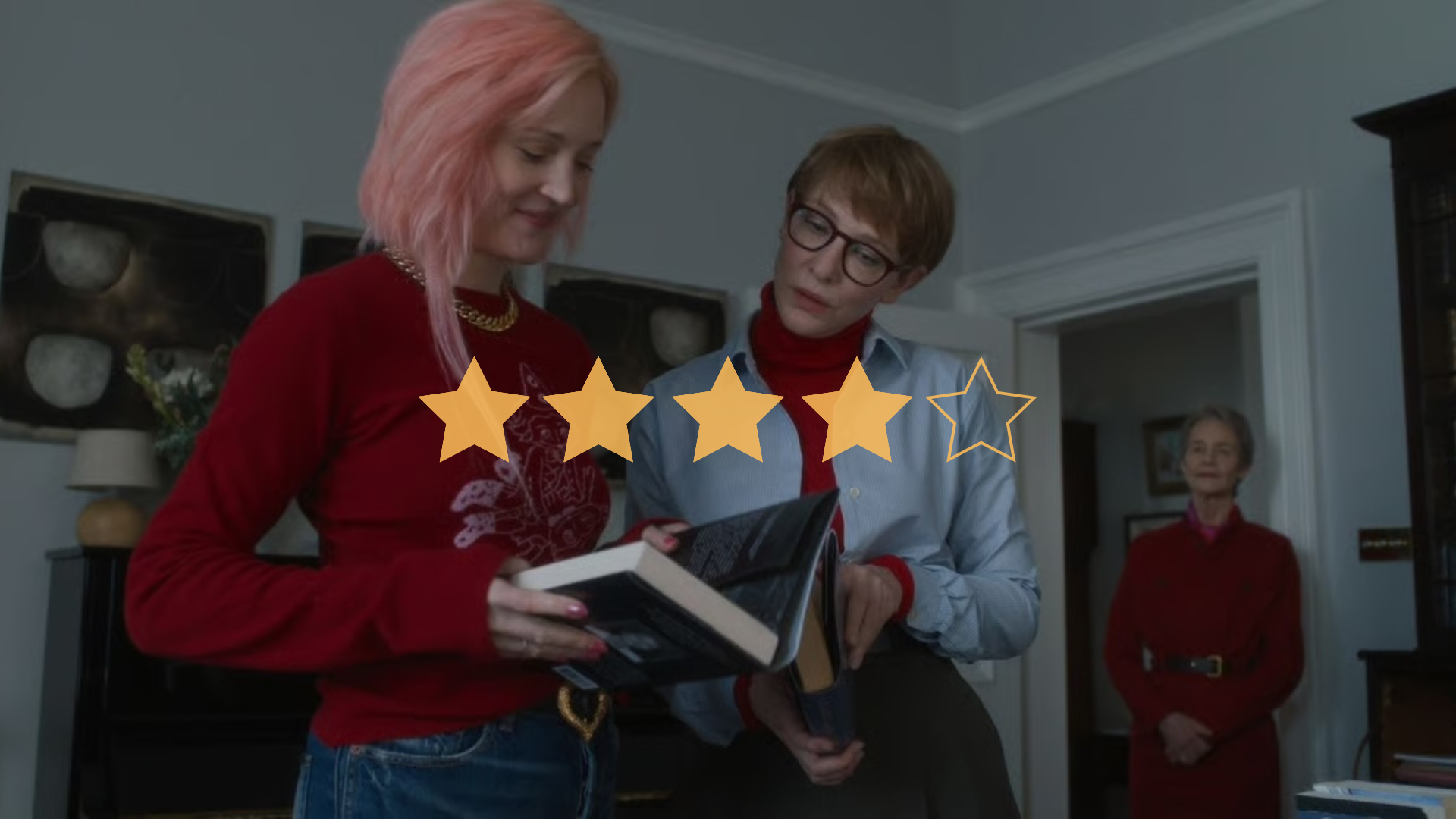
The Golden Lion-winning Father Mother Sister Brother may not follow the conventions of the American family drama, but Jarmusch’s subtle, understated approach makes it quietly and profoundly moving.
★★★★☆
Jim Jarmusch, one of the modern maestros of American cinema, has finally won one of the top prizes at a Big Three film festival, taking home the Golden Lion at Venice for his latest work Father Mother Sister Brother. Structured as a triptych, it is a subtle, poetic film about the spoken and unspoken truths that shape our closest familial bonds.
Father Mother Sister Brother unfolds across three intimate family encounters set in three cities. In Father, set in the United States, Jeff (Adam Driver) and Emily (Mayim Bialik) return to visit their ageing father (Tom Waits), where awkward daily routines slowly thaw years of quiet distance. It ends on a comical note, questioning how well we really know our parents. In Mother, set in Dublin, Timothea (Cate Blanchett) and Lilith (Vicky Krieps) visit their formidable novelist mother (Charlotte Rampling) for their annual afternoon tea, reassessing the fragile balance between independence and devotion, not just in their relationship with her but between each other. For the final part, Sister Brother, twins Skye (Indya Moore) and Billy (Luka Sabbat) drive across Paris, reunited in the wake of loss as they sort through their parents’ belongings and the histories they still share.
Family relationships are hardly new territory in American cinema, or indeed in storytelling more broadly, because they are among the most intimate and complicated bonds we know. They can easily tip into sentimentality or become heavy-handed with dramatic arguments and revelations. Yet in these three small stories, Jarmusch, in his typically masterful way, resists that impulse, refusing to build towards a grand, tearful climax. Many viewers might anticipate a triptych like this culminating in a unifying moment, perhaps in the style of Kieślowski’s Three Colours trilogy, where recurring actors create a sense of destiny linking the films, or at least some dramatic revelation in the final act to give the whole work added meaning or emotional weight. Jarmusch, however, deliberately sidesteps those expectations, favouring tenderness over spectacle.

Although the three stories share recurring motifs, such as a Roxley watch passed between generations, drives through the cities where parents live or lived, and overhead shots of family toasts with different drinks, he avoids allowing these threads to crystallise into a single, easy connection. Each segment stands as an independent world, linked more by atmosphere and rhythm than by plot. Their beauty lies in subtlety and in the weight of what remains unspoken during awkward, tender moments. It is often those closest to us, with whom we have shared our lives, who are hardest to speak to. You may sit at the same table, aware you should connect while there is still time, yet words fail you for no clear reason. You may know they are hiding something but choose not to confront it because it seems unnecessary. Or you may only begin to remember certain things when circumstances force you to face them.
Cinema often excels at capturing the life-defining moments that shape us, but few filmmakers dare to linger in what seems too ordinary to belong on screen, telling stories not meant to be solved but felt. Jarmusch never forces meaning or truth into his characters’ lives; instead, he allows feelings that cannot be spoken to hover at the edges, unarticulated yet deeply present. This is not a conventional family drama searching for closure or offering solutions. Every detail breathes into the film’s delicate emotional fabric, not as clues to be pieced together but as textures to be felt. The approach recalls Harold Pinter’s theatre, where deeper meanings await those who seek them but are never central to the plot. At their heart, these stories pulse with humour and humanity, rich enough that the pursuit of meaning fades beside the quiet, profound pleasure of simply dwelling within them.

Like all multi-legged features, different parts of Father Mother Sister Brother will resonate with different viewers. Some may be drawn to the understated melancholy of Father, others to the beauty of Mother, or the quiet intimacy of Sister Brother. That openness is part of the film’s quiet power: it offers not a single universal truth but a series of invitations.
It is also quintessentially Jarmusch. Like Paterson or Broken Flowers, it speaks as much in silences as in words, finding poetry in the smallest gestures. With Father Mother Sister Brother, Jarmusch shows once again that cinema’s most profound revelations do not always arrive with clearness or resolution. Sometimes, they dwell in the pauses between sentences, in glances left unspoken, and in the lingering ache of what remains unresolved.
The Verdict
A lyrical meditation on family, Father Mother Sister Brother finds beauty in silence and meaning in what remains unsaid. Jarmusch turns the ordinary into poetry, crafting a film that lingers softly, like an unspoken truth shared across a table.
Words by Matin Cheung
Father Mother Sister Brother does not yet have a UK release date.
Support The Indiependent
We’re trying to raise £200 a month to help cover our operational costs. This includes our ‘Writer of the Month’ awards, where we recognise the amazing work produced by our contributor team. If you’ve enjoyed reading our site, we’d really appreciate it if you could donate to The Indiependent. Whether you can give £1 or £10, you’d be making a huge difference to our small team.