
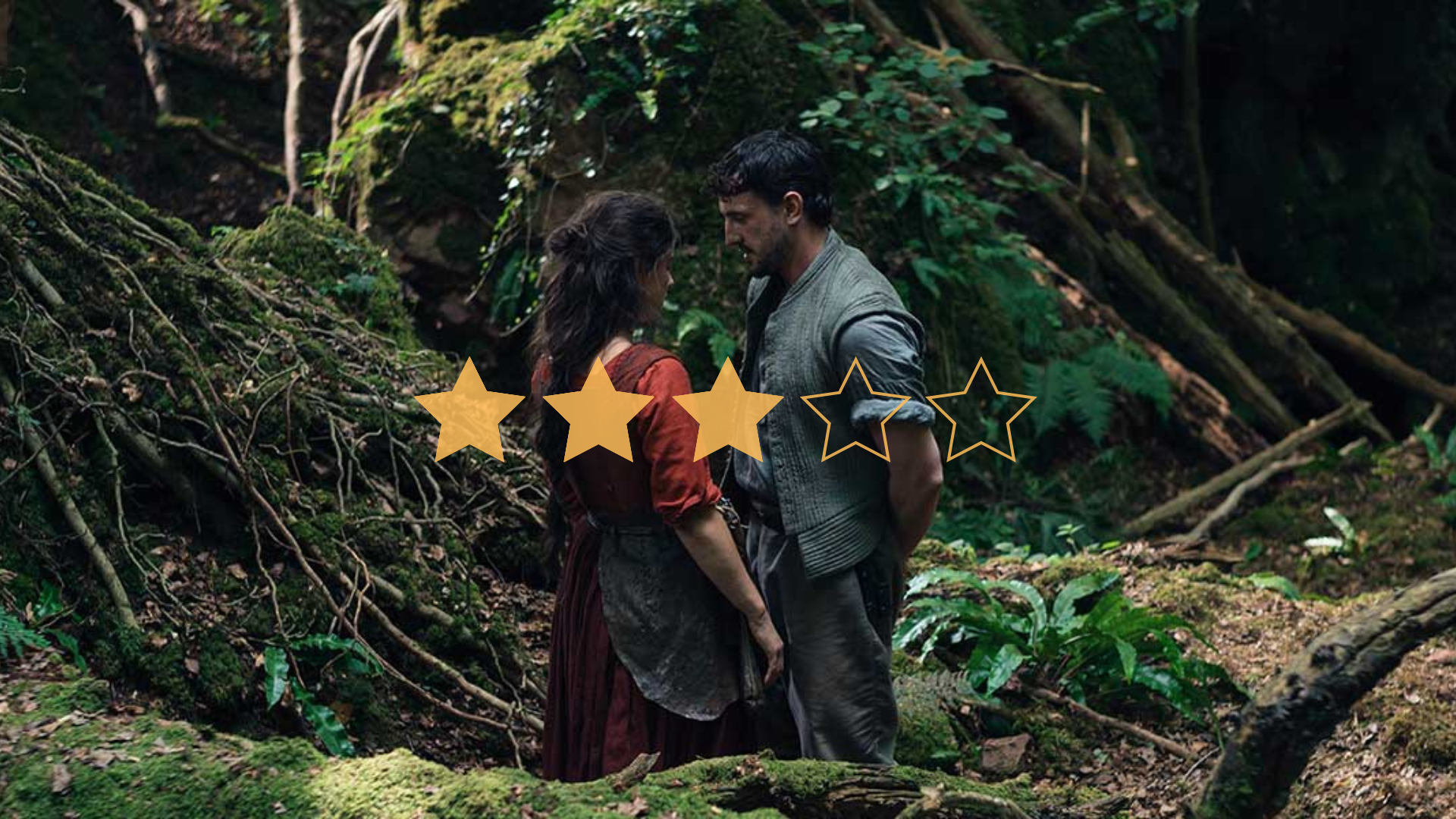
Chloé Zhao’s Hamnet turns Shakespeare’s genius into a story about love, motherhood, and the act of storytelling born from loss.
★★★☆☆
It has been four years since Chloé Zhao’s last film, the ambitious Marvel blockbuster Eternals, a cosmic tale that reached for the heavens but never quite found its grounding. With Hamnet, adapted from Maggie O’Farrell’s celebrated novel, Zhao returns to a more intimate realm, shaped by stories and poetry, by the fragile beauty of ordinary lives moving through nature, love, sorrow, and death. Here, she rediscovers the rhythm that has always defined her work: a gaze attuned to the silence between moments, where emotion and landscape become one.
Set in late sixteenth-century England, Hamnet imagines the private life of Agnes Hathaway (Jessie Buckley) and her husband, William Shakespeare (Paul Mescal), long before history remembers him as a playwright. The film begins with their first encounter: William, a young Latin tutor, and Agnes, a woman whose deep knowledge of herbs and the natural world sets her apart from her family and neighbours. Their relationship, shadowed by disapproval from William’s father John (David Wilmot) and mother Mary (Emily Watson), grows into a marriage built on curiosity, devotion, and quiet defiance. The couple settle in Stratford with their children: Susanna (Bodhi Rae Breathnach), and the twins Hamnet (Jacobi Jupe) and Judith (Olivia Lynes). Their household is marked by daily rhythms of work and play, scenes of ordinary tenderness, and the presence of nature that surrounds Agnes’ world. William frequently travels to London, where his writing begins to find its place on the stage, while Agnes remains in Stratford caring for their family and the home they’ve built together. When illness visits the household, life for the Shakespeares changes in ways that test the strength of love and memory. Moving between Stratford and London, the film follows both William and Agnes as they continue their separate routines, his among the playhouses and streets of London, hers within the fields and rooms of their home. Their separate processes of mourning gradually converge when Agnes travels to London and encounters her husband’s new work, a play that mirrors their shared loss in ways neither could have foreseen.
It is easy to mistake the world Zhao has built, the realm in which the story of Agnes and Hamnet breathes, for a faithful historical retelling of the real Shakespearean lives. Yet it is not history that she pursues, but a vision that demands imagination, compassion, and devotion from its audience. Zhao quite deliberately refuses the common markers of historical accuracy- her actors, all gifted, capable, and intelligent performers, speak without a pretended accent. In a time when accent has become the shorthand of “good acting” and the easiest bridge into period immersion, Zhao’s rejection of it becomes a quiet revolution.
What she offers, then, is a departure from the kind of historical imagination that cinema has long depended on, those worlds built upon costume and ritual, upon dialect and vivid visual effects. In Hamnet, historical accuracy is no longer the gate that allows us entry into fiction. Instead, Zhao builds her world upon the truth hidden in its poetic imagination, and emotional earnestness. The logic of this world is not held together by the stitching of period detail, but by the pulse of human experience. She asks us not to analyse her world, but to live within it, to inhabit the same air as her characters, to feel rather than to comprehend.
The sensibility guiding Zhao’s world-building is, paradoxically, not that of modern cinema with its obsession for authenticity and precision, but something older and more magical: the theatre itself. She reaches back toward the form defined, in the English-speaking world at least, by William Shakespeare, where truth emerges not from accuracy but from poetry and psychology. For Shakespeare, truth resides in language and symbolism, where history becomes a poetic metaphor for the human condition. Yet Zhao stands apart from him, even as her story includes him, for there is too much order and hierarchy in his theatre, and Zhao chooses only to embrace the parts her world would welcome. Her Hamnet rejects the order his stage once upheld. It turns instead toward love, nature, femininity, intuition, dream, and compassion, those fragile truths that resist all systems.
And so, when Hamnet nears its end, and the crowd weeps as the play within the film concludes, what might appear too sentimental for the sharp-eyed critic feels, in fact, profoundly right. For in Zhao’s hands, this sentiment is not indulgence but essence. It is the same emotional truth that once guided Shakespeare himself, that in the end, only through feeling do we come close to understanding what it means to live, to lose, and to be.
Overall, Zhao approaches the making of Hamnet with remarkable restraint, careful never to let sentimentality overtake sincerity. Jessie Buckley, whose Agnes is imbued with maternal strength and grace, resists the temptation to perform with grand gestures or overt emotion. Instead, she is vivid and grounded, belonging to a lineage of women attuned to the rhythms of nature and the realm of dreams and spirits, not the witchy stereotypes that Hollywood once favoured, but something truer, wilder, and more expansive, echoing the untamed force of the natural world that the female body itself can hold. Her moments of stillness and silence give her performance its power, making the film’s emotional finale, her reunion with William and Hamnet on the iconic open-air stage of the Globe Theatre, all the more breathtaking and devastating.
That said, a few passages drift toward sentimentality: the use of Max Richter’s On the Nature of Daylight feels a touch too familiar, and Mescal’s solitary lament by the river edges feels rather designed. But Hamnet’s deeper limitation lies not in its tone, but in where it chooses to look. For a film named after the couple’s son, we see little of the children’s world, their voices, their small discoveries, the way they see their parents’ love shifting around them. The daughters, especially, stay on the margins, even though there are fleeting, enchanting moments that echo the three witches of Macbeth. The existence of the couple is so massive that it leaves little space for us to resonate with Hamnet, the little hero of the story. Zhao draws strength from Agnes’ fear of loss, a fear bound to her visions of fate, yet there is little room to see how her love for her kids changes as she raises her children, or how that fear grows from loving them too deeply. The children exist mostly through the parent’s eyes, folded into Agnes’ dreams and premonitions, so their inner lives never quite take shape, even though Jacobi Jupe’s tender, aching performance hints at something more. And while the film calls on the weight of Agnes’ female ancestry, it ultimately ends with her, closing the circle rather than passing it on. The result is a story that feels, in its beauty, somehow already decided, a world too carefully held, without the restless freedom that once made Zhao’s cinema feel alive.
The Verdict
Hamnet marks a luminous return for Chloé Zhao to the intimate and humane storytelling that first defined her work. Rooted in nature and emotion, it reflects on the power of storytelling to create something that outlives its makers, something capable of healing, remembering, and enduring. Yet its tenderness sometimes slips into sentimentality, and its focus on the parents narrows what could have been a fuller portrait of family life. Even so, Zhao finds a quiet beauty in love, loss and storytelling.
Words by Matin Cheung
Support the Indiependent
We’re trying to raise £200 a month to help cover our operational costs. This includes our ‘Writer of the Month’ awards, where we recognise the amazing work produced by our contributor team. If you’ve enjoyed reading our site, we’d really appreciate it if you could donate to The Indiependent. Whether you can give £1 or £10, you’d be making a huge difference to our small team.