
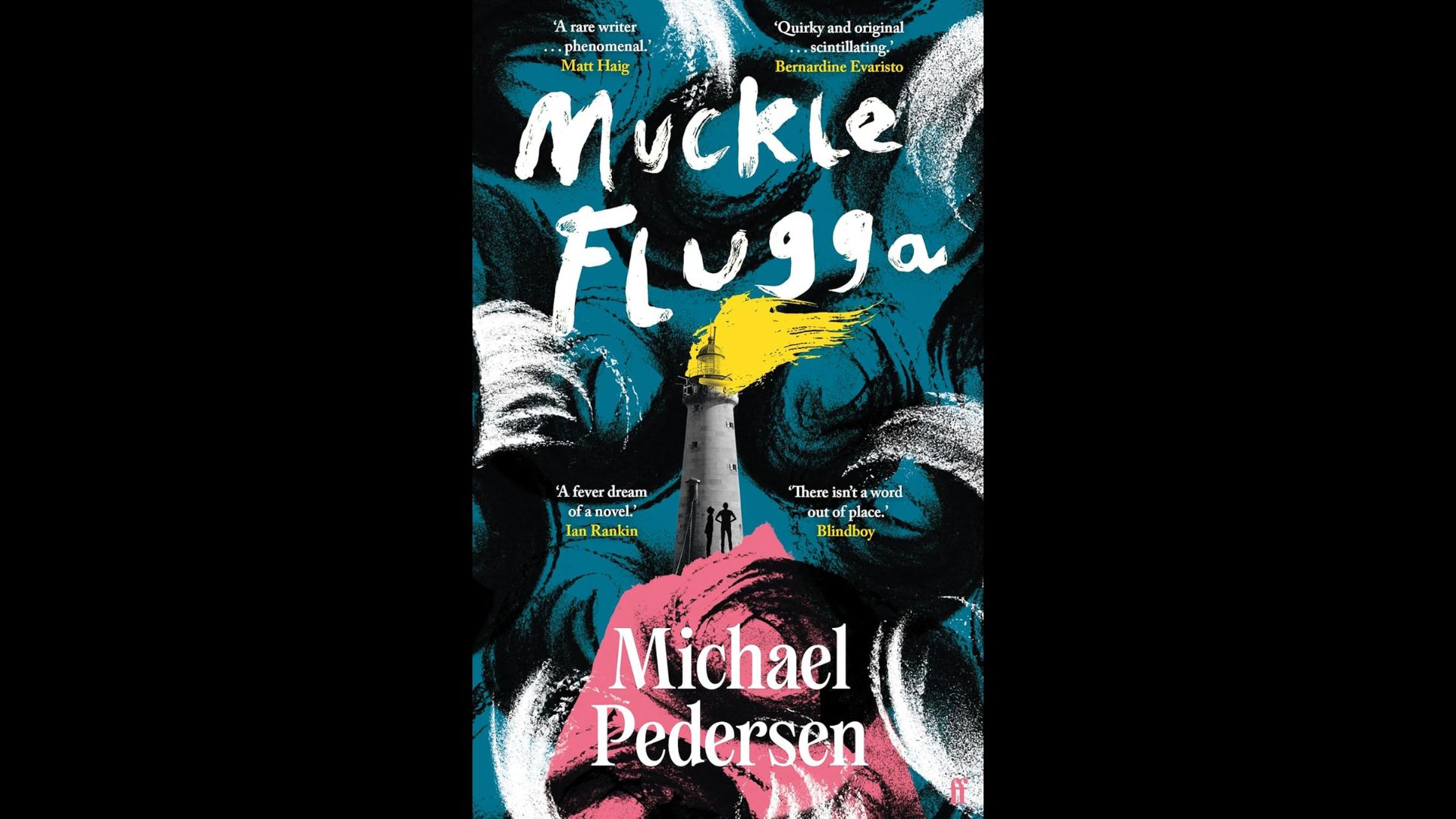
Set on the windswept outcrop islet of Muckle Flugga—the northernmost inhabited point in Scotland’s Shetland Isles—Michael Pedersen’s debut novel, which takes its name from this remote place, unfolds like a prose-poem of isolation, memory, and the beauty of human connection. As Edinburgh’s poet laureate, Michael Pedersen brings his lyrical touch to fiction, blurring the lines between reality, myth, and grief.
At the heart of Muckle Flugga are three characters: The Father, the island’s lighthouse keeper; his young adult son, Ouse; and Firth, an Edinburgh-based writer who arrives on the island bearing the final wish of his late grandfather—to paint a gannet, and then to die. Firth’s arrival shatters the strange, self-contained rhythms of island life. In a place where the days roll in with the fog and old wounds linger like ghosts, the newcomer stirs forgotten memories and unsettled emotions.
The book’s landscape is as much a character as its inhabitants. Pedersen paints Muckle Flugga in vivid, salt-drenched detail: jagged cliffs, gull cries swallowed by the wind, and the steady pulse of the lighthouse’s beam cutting through the dark. Reality, however, never quite holds firm here. Dreams bleed into waking life, the ghost of Robert Louis Stevenson drifts through the mist, and a faint, spectral hum lingers in the air—a quiet thread of magical realism woven into the fabric of the narrative.
Yet the story is not confined to the island. Edinburgh, too, lurks in Firth’s recollections—a city of contradictions, at once intimate and alienating. Through Firth’s disenchanted eye, Pedersen delivers sly, often stinging commentary on class and pretension in the capital’s literary circles. From the polished bars of New Town to the cracked pavements of Leith Walk, Firth’s narrative charts his own uneasy ascent through a world he despises but cannot escape.
What makes Muckle Flugga remarkable is its handling of grief and mental struggles. Each character battles private demons: unspoken loss, loneliness, inherited trauma. And yet, like the steady beam of the lighthouse, there remains a constant reminder that light persists. Pedersen’s prose thrums with tenderness even in its darkest moments, offering glimpses of resilience in unlikely places.
The novel reads, at times, like a long, lapping wave—part narrative, part meditation. Its strength lies in language: fluid, evocative, and textured with poetry. Pedersen’s words don’t just tell a story; they build a world both brutal and beautiful, a place where to grieve is to live, and to live is to endure.
As the inscription in my signed copy reads: “Long Live Love”—for the written word, for the natural world, and, most importantly, for life in all its perils and poetry. I wholeheartedly recommend this book to everyone, perhaps as a gift to someone you love, as a reminder that even the darkest waters are lit, however faintly, by an unwavering light.
Words by Angelina Castrucci
Want more Books content from The Indiependent? Click here
Support The Indiependent
We’re trying to raise £200 a month to help cover our operational costs. This includes our ‘Writer of the Month’ awards, where we recognise the amazing work produced by our contributor team. If you’ve enjoyed reading our site, we’d really appreciate it if you could donate to The Indiependent. Whether you can give £1 or £10, you’d be making a huge difference to our small team.