
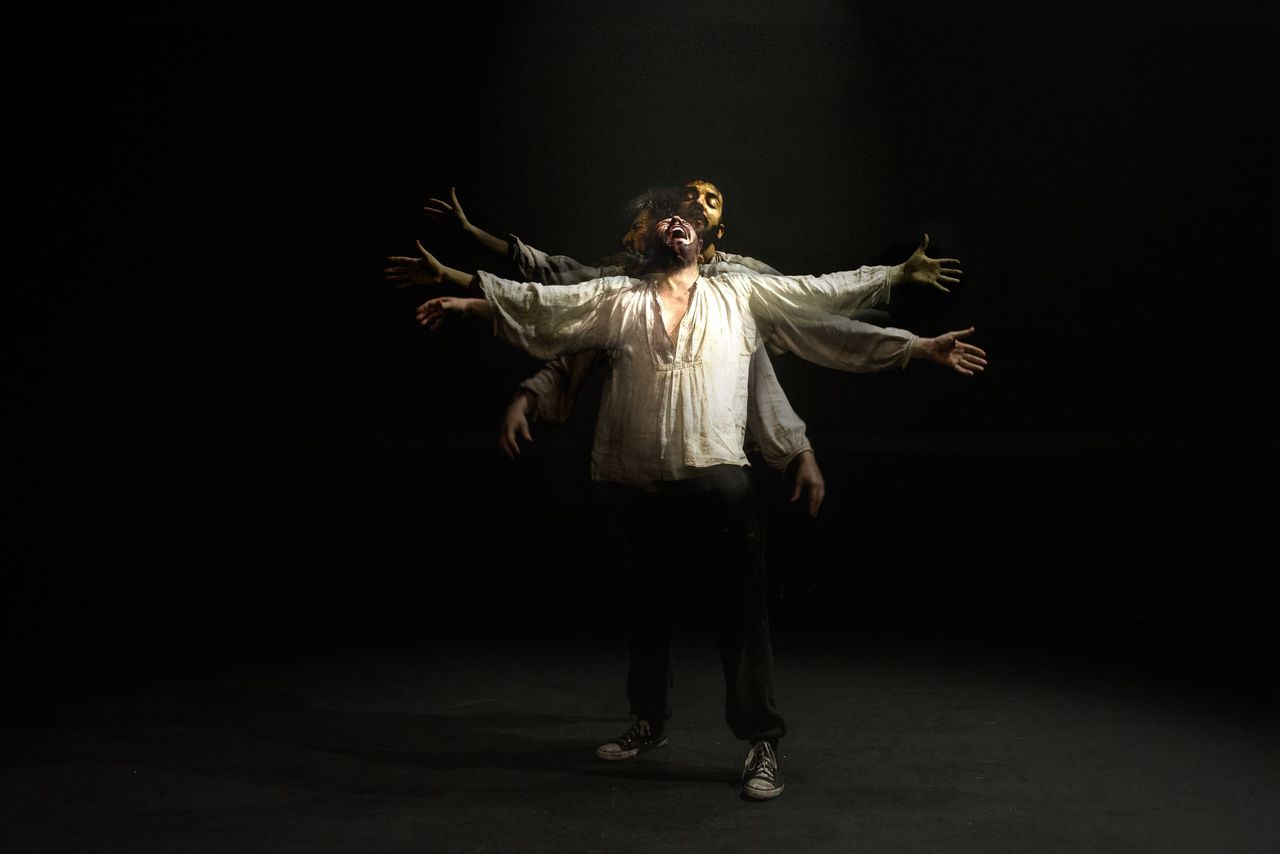
Rhum + Clay’s acclaimed adaptation of Mistero Buffo returns to London this autumn, bringing Dario Fo’s subversive, satirical classic to the Pleasance Theatre stage with renewed urgency. Originally penned by the Nobel Prize-winning playwright, the show reimagines biblical tales as sharp critiques of power—and in this revival, the storyteller appears as a modern Deliveroo driver, delivering biting commentary on society between shifts.
Julian Spooner, co-creator and sole performer, inhabits over a hundred characters in this physically demanding solo show, blending riotous humour, political satire, and moments of dark reflection. We had a chance to speak to him about stepping into this unique performance, the craft behind embodying so many characters, and how Fo’s work resonates with today’s turbulent world.
The Indiependent: Mistero Buffo is hailed as one of the most subversive plays of our time. What drew you to adapt it, and how does it speak to today’s political moment?
Julian Spooner: Before Rhum + Clay even existed, the director Nick Pitt (an old friend of mine) and I had just finished university and were talking about collaborating on a solo show. Mistero Buffo came up in conversation, as we were both huge fans of Dario Fo and subversive political humour (many a night spent together watching Brass Eye and Bill Hicks). I went off to train at École Jacques Lecoq in Paris, going on to form Rhum + Clay, and Nick did a directing MA. We came back together years later to adapt Mistero Buffo.
At that time, in 2018, we were right in the middle of Trump’s first presidency, and the British Parliament was in complete turmoil over Brexit. In many ways, it was the peak era of polarisation and contrasting narratives; as such, our adaptation focused on the manipulation of belief and the bending of truth.
Now, as we come back to the play in 2025, polarisation hasn’t disappeared but become amplified and splintered. We’re in Trump 2.0, Europe is at war again, and the unending horrors of Gaza — it feels like a moment of heightened paralysis, watching the world fall apart and feeling powerless to do anything about it. In this latest version, that’s what we want to speak to and fight against.
There’s so much in our version of Mistero Buffo that offers hope, laughter, anger, despair, protest. It’s not a show that goes away quietly, nor do we hope our audience does as they leave the theatre.
Your adaptation casts the central figure as a Deliveroo driver. How does this modern lens sharpen the satire?
Dario Fo was a hero for the Italian working class. He would occasionally perform Mistero Buffo in striking car factories for the workers, and much of what he was attacking in his version was the corrupt greed he saw in the factory owners, politicians, and those at the top of the Catholic Church.
The 1970s feels a world away from now, culturally and politically, and so we needed to find a resonance with today — a way of connecting to Fo’s message that felt more truthful to the 21st century. We landed on the idea of a travelling storyteller being a Deliveroo driver, running from their last delivery to perform the show. The “proletariat” has been replaced by the “precariat,” a figure even more exposed to exploitation — someone not protected by a union or solidarity with colleagues.
When we made the show, we collaborated with employment campaigners Organise [Network] to promote petitions fighting for the rights of zero-hour contract workers. It’s always a magic moment as a performer to step out onto the stage in full Deliveroo uniform; it feels exciting to put something so quotidian and so much a part of the urban landscape under the spotlight.
You’ve toured Mistero Buffo across the UK and abroad. What feels different about returning to London with it in 2025, compared to your last run here?
It’s gone all over the world and was last in Australia on a month-long tour just after COVID-19. It’s great to bring it back to its birthplace, London. I can’t wait to put it in the main house at The Pleasance for three weeks — it’s going to look absolutely stunning. The great thing about putting a show into a venue for an extended period is that you can really fine-tune it to perfection.
You embody over a hundred characters in this solo piece which is immensely challenging. How do you keep them distinct and sustain that intensity each night?
It’s definitely a challenge, and it really does take it out of me. One part of my process is being on “energy-saving mode” through the day, staying within myself a little bit so I can peak at 7 p.m. Each time I do the show, I need to work it back into my body and brain so it can live and breathe inside me again. When I did the show in Edinburgh, I used to run through the script to myself on the Meadows before the show whilst bouncing a tennis ball. I seemed only a touch more peculiar than the promenade silent disco that used to pass me every day.
The show embraces an ‘empty space’ concept, conjuring worlds with body and voice alone. What excites you about this stripped-back theatricality?
There’s a purity to this style of performance: the only instrument or prop I have is my own body, and I really love that constraint. I love the challenge of sparking the audience’s imagination with just the gesture of a hand, getting a laugh from the twiddle of an eyebrow, or conjuring up a crowd scene with just my body and feeling all the characters chatter around me like ghosts or animated shadows.
I always say that in theatre, CGI is the audience’s imagination — you kick it off with your performance, and they paint the rest in their brains. It also engages the audience with the thematic elements of the piece: belief in the intangible, the collective act of imagination required to come together and fight for a better future.
At its core, the play is both satire and rallying cry. Beyond the laughter, what do you hope audiences take away from the theatre this time?
Active hope would be nice. The world can feel overwhelmingly bleak right now, and I think our show does bring light among the darkness. It’s a show that celebrates the human spirit, and I look forward to spending some time in the presence of whoever decides to come.
Mistero Buffo will be performed at the Pleasance Theatre from 23 September to 11 October.
Words by Khushboo Malhotra
Support The Indiependent
We’re trying to raise £200 a month to help cover our operational costs. This includes our ‘Writer of the Month’ awards, where we recognise the amazing work produced by our contributor team. If you’ve enjoyed reading our site, we’d really appreciate it if you could donate to The Indiependent. Whether you can give £1 or £10, you’d be making a huge difference to our small team.