
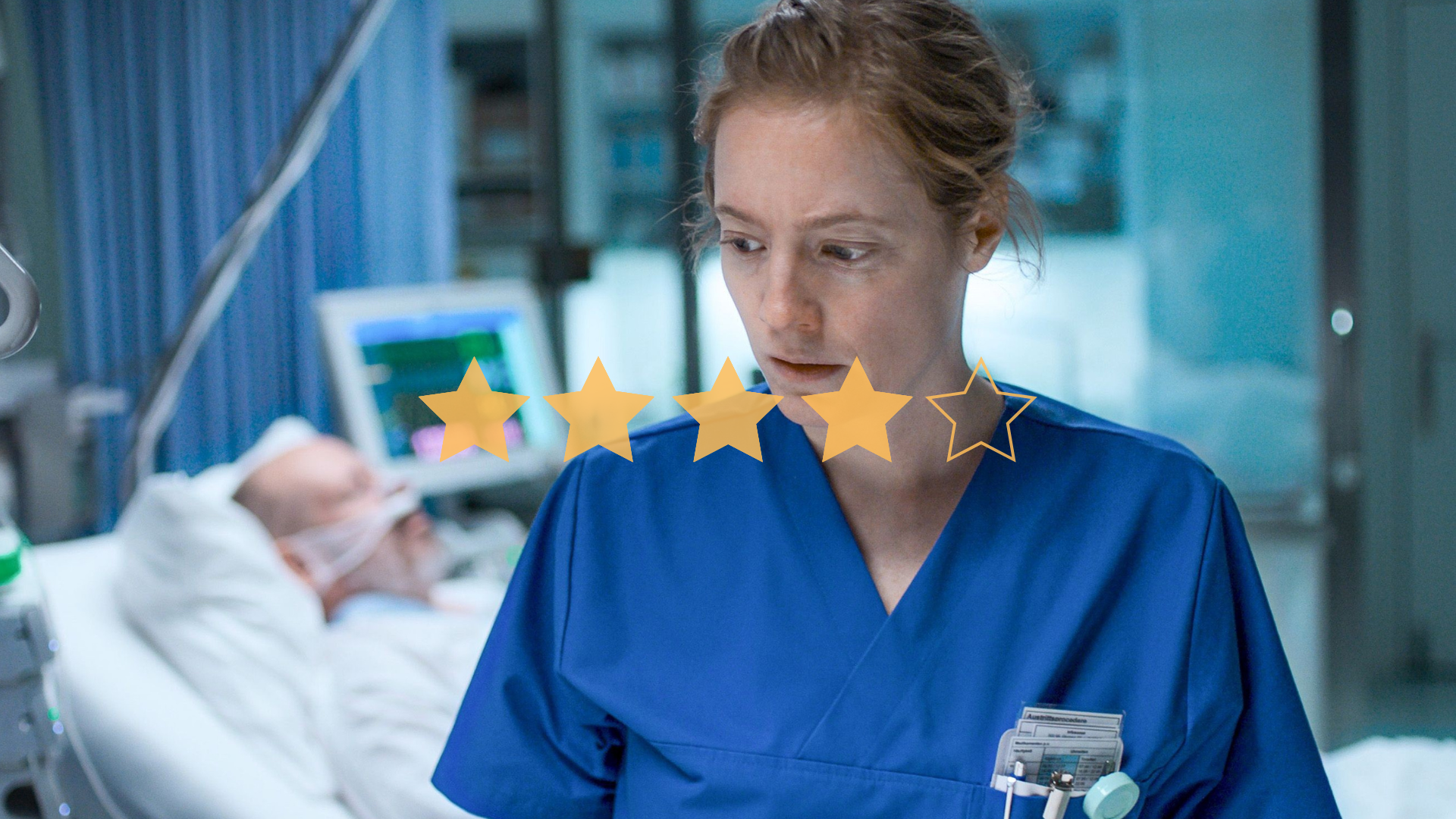
Helmed by a transfixing Leonie Benesch and driven by Petra Volpe’s assertive direction, Late Shift charts the terrifying challenges that nurses face every time they go to work.
★★★★☆
Petra Volpe’s gripping medical drama, Late Shift, begins not in the hospital, but in the factory that cleans the hospital’s scrubs. The conveyor belt feeds through blue uniform after blue uniform, a never-ending loop of unchanging appearance, mirroring the medical world’s non-stop challenges and the way it strips workers and patients of identity and humanity. From here, Late Shift enters the hospital to follow Floria (Leonie Benesch) through a testing, tense shift. Volpe’s unrelenting approach to the subject matter creates a film that is simultaneously heartwarming and heartbreaking, inspiring and terrifying.
The first red flag of the evening comes at the start of the shift, when Floria is informed that a colleague is absent. Faced with a fully-occupied ward and not enough staff, Floria, alongside other nurses and doctors, does her best to keep the ship afloat. Benesch further cements her place as one of the best actors currently in world cinema after a starring role in 2023’s The Teachers’ Lounge. From the off, there is an intensity and tension to Floria; it starts in her face and seeps into her core. But despite this stress, Benesch also imbues Floria with a remarkable humanity in the face of adversity, even when conditions are testing and patients are rude.
Along with other nurses, Floria moves with a steely resolution, like a soldier in the face of battle. The nurses’ team meeting at the start of the shift feels like the last moment of calm before unassailable gunfire will come at them. Amidst the turmoil, Volpe finds time for quieter, reflective moments, such as when Floria brings lollies to two children who regularly visit their mother, ill with cancer. On the whole, the pacing in Late Shift is terrific, aided by Judith Kaufmann’s dynamic cinematography and Hansjörg Weißbrich’s intelligent editing. Both recognise when to speed up and slow down proceedings, moving with pace to reflect Floria’s stress or restraining things when she has a quieter, but no less demanding, moment.
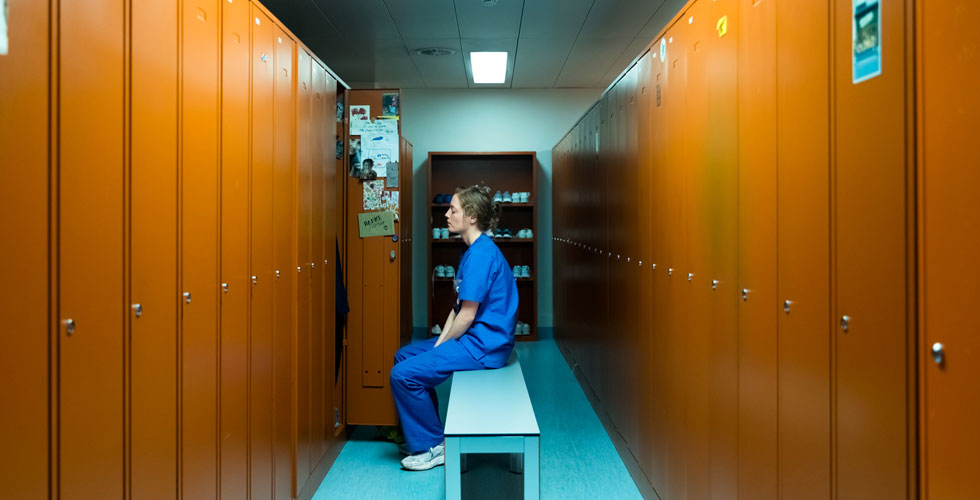
Perhaps Late Shift’s most impressive facet is the way it doesn’t cut corners. It isn’t a one-shot film, but it feels like it. We never leave Floria’s side, and every detail and intricacy of her day, good and bad, are shown in all their fullness. Volpe keenly impresses upon us that this situation is very, very real, eking out every intimacy of Floria’s experiences. Furthermore, the ensemble of patients is fascinating; from a kindly older man or the friendly cancer patient, to the combative sons of a seriously ill woman, to a private patient who treats Floria like a slave.
Late Shift has some formulaic elements. Emilie Levienaise-Farrouch’s score, whilst effective, feels akin to so many other tense musical compositions for similar films. Some moments, which accurately reflect Floria’s exasperation at the situation, feel far-fetched and jarring, such as a late scene with the private patient. Overall, Late Shift shakes off these small shortcomings to give us a breathless experience of what it is like to feel like you’re sinking whilst trying to keep countless others alive and healthy, across the course of just one evening among many. Most admirably, Volpe doesn’t just take aim at the medical world in crisis. Late Shift is also a poignant and warming dedication to all of the professionals working in this sector throughout the world.
The Verdict
It comes as no surprise to learn that healthcare around the world faces dire challenges, but this doesn’t make Late Shift any less urgent or transfixing. Powered by a wonderful central performance by Leonie Benesch, Petra Volpe’s film is a must-watch for its terrifying timeliness.
Words by William Stottor
Support The Indiependent
We’re trying to raise £200 a month to help cover our operational costs. This includes our ‘Writer of the Month’ awards, where we recognise the amazing work produced by our contributor team. If you’ve enjoyed reading our site, we’d really appreciate it if you could donate to The Indiependent. Whether you can give £1 or £10, you’d be making a huge difference to our small team.