
Content warning: discussions of racism and racial slurs
What happens when the world insists on defining you by where you’re from—and stops asking who you really are?
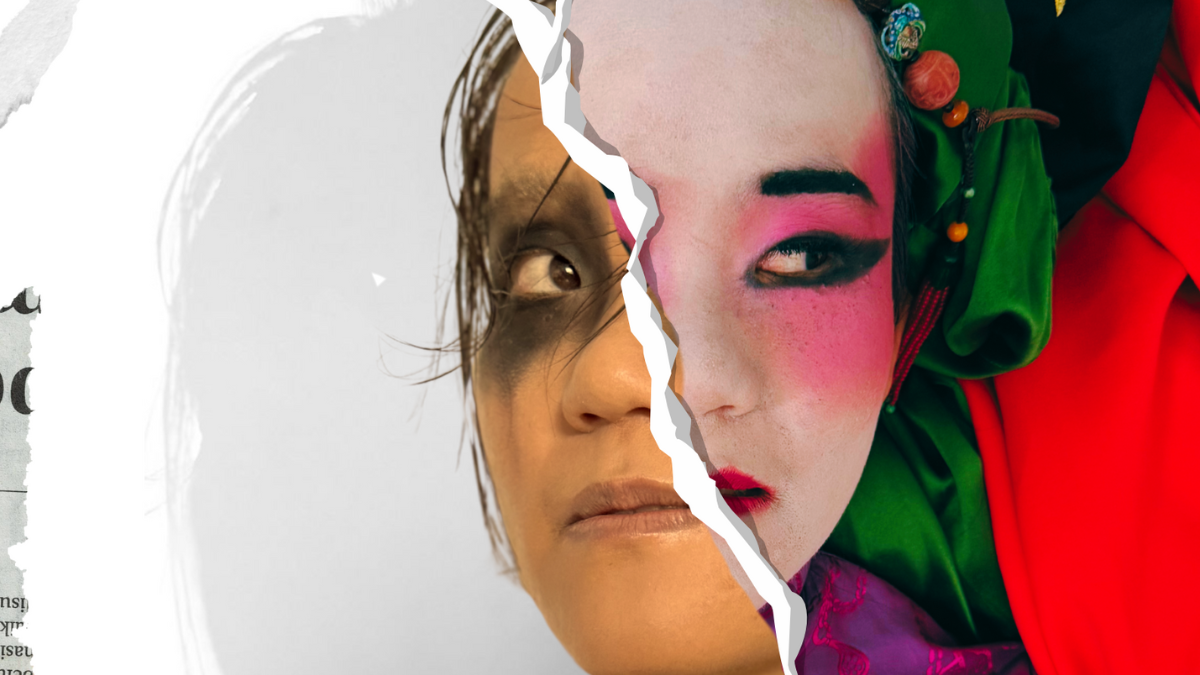
In her bold and bitingly funny solo debut Who the Hell is Robert Wayne?, writer and performer Li Zhuolang confronts the quiet ache of being seen only as a label. Personal and universally resonant, the play follows Lily, a young Chinese woman living abroad, who is desperate to land the role of Ratman, a white male superhero and the fictional alter ego of Robert Wayne. Blending theatrical storytelling with comic book fantasy, Li uses Lily’s story to examine tokenism, identity and the impossible tension between heritage and individuality.
Drawing from her own journey—growing up in Mainland China, studying in Hong Kong and later moving to the US and UK—Li Zhuolang explores how representation often becomes reduction. Premiering at Camden Fringe, Who the Hell is Robert Wayne? is a witty, provocative interrogation of who gets to be the hero, and what happens when we demand to be more than a stereotype. With sharp humour and emotional nuance, Li brings a fresh voice to the stage; one unafraid to challenge assumptions and push back against invisibility.
We caught up with Li Zhuolang to talk about comic book fantasies, cultural loneliness and what it means to step into the spotlight when the world keeps looking away.
Let’s begin with the spark. You’ve described cultural loneliness as a driving force behind Who the Hell is Robert Wayne?. When did that feeling become something you had to write about?
The need to write a story came up the first time I set foot beyond Mainland China. I was fifteen and in central London with a group of young students, and we were asked to leave a museum exhibition when someone else had tripped an alarm, and the people in charge assumed it was us. I was in Seattle for a few years, one of the most welcoming cities, and yet someone carved the word “Chink” on our car door once, and someone charged at me from three blocks away to spit on me, and someone plopped themselves down right next to me on an empty bus to tell me, “I know how they treat you over there.”
I was thrown out of shops in Italy as well as Chiswick the second I went in. I was surrounded by a group of teenagers on the Piccadilly line while they yelled “Covid” and threatened to take my phone and kicked me. Someone threw liquid at my mother in France. My best friend was walking down Oxford Street when someone came up and slapped them on the back of their head. I have never met a Chinese person, or anyone Asian, that doesn’t have a story like that. And the thing is, not all of them speak English, and even fewer of them write plays. I believe that the more we tell stories about this, the easier it would become for people to humanise faces that look different than their own.
It became a need to write this specific story when I noticed how people would consistently misspell part of my name, Zhuolang, even after knowing me for years. It was a funny feeling, since names seem to be such a basic thing, right? And it’s harder to reconcile because we talk about diversity and inclusivity so much—especially in the arts—nowadays. I thought it’s great that people seem to want to celebrate the symbols of my culture, and what if I could also give them a peek behind the curtain too? A real, “authentic Chinese story,” if you will.
That’s incredibly powerful, and heartbreakingly painful to see how familiar this feels being as Asian person myself. Why did the theatre feel like the right space to hold all of that? Did being on stage help or make it harder to confront?
For sure. This is my first year taking part in Camden Fringe (Happy 20-year Anniversary!!), and I’m really happy to see so many people sharing specifically what matters to them the most. The great thing about theatre—and especially here in London—is its availability. People have a keen interest in it.
Also, if I’m being completely honest, theatre stages make me feel more comfortable because everything is live. I’m not doing one thing and obsessing over whether I said something too brazen or stepped on any toes or stuff that could be interpreted in the wrong way twenty months later. It’s live, and it’s intimate and I think/pray/hope that if I do my job, the audience would understand.
There’s a fascinating metaphor at the centre of your play—a Chinese woman fighting to play a white male superhero. What drew you to that idea, and how did Ratman come to life?
I’ve rephrased this in my head three times to sound cooler, but I think I’ll just say it—the thing is, I love superheroes. I love Batman and everything Bat-adjacent even more. It’s at the centre of my being. The executive decision to dub this metaphorical hero Ratman is so that I could be a bit freer while playing with him. But despite my intense love for this genre, I felt the need to confront some aspects of it.
Like we were saying before, the industry in general talks about inclusivity and diversity, and there are genuine efforts made to bring in more representation — but it’s a work in progress. I was talking to a fellow Batman friend about how and why writers choose to focus on the mask instead of the person. There are questions you have to ask if you look at the person.
It’s not that I want or don’t want a classic hero to match my traits, such as my race or gender—it’s what would happen if he were me? What would be the new focus? And why would the focus shift? What is it about me that would truly be worthy of that mask? That’s what I wanted to talk about—the whole idea revolving around labels and tokenism.
Your play also critiques how Chinese and East Asian identities are flattened or caricatured in Western narratives. Are there any specific tropes, patterns or blind spots you’re most keen to dismantle?
Whoever came up with this question, know that I love you. May your pillow always be cool, and may your garden flourish.
That would be me—thank you! So, what would you like to see done differently?
I’m seized by this fear that as we move away from the more blatant yellow fever and fetishizing of East Asian women, people might be shoving them into a different yet equally damaging corner. At the root, this is the pattern I see, and it concerns me—we talk about giving certain groups a voice, but do we actually listen? There is a huge difference between “telling the story of someone” and “letting someone tell that story themselves.”
The major culprit of this, in my play, is Lily’s boyfriend. For me, he represents a particular mindset with a secret sense of jealousy and even resentment, where people might think, “If I had all the ‘cards’ a woman of color has, I could be so much better at playing this. I could tell more beautiful stories, and I could live their lives better than they do.” It manifests as people telling the story of what they think someone else’s reality is.
You’ve lived across China, Hong Kong, the US and now the UK. How have those cross-cultural shifts shaped your voice as a storyteller?
It made me careful, and it made me scared. It made me look at people sometimes and want to keep clawing at them to hollow out a space for myself to move in, and to manually create a connection because you can’t telepathically communicate the idea, “I’m a person too.” This is probably very naïve and idealistic of me, but I think the second that little spark lit up and people realized, “Oh yeah, you are a person too,” it would change the way they look at my face or body.
I guess the experience of moving to and living in different places gave me more of a perspective, to sort of craft a way to communicate that might make understanding easier. But it also made me desperate. The more I meet and see people, the more I realize how we fundamentally want the same thing. It compels me to reach out, maybe.
Humour is woven so seamlessly into your show. What has comedy allowed you to say—about alienation, anger, or even belonging—that drama alone might not have?
Who came up with these soul-searching questions?! Humour has been a big part of my own coping mechanism in real life. Some days you get so many side-eyes at a restaurant, and a group of middle-aged white men laugh so hard when you sit down and they point at you and look away, and you think maybe it’s racism, then you think maybe you are too sensitive, and then you think maybe you shouldn’t take everything so personally, and then you think you are crazy—what do you do?
I look at my Batman poster and say, “Bruce Wayne would never,” and watch BTAS and laugh at his silly little Brucie running. (Have you noticed how he runs in a very specific way when he’s Brucie?) And I feel a little better, because not everybody is like that. Humour is kind of what you make out of every bad situation. Sometimes I even hum my own little affirmation song—it’s called “The Chinese Person is a Human Toooooo.”
Also, I’ve learned that people don’t tend to react well when you wave a finger at their nose. Nobody likes lectures. Everybody wants fun anecdotes. That’s the relatable part. If I paid 12 quid to see a one-hour solo show at Etcetera Theatre, on August 6, 8, 11, and 13, and it’s actually a 45-minute seminar on a soapbox, I might feel less inclined to listen.
You’ve trained in classical theatre and ensemble work. What drew you to solo performance, and how did it feel to carry your own words on stage alone?
Aside from logistic reasons, I wanted this play to solely focus on Lily because this is her story. She exists in her own capacity—not really in relation to anyone else, or in contrast to anyone else. She isn’t there as the obstacle or the object. She is the hero and the journey and the story. I miss having someone else on stage though. No one told me (multiple people told me) a one-hour solo show takes this much stamina.
Now that Robert Wayne is out in the world, has it influenced what you want to create next as a theatre-maker?
If you told me I’d be a theatre-maker when I was fifteen, I probably would have punched you, but I very much see the appeal now. I thought the premise of this show would make a good ensemble play as well, and I do still want to make that version. I’ve also started fantasizing about a play that focuses on the women in comic books—or rather, the women-in-fridge trope in the superhero genre.
And lastly, how do you think the meaning of this play shifts depending on who’s watching? Was that dual gaze, especially between East Asian and non-East Asian audiences, something you thought about?
This is a brilliant question. I feel the dual gaze following me throughout life, so much so it’s become a part of life. You start to constantly wonder and judge yourself: Am I Chinese enough? Am I a good Chinese? Am I westernized? Am I too westernized? I don’t know if I think about it so much that I didn’t consciously put that in the writing, ’cause it was always just there? The goal is to make the play relatable and enjoyable for everybody watching, though. And if someone happens to understand my curses in dialects, that is just an extra fun Easter egg hehe.
Who the Hell is Robert Wayne? will be performed at Etcetera Theatre at Camden High St until 13 August.
Words by Khushboo Malhotra
For more theatre coverage, head here. Got thoughts on Who the Hell is Robert Wayne? Join the conversation on X @indie_pendent.
Support The Indiependent
We’re trying to raise £200 a month to help cover our operational costs. This includes our ‘Writer of the Month’ awards, where we recognise the amazing work produced by our contributor team. If you’ve enjoyed reading our site, we’d really appreciate it if you could donate to The Indiependent. Whether you can give £1 or £10, you’d be making a huge difference to our small team.