
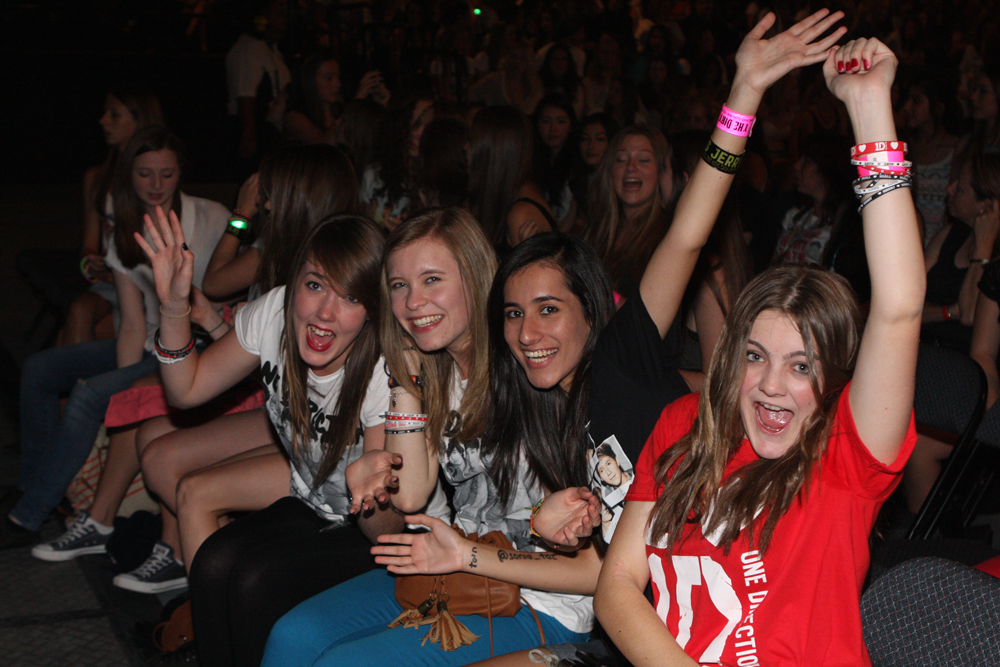
“Young girls like the Beatles. You gonna tell me they’re not serious? How can you say young girls don’t get it? They’re our future.”
Harry Styles for Rolling Stone
Imagine…
It’s 2014, and you have just come home from a long day of school. You log onto your laptop and, to your excitement, the One Direction fanfiction you have been staying up for the past three nights reading has been updated.
The thrill is indescribable, and to anyone who has never been a fan or considered themselves a ‘Fangirl’, it is abnormal. Fanfiction, in its simplest terms, is fiction written by a fan concerning any form of media, whether that be books, TV shows, movies, or, as discussed throughout this piece, musicians. This is an extremely common and adored practice in fandoms that allows fans to explore their own sexuality.
For too long, the female fan, or ‘Fangirl’, has been represented in the media as “hysterical”, “hormonally charged”, and ultimately “irrational”. And it is this label of irrationality that consequently lends itself to the gender essentialism at the very heart of fan culture. More often than not, art and music are not considered viable until male-led audiences deem them so. As Gergorić highlights in Fangirls: Power-relations and Commodification, when the behaviour of a fan is fundamentally described as irrational, excessive, and emotional, the fan is made female, whilst male interests are characterised as passionate; fangirls are pathologised.
The most prolific example of the pathologisation of the fan is ‘Beatlemania’, a subculture associated with the young female fans of The Beatles during their insatiable rise to fame in the early 60s. This image of the screaming, crying, infantilised fan became the blueprint for how fandoms dominated by girls were to be characterised by the media.
The same treatment was awarded to the fans of Justin Bieber, with ‘Bieber Fever’, and to One Direction fans, with the classic ‘One Direction infection’, both popularised terms in the early 2010s. Mania and disease in time became associated with collective female sexual desire.
When psychoanalysing the Fangirl, former war correspondent, David Dempsey, found it easier to reduce these girls to “hysteria” than to acknowledge that women may prioritise their sexuality the same way men do. This reduction is grounded in gender stereotypes that paint women to prioritise their feelings and emotions over their sexuality.
Back in 2013, the documentary Crazy about One Direction was made by Channel 4 to expose the extremities the young female fans go to for their favourite boy bands. Upon first watch, the girls appear obsessive, completely infantalised and addicted to these boys. However, Ewens explored how directors of the documentary purposefully set out to find the most unhinged girls, pushing girls back if they hadn’t gone to ‘extreme’ enough lengths for the boys. Exploiting women’s interests to push a misogynistic hate train to young girls.
This depiction of Fangirls in the media does not account for the possibility that young women, for the first time, found a vessel to express natural, authentic sexual desire. Which is why Fangirls are often scapegoated as deranged, making them deviant and therefore dangerous to others in society. Afterall, what is more deviant than female sexuality outside of the constraints of the male gaze?
Within the media, the expression of female sexuality is decided within the terms of this male-dominated space. For them, Fangirls were deviant because their sexual innocence was a prized commodity, and it had started to become a commodity that the girls took ownership of. The lack of representation of women prioritising their sexuality in the media, compared to men, has caused this confusion of the fangirls as hypersexualised due to their obsessions. With each scream, cry, and faint, their sexuality slowly became theirs for the taking.
The rise of the digital age allowed any fan, anywhere, the creative freedom to explore their passions through fanfiction and outside the realm of male-dominated media that presented female sexuality under the male gaze. Nowadays, young girls’ first sexual endeavours are instead explored online, in female-dominated fandoms. These fandoms explore feminine sexuality in an unpredictable and decidedly unconventional fashion beyond male sexual pleasure. Women writing literature about women for women, with the male artists being a mere vessel for exploring their sexuality, is positively represented in this community.
The more the Fangirls wrote, the more female sexual desire became deeply and openly discussed and therefore, normalised. For the first time, young girls read about female characters that are fully developed from the perspective of women and girls alike, devoid of hegemony. However, over the years, fandoms have continued to be scrutinised by the broader media despite the level of community they provide for young girls. According to Stanfill, fandoms are perceived as “failed masculinity” due to characterisations of the fan equating with gender essentialism of a woman; if one is manic, irrational and emotional over an interest, one is failing to perform their masculinity. Despite this depiction of infantilisation, women are still expected to be devoted to these men, as they need to maintain their dominance. This opens up an important discussion of the essentialism of the female fan.
More often than not, misogyny scapegoats female fans as the downfall of fandom culture, although in reality, they are the driving force of it. Without the female fan, men would have to deconstruct the stigma that the male enjoyment of pop music is emasculating and ultimately deconstruct the hegemonic rhetoric that women’s interests are only driven by the motivation of sexual attraction. This is already contradictory in nature, reflecting on previous discussions of the male disregard for female prioritisation of sex, demonstrating the complexity of the misogyny that exists in the depths of fan culture.
The shame inherited by this misogyny is integral to the formation of intimate communities of women, and integral to the success of these multimillionaire male artists.
Without the Fangirl and without misogyny, where would our teenybopper sensations be?
Words by Molly Morrison
Support The Indiependent
We’re trying to raise £200 a month to help cover our operational costs. This includes our ‘Writer of the Month’ awards, where we recognise the amazing work produced by our contributor team. If you’ve enjoyed reading our site, we’d really appreciate it if you could donate to The Indiependent. Whether you can give £1 or £10, you’d be making a huge difference to our small team.