
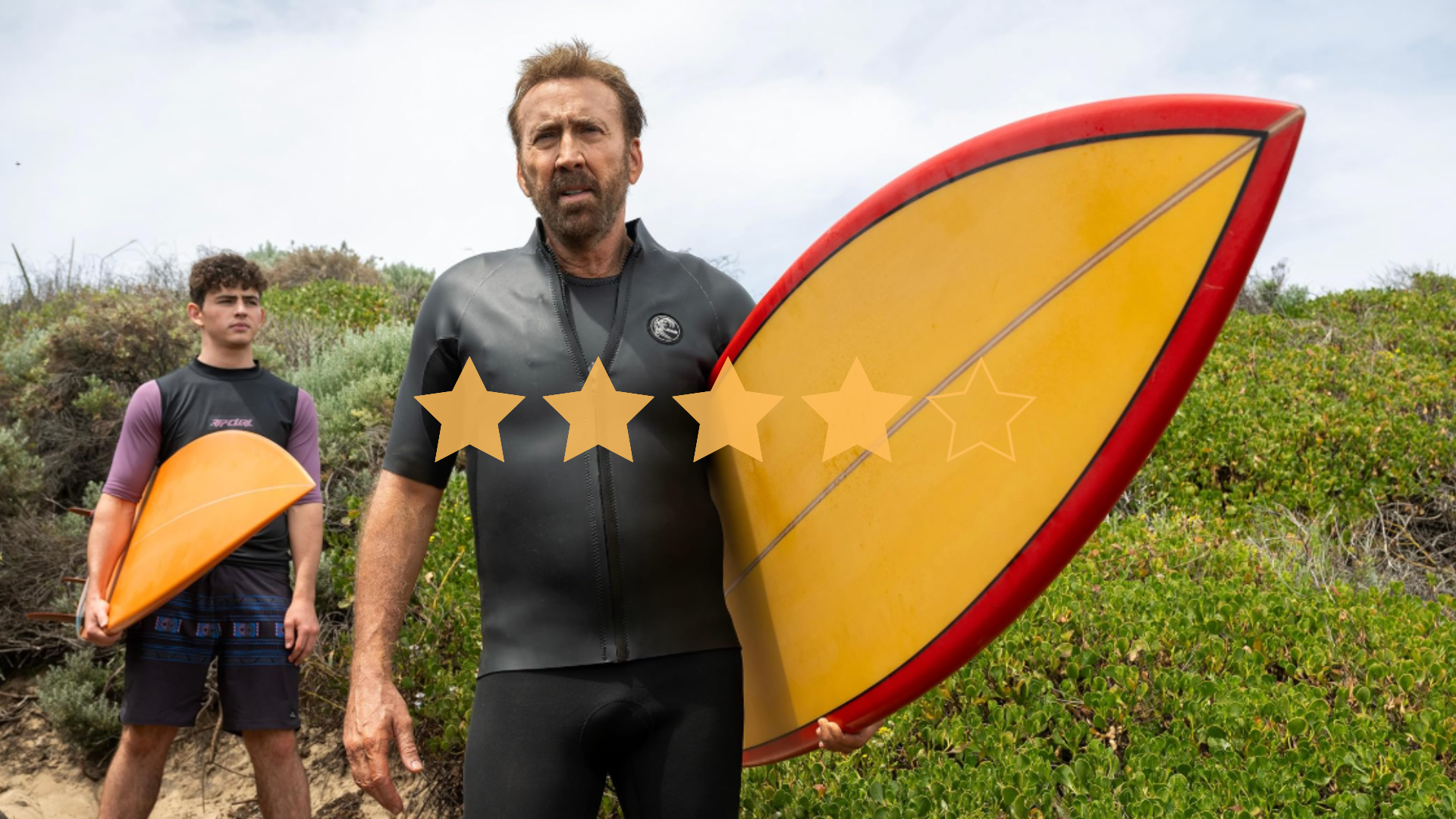
The golden Australian coast is the backdrop of Lorcan Finnegan’s sunkissed and twisted trip into madness in The Surfer. Nicolas Cage helms this whacky, low-budget thriller about a desperate father whose feud with a group of local surfers descends into a surreal loss of identity.
★★★★☆
Lorcan Finnegan is perhaps most well-known directing Vivarium starring Jesse Eisenberg and Imogen Poots, a film which was defined by its confounding yet intriguing narrative. The director has followed a similar style of filmmaking for new release The Surfer, a slick yet perplexing story which engages with the masochismo of an Australian coastal town. Finnegan offers no clear answer to the events presented in the narrative, instead focusing on cleverly capturing a zany energy that only a film starring Nicolas Cage could exude. The theatrics are dialled up in The Surfer, effectively exploring and amplifying themes including male rituals of pain and dominance.
Cage’s character, who is simply known as the Surfer, arrives at Luna Bay with his teenage son to take him surfing. His character is frantically trying to buy a house above the beach, telling his son that the cliff top home is best viewed from the ocean. It is revealed that the house is in fact his childhood home where he lived until his father died and his mother took him to the US. What quickly becomes apparent is that the house is the key for the Surfer to get back to an idyllic life, one where can get his family back together. However, the Surfer’s dreams of riding the waves are aggressively cut short when he and his son reach the beach to shouts of “don’t live here, don’t surf here”. Temperatures and tempers then start to rise as the Surfer must fight against a group of local men, known as the Luna Bay Boys, who aggressively assert dominance over the beach and its surroundings.
Whilst it is initially Cage’s distinctive American accent which signals his character’s status as an outsider, the Bay Boys reinforce this by humiliating the Surfer until he begins questioning reality. Before long, the Surfer becomes increasingly unhinged as his schemes to get to the shore are forcibly stopped by the Bay Boys’ actions. Cage is able to effectively portray his character’s journey from vexation to outrage, culminating in some campy moments of freak-outs as the psychodrama increases. It is this escalating emotion which demonstrates how the character is clinging onto nostalgia for the life he once lived. It becomes clear that he is no longer the man he once was, with multiple failures culminating in a loss of self and insecure masculinity. The more he grasps onto the idea that the beach and childhood home will bring his family back, the more Cage emphasises the character’s increasingly unbalanced mental state. Consequently, the Bay Boys’ rejection and hostile actions against the Surfer becomes a strong contrast which signals an almost cult-like preservation of male youth and extreme tribalism.
In particular, Julian McMahon’s performance as Bay Boys leader Scally stands as the counter to the pitifulness of the Surfer. With a grin like a shark, Scally represents the chance to belong in a community and return to a self-assured state of masculinity. However, it is this which forms the basis for toxic masculinity to thrive and the film highlights the destructive aspects of patriarchal beliefs primarily through him. McMahon imbues an almost seductive aspect to the character, showing how Scally weaponises his charm to prove that men must go to extreme violence and dominance to show their worth. The justification for this is depicted through the character’s controlling and territorial behaviour, constructing a type of menace that is both skin crawling yet strangely affable. Ultimately, McMahon’s performance illustrates that Scally’s actions are rooted in local history and the societal expectations of men. It is in these scenes of Bay Boy violence where The Surfer pays homage to 1970s Ozploitation films, upping its sensationalist aspects to show the tightening grip of Aussie macho terror.
One of the most interesting aspects of the film is cinematographer Radek Ladczuk’s use of colour. Heavy saturation is used to construct dreamlike and disorienting visuals, with a yellow glow used from the beginning to establish an unsettling and almost claustrophobic atmosphere. In particular, the vibrancy of the sea and its blue waves become central to the imagery of the film. Colours are used to make the landscape enticing but hint to a darkness underneath, mirroring the nature of the Bay Boys. This vibrancy is combined with dramatic zooms and distorting lenses, emphasising the increased psychological distress of the Surfer. It is this which most effectively indicates the blurring of reality for the character, creating a discomforting viewing experience.
The Surfer is mostly a tight exploration of hypermasculinity and the consequences of rigid patriarchal beliefs. However, it does partly lose itself in the final act and meanders towards its final message surrounding male toxicity. Whilst some audiences may want a more conventional plot, the film is most effective when it leans into the unhinged and leaves its viewers feeling uneasy. Cage effectively portrays the Surfer’s descent into mental instability as a consequence of alienation, critiquing the actions of the locals who force their expectations of manhood violently upon others.
The Verdict
Some audiences may find this film akin to the experience of finding sand in their clothes months after visiting the beach: baffling and frustrating. But for those willing to experience the madness so often associated with Cage’s films, The Surfer is a hypnotic exploration of masculinity and identity in contemporary Australia.
Words by Jess Bradbury
Support the Indiependent
We’re trying to raise £200 a month to help cover our operational costs. This includes our ‘Writer of the Month’ awards, where we recognise the amazing work produced by our contributor team. If you’ve enjoyed reading our site, we’d really appreciate it if you could donate to The Indiependent. Whether you can give £1 or £10, you’d be making a huge difference to our small team.