
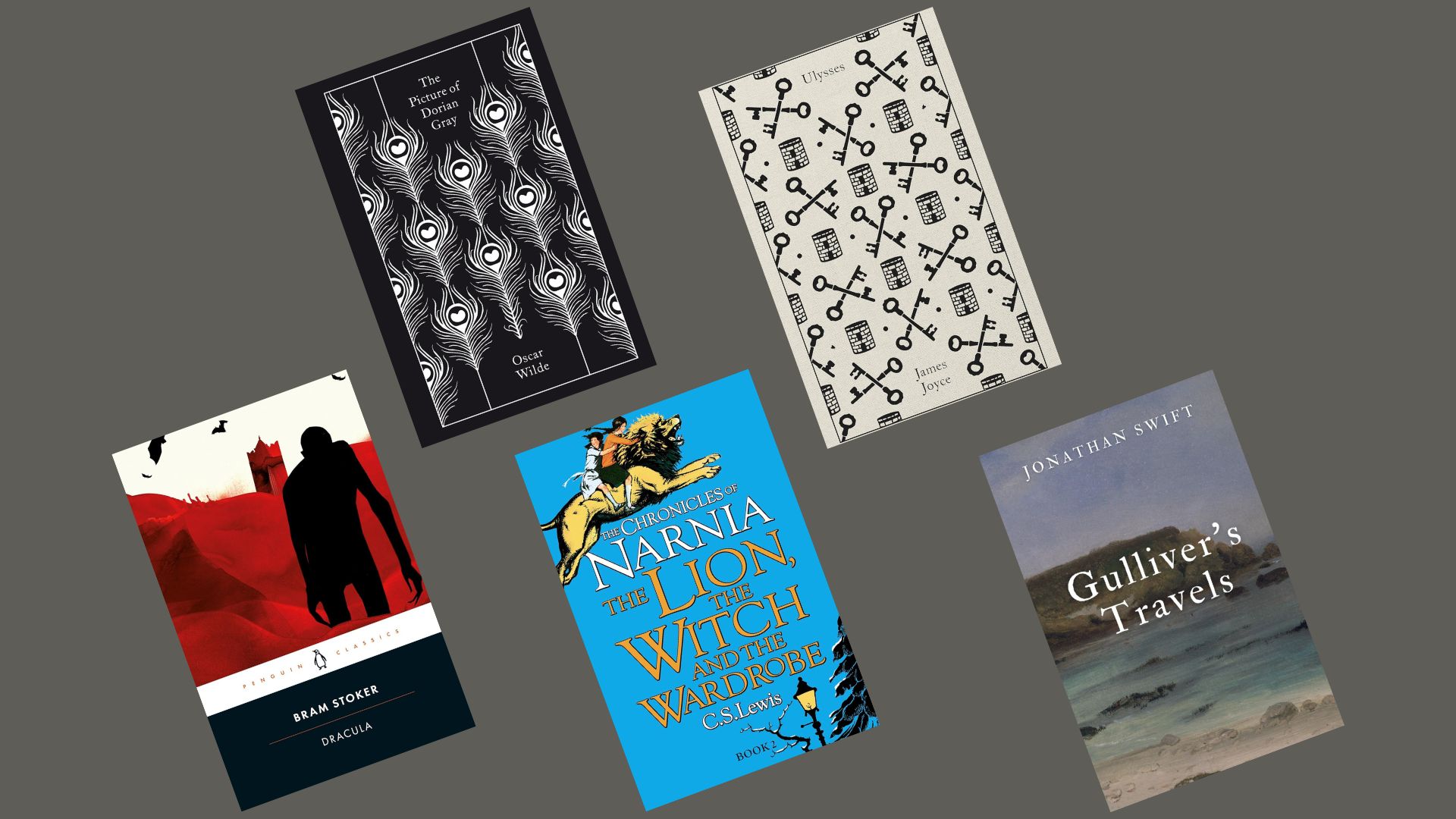
Launched in 2018, Irish Book Week (18-25 October 2025) is an innovative partnership between Bookselling Ireland (a committee of Booksellers Association members representing bookshops big and small across the Republic of Ireland and Northern Ireland) and Publishing Ireland. It celebrates Irish authors and illustrators, Irish publishers, and Irish interest books, as well as the many incredible Irish bookshops that sell them, playing a crucial role in championing homegrown talent and putting great Irish books into the hands of readers.
So as the week comes to a close, here are five Irish classics to cosy up with:
Gulliver’s Travels by Jonathan Swift
Gulliver’s Travels is famous throughout the world, but did you know that its author, Jonathan Swift, was Irish?
Born in Dublin in 1667, Swift was a satirist, essayist, novelist, and poet who became a prominent figure in English-language literature, often using satire to comment on politics, social issues, and the human condition. His most famous works are the novel Gulliver’s Travels and the satirical essay A Modest Proposal.
First published in 1726, Gulliver’s Travels follows a surgeon and sea captain named Lemuel Gulliver who travels to fantastical lands, including Lilliput where its people are less than six inches tall, encountering bizarre societies that serve as a critique of human nature, government, and hypocrisy.
The novel combines adventure with savage satire of British colonial rule over Ireland, mocking English customs and the politics of the day, reflecting Swift’s critiques of the English government’s treatment of the Irish people.
The Picture of Dorian Gray by Oscar Wilde
Oscar Wilde, famed as one of the literary greats, is known for his wit, quick one-liners, and obsession with aesthetics.
Born in Dublin in 1854, Wilde was a novelist, poet and playwright. His most famous works are the novel The Picture of Dorian Gray and the play The Importance of Being Earnest.
First published in 1890, The Picture of Dorian Gray follows a young man named Dorian Gray who makes a Faustian wish that his portrait will age and bear the burden of his sins while he remains young and beautiful, but the portrait’s hideous corruption ultimately drives him to murder and his own demise.
Dracula by Bram Stoker
Born in Dublin in 1847, Abraham ‘Bram’ Stoker was a novelist, journalist, civil servant, and a theatre and business manager for actor Sir Henry Irving at London’s Lyceum Theatre. His most famous work is the novel Dracula.
First published in 1897, Dracula follows Count Dracula as he moves from Transylvania to England to spread his vampiric curse, and the group of people led by Professor Abraham Van Helsing who must work to defeat him. The story unfolds through a series of diary entries, letters, and news articles that document the horror as Jonathan Harker’s encounter with Count Dracula turns into a battle between good and evil.
Of course, we can’t talk about Dracula without a mention of the 1872 gothic novella Carmilla by Joseph Sheridan Le Fanu, and another brilliant Irish author (born in Dublin in 1873), which is generally believed to have been a major source of inspiration for Stoker.
Carmilla tells the story of a young woman named Laura who is isolated in her Austrian home until a mysterious and beautiful guest, Carmilla, arrives after a carriage crash. The two form an intense and intimate bond, but Laura grows weaker as she suffers from nightmares and strange nocturnal attacks. Carmilla is ultimately revealed to be a centuries-old vampire, and her tomb is discovered and destroyed by a group of hunters, saving Laura from death.
Ulysses by James Joyce
Born in Dublin in 1882, James Joyce was a novelist, poet, short story writer, and literary critic. He also worked as a teacher at language schools and briefly as a bank clerk and cinema owner. He is known for pioneering literary techniques like the stream of consciousness narrative – a literary method which represents the flow of a character’s thoughts and senses in an unpunctured or disjointed form through an interior monologue. His most famous works are the novel Ulysses and the short story collection The Dubliners.
First published in 1922, Ulysses follows the lives of three Dubliners – Leopold Bloom, Stephen Dedalus, and Molly Bloom – over a single day on June 16, 1904. Through a stream of consciousness, parodies, poems, and prose, Joyce parallels their day’s events to Odysseus’ journey in Homer’s The Odyssey.
Similarly, The Dubliners (first published in 1914) is a collection of fifteen short stories which also explores the paralysis and stagnation of life in early 20th century Dublin, featuring everything from the death of a priest to conmen and parties.
The Lion, the Witch, and the Wardrobe by C.S. Lewis
The Lion, the Witch, and the Wardrobe is famous throughout the world as a classic children’s story, but did you know that its author, Clive Staples Lewis, was British Irish?
Born in Belfast in 1898, C.S. Lewis was a novelist, scholar, and theologian. He was also a professor at both Cambridge and Oxford, and was a prominent member of the literary group The Inklings along with J.R.R. Tolkien. His most famous works are the Chronicles of Narnia series.
First published in 1950, The Lion, the Witch, and the Wardrobe follows the Pevensie children – Peter, Susan, Edmund, and Lucy – who discover the magical land of Narnia through a wardrobe in a country house during World War II. In Narnia, they must help the great lion Aslan defeat the evil White Witch, who has cured the land to an eternal winter without Christmas.
The fictional world of Narnia was inspired by the countryside and coastal landscapes of Northern Ireland, including Lewis drawing on his childhood memories of holidaying in the Mourne Mountains of County Down.
Words by Jugo O’Neill
Want more Books content from The Indiependent? Click here
Support The Indiependent
We’re trying to raise £200 a month to help cover our operational costs. This includes our ‘Writer of the Month’ awards, where we recognise the amazing work produced by our contributor team. If you’ve enjoyed reading our site, we’d really appreciate it if you could donate to The Indiependent. Whether you can give £1 or £10, you’d be making a huge difference to our small team.