
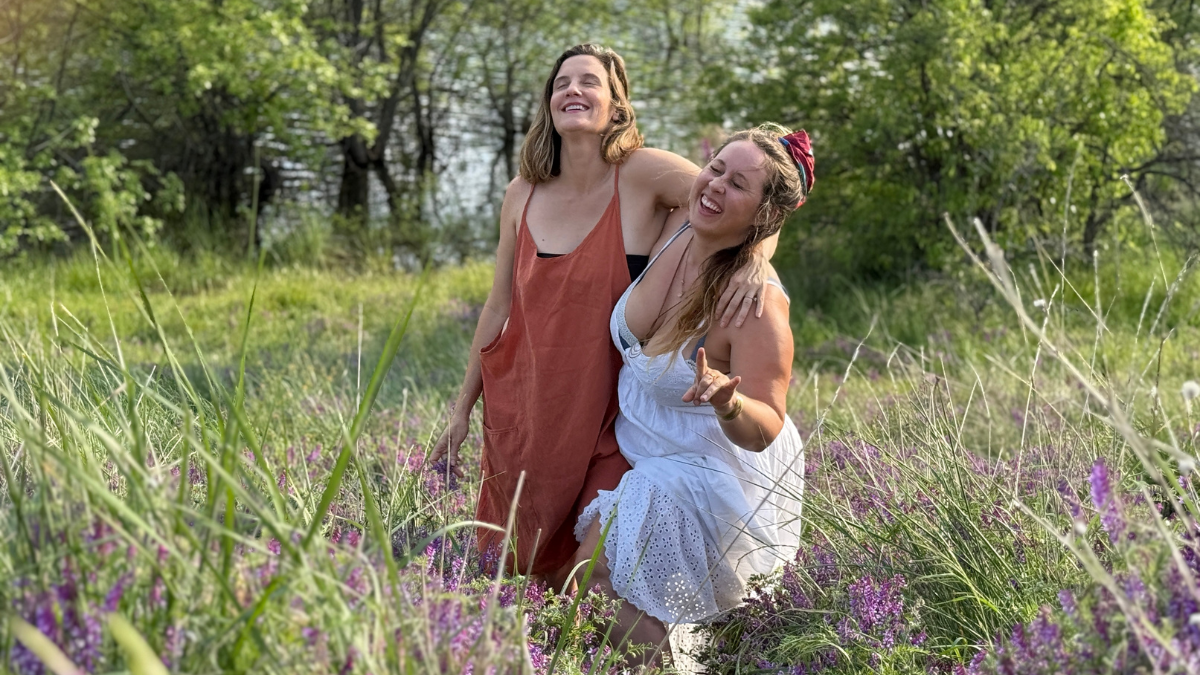
At the Edinburgh Fringe this August, a tender, aching new musical play unfolds in the quiet corners of motherhood, creativity and female friendship. Forget-Me-Not—created and performed by Julie Lake (Orange is the New Black) and award-winning singer-songwriter Annie Macleod—is a deeply personal excavation of what it means to love, let go and begin again.
With original music and bare-boned intimacy, the show navigates the contradictions women carry: the guilt of ambition, the grief of lost selves and the fragile beauty of friendships that survive rupture. Told through raw dialogue and soul-stirring music, it follows two longtime friends reconnecting in midlife—one embracing motherhood, the other reclaiming her voice—and all the tensions that come with it.
We caught up with Julie and Annie to talk about the play’s origins, the emotional cost of choosing yourself, and how Forget-Me-Not sings with both heartbreak and hope.
The Indiependent: You’ve spoken about the real-life friendship rupture that inspired Forget-Me-Not. When did it start to feel like a story that belonged on stage—and why tell it through theatre?
Julie & Annie: What we’d gone through over the past five years—new motherhood, divorce, the suicide of a loved one and our own falling out—felt dramatic and deeply human. When we came back together, we started simple: sharing songs and telling our stories to each other, sharing our truth. It wasn’t clear what we were making at first, just that something bigger wanted to emerge around the themes of motherhood, creativity and friendship. It took time (and about 30 drafts) to find the shape. We knew we wanted to play our songs live, and since theatre has always been Julie’s first love, it organically became a play.
Thirty drafts—that’s intense! What was it like to write together again after that break? Were there truths that felt too raw to write, or too essential to leave out?
There were definitely moments when it all felt too hard to write. Julie kept trying to cut certain scenes because they felt too vulnerable to share. Annie worried some parts might reopen old wounds. But by the time we came back together to make this show, we’d both done so much healing. We weren’t the same people we were during the chaos we’re writing about. We used a form of therapy called IFS (Internal Family Systems) a lot—naming our “parts,” checking in emotionally, working through fear and resistance. We only had one real fight through the whole process (pretty good, considering), and we moved through it fast.
You’ve said this play was born because nothing like it existed. What gaps did you see in how women’s experiences, particularly around motherhood, identity, and friendship,were portrayed?
Maybe something like this does exist and we just haven’t seen it. Nightbitch and All Fours hit similar themes, but Forget-Me-Not still felt like something we were aching to see onstage—something that would’ve wrecked us (in a good way) a few years ago. We wanted to tell the truth about motherhood, marriage, identity and female friendship; not the polished version, but the raw, unsaid stuff. The parts most women carry silently. If our show helps even one woman feel seen, or inspires her to share her story—or make art—we’ll feel like we’ve done something right. And if she’s looking for community, we’re starting artist-mother circles soon.
One of the play’s most powerful elements is its ability to hold emotional contradictions with honesty and nuance. How did you navigate those without simplifying them?
Because that’s life—a swirl of conflicting emotions all at once. Nothing is black and white. There’s no such thing as a purely “good mother” or “bad mother,” even though culture pushes that binary. No perfect choices. Of course, we had to simplify some things. We only had 55 minutes to tell the true story of our lives (plus six original songs!). Honestly, each paragraph of this play could be its own full-length piece. But by telling the most essential truths, as plainly as we could, we’ve found that audiences connect the dots themselves. They bring their own stories, their own contradictions, and that’s the point. We’re not offering answers, we’re creating space for people to feel what’s real.
Speaking of female friendships—so often reduced to clichés onstage, either saccharine or catty—how did you go about writing something more complex and less idealised?
We just told the truth. We didn’t have to invent conflict or force drama: real life gave us plenty. And instead of cleaning it up or smoothing it out, we leaned into that messiness. We didn’t write “characters”, we wrote ourselves. That meant being vulnerable and owning the parts we’re not proud of. But we trusted that if we were honest, other women would see themselves in it too. Because friendship—real friendship—is complicated. It’s not always pretty, but it’s deep.
Motherhood and creative identity are central to the piece. Do you feel women are still conditioned to sacrifice everything to to become caregivers?
Yes, we’re still very much conditioned to believe that being a “good mother” means sacrificing everything else, including our creative selves. There’s this lingering cultural message that art, or anything that doesn’t directly serve our children or bring in money, is indulgent or selfish. But we’ve come to believe the opposite: staying connected to our creativity is essential, not just for us, but for our families. Making and performing Forget-Me-Not has helped us reclaim our right to be fully expressed. It’s shown us that honouring our creative identities isn’t a betrayal of our caregiving—it’s modelling wholeness for our kids and for other women.
We’re curious, how much does the story rely on unlocking the audience’s emotional memory—their own silences, regrets or friendships? Did you see the viewer as a third presence while writing?
Yes, absolutely. This show was always meant to be a conversation, not a performance behind a fourth wall. The space is small and intimate, and we speak directly to the audience throughout, sometimes even assigning them roles as our children. It’s designed to feel like we’re talking to a group of friends, or a women’s circle, like we’re all in it together. We hope the story stirs something real—regret, recognition and relief. If our vulnerability invites someone to touch their own story more deeply, that’s the kind of theatre we want to make.
Annie, you’ve called music the “lifeline that brought us back together”. How did song-writing let you express what words couldn’t, and what was your process like within such an intimate setting?
Yes! We both wrote the music—three original songs each—and we harmonise on every one. The songs came straight out of the experiences we were living at the time: motherhood, heartbreak, friendship rupture and longing. Music gave us a way to express the emotions that words couldn’t quite hold. Our voices blend in this uncanny way that feels like a metaphor for our friendship—distinct, different, but creating something more beautiful together. Writing and singing these songs was part of our healing, and now it’s part of the audience’s experience too.
The minimalist staging—just voices, two chairs, a guitar and a keyboard—is quite striking. What freedoms did that simplicity give you as artists that a larger production might have obscured?
The simplicity of the production is what allows the emotional depth to land. It’s just us—our voices, our instruments, our history—so nothing gets in the way of the story. A bigger production might have distracted from the rawness and intimacy we were after. The minimalism keeps the focus where it belongs: on the truth of the experience. It also gives the show a kind of spaciousness, where the audience can fill in their own memories and emotions. Honestly, it could work beautifully as a radio play or podcast for that reason.
The play ends not in a clear triumph, but in a fragile kind of truce. Why did emotional ambiguity feel like the most honest ending?
We wouldn’t call it a truce or a triumph either. It’s more like: here we are. Two artists, two mothers, two friends, showing up for each other in all our messy, complicated humanity. That felt like the most honest ending we could offer. But in the final moments of the show, we are still together, housed in love. And maybe that is a kind of quiet triumph; the kind that comes from being seen, held, and still choosing each other.
Finally, you’ve spoken about expanding Forget-Me-Not beyond the Fringe. What might that look like and who do you most hope to reach?
We’ve realised there’s a real need for deeper support and community among Artist Mothers—women trying to raise children without losing their creative voice in the process. Post-Fringe, we’re expanding Forget-Me-Not into a broader offering: intimate groups, retreats and live performance/showcase opportunities designed specifically for Artist Mothers. We want to help women reconnect to their art, their truth, and each other. If this resonates, we invite you to begin with our Artist Mother quiz.
Forget-Me-Not will be performed at 11:40 in Greenside at George St until 9 August.
Words by Khushboo Malhotra
For more Edinburgh Fringe and theatre coverage, head here. Got thoughts on Forget-Me-Not? Join the conversation on X @indie_pendent.
Support The Indiependent
We’re trying to raise £200 a month to help cover our operational costs. This includes our ‘Writer of the Month’ awards, where we recognise the amazing work produced by our contributor team. If you’ve enjoyed reading our site, we’d really appreciate it if you could donate to The Indiependent. Whether you can give £1 or £10, you’d be making a huge difference to our small team.