
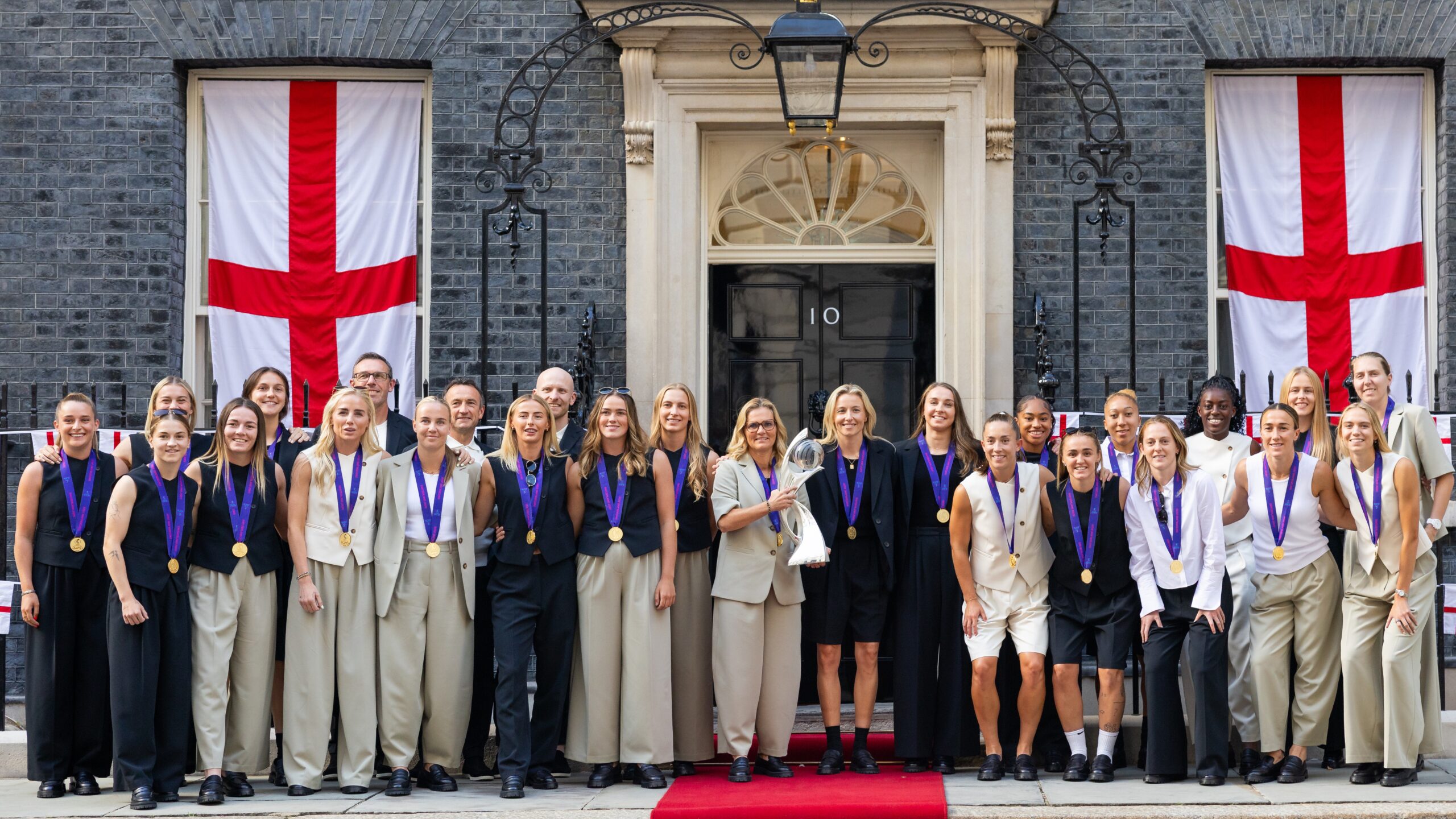
With one goal and three flawless penalties, the Lionesses secured their second consecutive UEFA Women’s European Championship. It is a historic win for England and the first time that any England team—men or women—has lifted a major trophy abroad. But while they were lifting the trophy, a darker reality was unfolding online. One that makes a horrible truth painfully clear; winning still isn’t enough to shield women and women’s football from prejudice.
As women’s football finally steps into the spotlight, so too has the abuse directed at it and at the players who compete. How can a game built to unite end up dividing us? The Women’s Euros in 2022 proved it doesn’t have to, showing sport’s unmatched power to inspire and connect. UEFA reported that 400,000 new opportunities for women and girls to take part in grassroots football were created following the 2022 competition. Furthermore, 84% of spectators said that the tournament improved their perception of the women’s game.
But that progress exists alongside an uglier reality. Misogyny, racism, and homophobia have become so normalised in women’s sports that they’re almost expected; in online comment sections, during press conferences, and when comparing support levels to the men’s game. A survey by Her Game Too found that almost 92% of female football fans have witnessed sexist abuse online, and 63% have experienced it personally.
After the Lionesses’ win, a BBC post-game interview with defender Lucy Bronze circulated on TikTok. She revealed she had played through the tournament with a fractured tibia, a moment that should have inspired admiration. Yet, scrolling through the comments, it is clear that not everyone feels this way. Instead of praise, the comments are awash with dismissive and even abusive remarks, highlighting just how persistent and normalised the disrespect towards women’s football remains. One user writes “Can’t wait for the actual Euros to start” whilst another adds “Wouldn’t be possible in men’s football because of the pace and standard.” Other comments describe her as a “lad” and a “fella,” and many dispute whether she fractured her tibia at all. Regardless of who is writing these comments, whether they’re being deliberately provocative or genuinely expressing their beliefs, the impact is harmful to the game. Kick It Out found that 38% of women’s football fans avoid posting about the game online because they fear becoming targets of sexist abuse.
This hate toward women’s football is nothing new. Back in 1921, the Football Association banned women’s matches from being played on affiliated grounds, claiming the sport was “unsuitable for females” and a threat to the men’s game. That ban lasted 50 years and wasn’t lifted until 1971, stunting the growth of the women’s game for generations. At the time, women’s matches were drawing crowds of over 45,000, proving the demand was there. It was institutional bias that silenced it.
Today, echoes of that resistance remain. According to data from FIFA’s Social Media Protection Report, players at the FIFA Women’s World Cup 2023 were 29% more likely to be targeted with online abuse compared with players at the Qatar FIFA World Cup in 2022, emphasising the heavily contrasting attitudes towards the men’s and the women’s game. What doesn’t help matters is when high-profile football commentators, such as former Manchester City player Joey Barton, continue to dismiss the women’s game and amplify these feelings to millions of online followers.
Lionesses defender Jess Carter has faced relentless waves of racist abuse online throughout the tournament. Social media analysis conducted during the match against Sweden, using SentientSports’ GuardianAI and published by Sky Sports, revealed that Carter was the England player targeted with the highest volume of negativity. This is a stark reminder not only of the abuse all women continue to face, but also of the racism that continues to plague the women’s game, even at its highest levels.
An Instagram post by Versus, meanwhile, describes the “unsettling reality” of racism in England’s football as “simmering underneath the surface,” a fact painfully familiar to both the men’s and women’s teams. It became evident in 2020 when Marcus Rashford, Jadon Sancho, and Bukayo Saka faced a torrent of racist online abuse after missing penalties in the Euros final. Over 78% of the abuse around the match was identified as racist or homophobic, according to FIFA’s 2022 Threat Matrix Report. Only eleven people were arrested for this online abuse, an alarmingly low number that exposes the urgent need for tougher enforcement and decisive action to hold offenders accountable and protect players from such hate.
At this year’s Women’s Euros, UEFA launched an online abuse programme with Meta, TikTok, and X, aiming to monitor, report, and tackle the hate that teams and individuals face. They tracked 443 players, coaches, and referees and provided them with manuals on how to protect their social accounts. Although almost 67% of abusive posts were removed, the abuse is growing. Compared to the Women’s Euros in 2022, there’s been a 7.3% rise in abusive posts.
A few days before England and Spain went head to head, it was reported by the BBC that the head of Sport England, Chris Boardman, wrote to Ofcom to express the organisation’s “deep concern regarding the recent wave of racist and sexist abuse” directed at England’s women’s football team on social media. With the Online Safety Act, which passed in October 2023, there is now a requirement for social media platforms to tackle harmful content like racist abuse. Yet for many campaigners, action remains too slow, and the abuse persists despite the law. According to Kick It Out’s new data, reports of sexism and misogyny increased by 67% compared to the previous season (2023-2024). More needs to be done, and it needs to be done quickly, as these torrents of abuse could change the face of women’s football.
The women’s team has fought long and hard for space on the pitch, in the media, and in the history books, and they’ve inspired countless women along the way. Yet, despite their achievements, only a third of fans believe there is sufficient coverage of women’s football in mainstream media and TV, according to FSA’s Women’s Game Supporters Survey 2024. It has never been enough to applaud the wins while ignoring the abuse, a fact that is more apparent now than ever before. Women’s football deserves not just equal footing, but equal respect, online, in the media, and every stadium across the country.
Words by Amber Lowen
Support The Indiependent
We’re trying to raise £200 a month to help cover our operational costs. This includes our ‘Writer of the Month’ awards, where we recognise the amazing work produced by our contributor team. If you’ve enjoyed reading our site, we’d really appreciate it if you could donate to The Indiependent. Whether you can give £1 or £10, you’d be making a huge difference to our small team.