
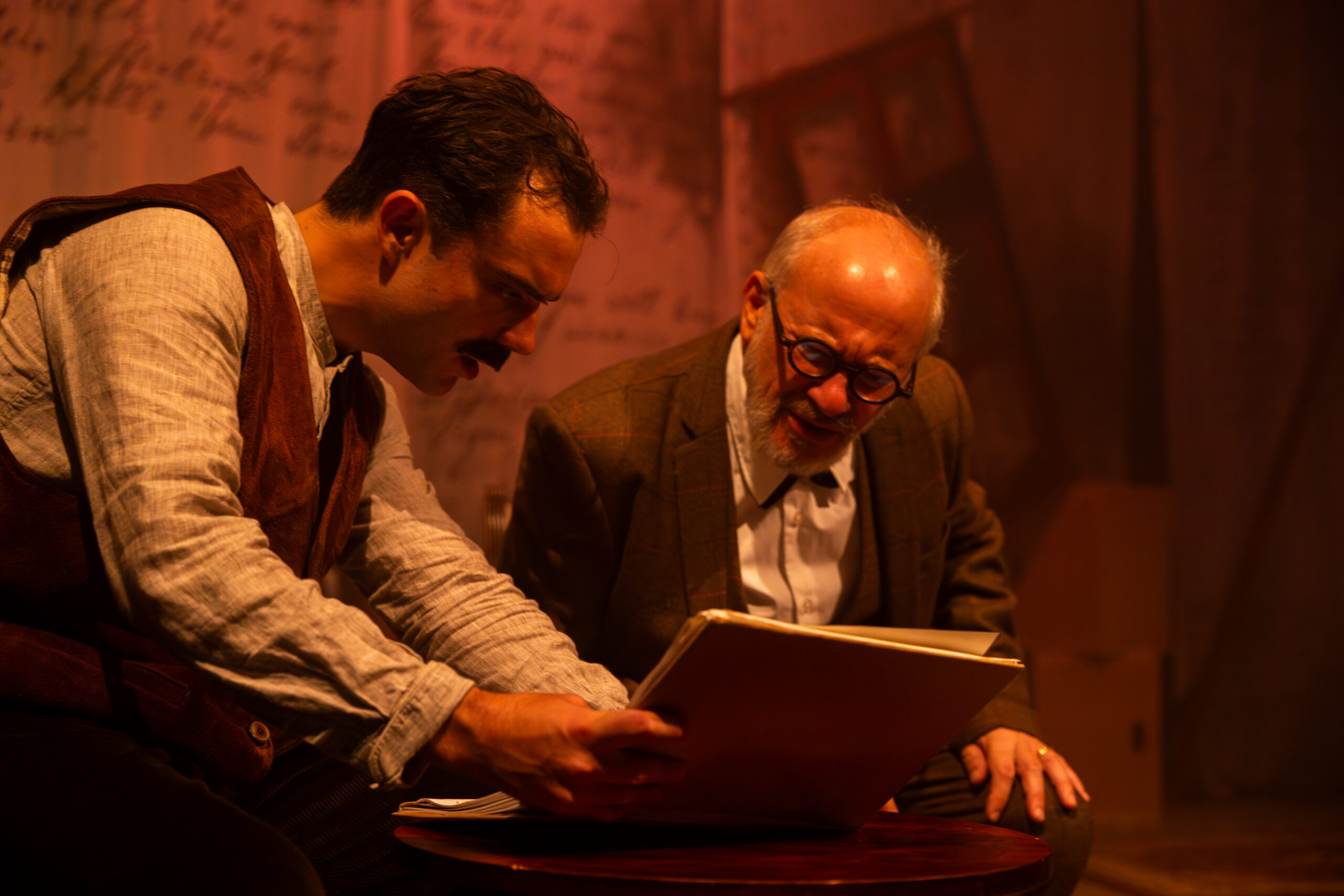
What if history’s darkest figure had once found himself on a psychoanalyst’s couch? That is the audacious premise behind Dr Freud Will See You Now, Mrs Hitler, the new play from BAFTA-winning writers Laurence Marks and Maurice Gran (Birds of a Feather; Goodnight Sweetheart). Now running at Upstairs at the Gatehouse—just two miles from where Sigmund Freud spent his final days—the play imagines a chillingly plausible encounter between the father of psychoanalysis and a young Adolf Hitler.
Grounded in a real historical footnote—that Hitler’s childhood doctor once recommended psychiatric treatment—Marks and Gran spin a darkly comic alternate history that asks whether early intervention might have changed the course of the 20th century. Through encounters spanning three decades, Freud and Hitler spar in scenes that probe the psychology of hatred, the seduction of power, and society’s blind spots in the face of danger.
At once provocative and unsettlingly timely, Dr Freud Will See You Now, Mrs Hitler explores not whether evil can be excused, but whether it can be understood—and perhaps, prevented. It’s a play that sits in dialogue with both history and the present, echoing contemporary anxieties about populist leaders and simple answers to complex problems.
To delve deeper into this reimagined world, The Indiependent spoke with Jonathan Tafler, who steps into the shoes of Dr Freud himself.
The Indiependent: Dr Freud Will See You Now, Mrs Hitler imagines a meeting that never was. What first hooked you about the script, and about stepping into Freud’s world?
Jonathan Tafler: Well, it’s a brilliant idea, perfectly summed up by the title. It’s a play that does what it says on the tin. To have the privilege of stepping into Freud’s world and presume to step into his shoes is entirely thrilling. I was offered it quite a while ahead and knew, without a shadow of a doubt, that I wanted to do it. That gave me the chance to do a lot of research, which I love, not just about Freud but also about the world that he was living in—Vienna in the first part of the 20th century. I looked at the art of the period and read memoirs by his Viennese contemporaries, Stefan Zweig and Anatol [by Arnold] Schnitzler. It was great to have the excuse to do it.
Freud and Hitler shaped the 20th century in very different ways. As an actor, how do you make their imagined encounter feel both credible and compelling on stage?
As I have said, research is important to me, just to locate the world in which your character is existing; but at the same time, most of it falls away when you are actively working on the play—ultimately, it is the world of the play that you inhabit, not the actual Vienna of 1907. But perhaps that research roots you and gives you the confidence to feel you can jump off into being this remarkable man. I looked at film of him, which was incredibly valuable and informative. He was an old man at the time, but still you can see how tactile he was, how animated, how affectionate he was with children.
From other sources, I learnt that, like Hitler, he had a strong sense of his destiny—that he was intended to accomplish great things. The only way to make it believable is to believe it yourself, to connect thoughts, and feel what prompts each word that you speak. And if you are sufficiently committed to the words that you speak, and they are good words—as these are—hopefully it becomes compelling.
Immersing yourself in Freud’s life and writings, did anything you discovered change how you approached the role?
Yeah, I would add that visiting the Freud Museum was a moving and valuable experience. To stand in his consulting room, to see the couch, his desk with all the figurines from ancient cultures, the desk chair that he designed so that he could hook a leg over the arm of it and had custom-made—all this made it far easier to imagine oneself standing in his shoes.
The play swings tonally from sharp humour to chilling tension. How do you keep the audience with you through such dramatic shifts?
You have to feel it in the moment. If an actor doesn’t have good instincts, he has nothing—even more important than research! [Laurence] Marks and [Maurice] Gran are brilliant comedy writers, but this is a very serious comedy. Freud has funny lines and most of them were actually said by the man himself. The play shifts in tone quickly; it surprises you. You just need to go with it and be true to the moment. It is an unusual piece, dealing with monumental characters and some dreadful themes, but it is, in the end, an entertainment, not a thesis. Audience reaction thus far has been terrific, but some people have been unsettled by it. That is inevitable, I think.
This is the first full staging after the story was first heard on BBC Radio 4. From your perspective, what does live theatre add that radio can’t?
I didn’t hear the radio play, and I wouldn’t want to hear it now until our production closes. I know and have worked with the actors who played Freud and Hitler (portrayed by Allan Corduner and Toby Jones)—but I wouldn’t want to hear Allan saying my lines at the moment. I made the huge error of watching Anthony Hopkins as Freud in the film Freud’s Last Session, and for a few days my own Freud started developing a Welsh accent.
I love radio—I write for the medium, direct radio plays, and have acted in several hundred. It is a wonderfully intimate medium and would suit this play very well; what it can’t do is put you in the room with Freud and Hitler. Sam Mac plays Adolf and is incredibly compelling. After the show yesterday, someone said to me that they had believed they were really in the company of Sigmund Freud, and that was a great compliment.
One of Freud’s sayings “As modern life becomes more complex, the masses look to their leaders for ever more simple solutions” feels painfully current. How does this production resonate with today’s politics and leadership?
It’s ghastly. The warnings from history are writ so large, and yet we seem to be oblivious. I learnt about the rise of the Nazis at school, my parents saw it happen, and I wondered how people could have been so stupid as to let themselves be fooled by this obviously evil doctrine, by these terrible people. When I was growing up, it seemed that progress in every way would continue unabated—the world would become more equal, more just, nations would live in amity.
Now we see the popularity of demagogues all over the world, how frail democracy is looking in the homeland of the Western world, the USA. And we see [Nigel] Farage in our country touting the simplest solutions to all ills and attracting great support—about the same percentage that carried Hitler into power initially in Germany. It all feels far too relevant.
At its heart, the play probes what therapy can really achieve. Do you think it also nudges audiences to reflect on the limits of psychoanalysis in today’s still-stigmatized mental health landscape?
I have to avoid spoilers in answering this question, as it is the central question of the play. Anna Freud (played by Ruby Ablett) is our guide and asks whether it would have been different if Freud had had the chance to work with Hitler. Last night at the play, there was a man I was at university with forty-five years ago and hadn’t seen since. He is now a psychotherapist and became so after going through therapy himself. He remarked that it had changed him, and that he had needed to change because he was such a “cocky so-and-so” before.
I told him the story of a kindness he had done me, which he had entirely forgotten, and he found it very moving. I am sure therapy can be helpful, but I think you are who you are. I also believe that we are as much a product of our nature as of nurture, a view that has occasionally got me into trouble. I think when babies turn up, they are already somebody—they aren’t blank tablets.
Finally, when the curtain falls, what do you hope audiences walk away carrying—a reimagined history, or a sharper reflection on our own time?
I think this is one of those rare plays that gives you plenty to take away with you; it is a lot to think about—entertaining, certainly, but also intriguing. It certainly reflects on our own times, and it also lets you meet two gigantic figures from the twentieth century in a way that you won’t have done before.
Dr Freud Will See You Now, Mrs Hitler will be performed at Upstairs at the Gatehouse until 28 September.
Words by Khushboo Malhotra
Support The Indiependent
We’re trying to raise £200 a month to help cover our operational costs. This includes our ‘Writer of the Month’ awards, where we recognise the amazing work produced by our contributor team. If you’ve enjoyed reading our site, we’d really appreciate it if you could donate to The Indiependent. Whether you can give £1 or £10, you’d be making a huge difference to our small team.