
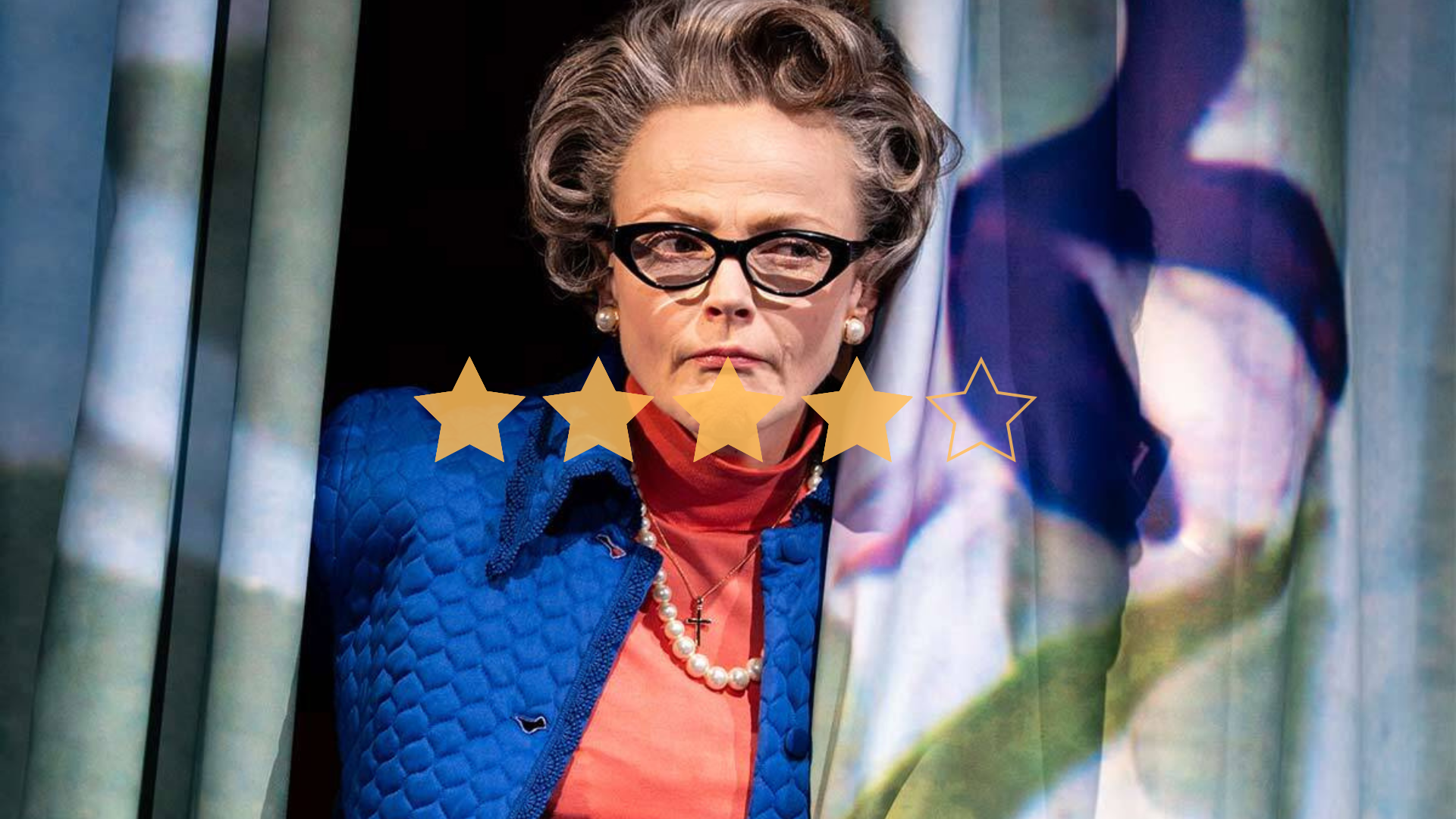
★★★★
One of Nottingham Playhouse’s most compelling outputs for this year is The Last Stand Of Mrs Mary Whitehouse. With a script by Caroline Bird and starring Maxine Peake and Samuel Barnett, the play explores the life and mindset of Mary Whitehouse, an activist and campaigner active from the 1960s to the 1990s. For the uninitiated, Whitehouse was known for her conservative campaigns against mainstream media, particularly issues such as the conclusion of bad language, sex and violence on television. Perhaps more prolifically, in the 1970s she took on nationwide paper Gay News for blasphemous libel in a poem published by the paper. Gay News closed down several years later.
While Whitehouse did good work in some areas—such as the push for the Protection of Children Act 1978, and her concern about the exploitation of women in sexually graphic media—Whitehouse’s other very conservative views, including her extreme homophobia, mean that many people clash on how she is remembered today. Caroline Bird’s script is a masterclass in how to humanise a public figure without glorifying or excusing their actions—it encourages the audience to consider how we define a “good” person, and whether the label of “good” or “bad” can in itself be dangerous in how it allows people to excuse their own actions.
Maxine Peake, in the titular role, handles the entire performance deftly and expertly, but she truly comes into her own when we meet Whitehouse as a young woman, aged twenty-two and about to say goodbye to her mother before leaving for a religious cult. We have seen middle-aged Whitehouse with her stiff upper lip, but to see a younger one, filled with the same drive and anger that many young people will later face her with, shows that Peake can act this multifaceted character as well as Bird can write her. Her performance does not feel like a pantomime or a mockery—and nor should it be, when she is portraying a figure who was dangerous exactly because she was underestimated.
The other powerhouse of the stage here is Samuel Barnett, whose role as named in the programme is, quite simply, ‘everyone else’. For us to fully grasp within this play the impact that Whitehouse had on those around her and how she interacted with the world, there needs to be a world for her to interact with. Barnett plays a multitude of roles—as many as around seventeen if one counts one-liners with a distinct accent—including a roman centurion, a troubled music student, Whitehouse’s mother, Jesus himself and, perhaps most memorably, Margaret Thatcher. There is no sense of deja vu with Barnett—you do not feel as if he is playing a similar character to his previous one just minutes ago. He inhabits each role as if it is a second skin, and the chemistry between each character and Whitehouse is both unique and compelling.
Also to be credited is Helen Keane for her work in wigs, hair and makeup—there are several onstage transitions from an older Mary to a younger one and vice versa, all of which are swift and incredibly natural-looking. Barnett’s transformation into Thatcher is seamless.
The Last Stand Of Mrs Mary Whitehouse is a biographical play that holds its subject accountable and muses on how our lives—and those of others—are altered by either our ability or refusal to change.
The Last Stand Of Mrs Mary Whitehouse will be performed at Nottingham Playhouse until 27 September.
Words by Casey Langton
Support The Indiependent
We’re trying to raise £200 a month to help cover our operational costs. This includes our ‘Writer of the Month’ awards, where we recognise the amazing work produced by our contributor team. If you’ve enjoyed reading our site, we’d really appreciate it if you could donate to The Indiependent. Whether you can give £1 or £10, you’d be making a huge difference to our small team.