
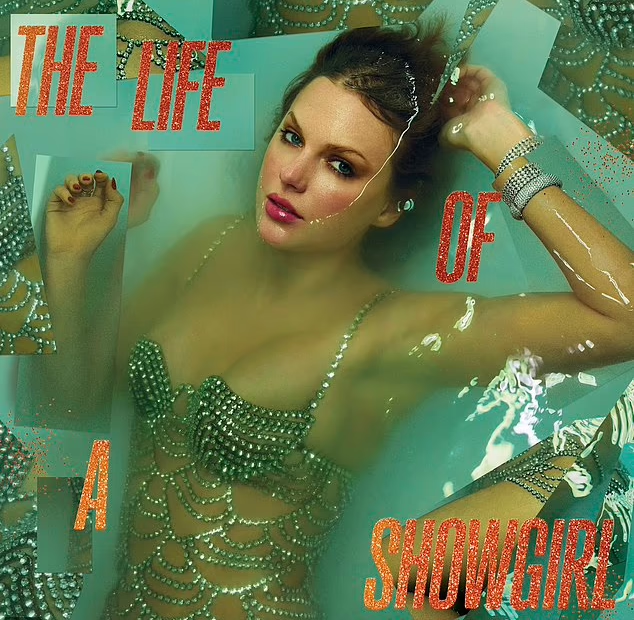
What does a megastar do when she’s already played every part? That’s the question hanging over Taylor Swift’s The Life of a Showgirl, her twelfth album, that not many expected to drop so soon after the conclusion of the mammoth Eras Tour and 2024’s double opus The Tortured Poet’s Department. With five million Spotify pre-saves, expectations were high. This is an album that steps onto the stage in sequins and heels, but is it just the Showgirl Era or does it carry something more beneath the glitter?
Swift knows how to tease and play with expectations. The title, and the pre-release photos, promise cabaret and glamour, yet only the title track finale—a radiant duet with Sabrina Carpenter—leans into that world. The closing track swells with theatrical grandeur: clapping back beat, tinkling piano, and soaring harmonies reminiscent of The Greatest Showman. Yet despite the theatrics the song manages to feel poetic given how the narrative harks back to ‘Clara Bow’ or the ‘Lucky One’. Real-life dialogue from Swift and Carpenter at the New Orleans leg of the Eras Tour, adds a finishing showgirl flourish, a performer bowing as the curtain falls.
The Life of a Showgirl feels like that curtain call: not a reinvention but a reflective encore—a love letter to Swift’s eras; from Midnights’ shimmer, to Lover’s warmth. The album is stitched together with the polish of 1989 and reputation collaborators Max Martin and Shellback. Yet, the record avoids slipping into the obvious electro-pop of either of those two earlier collaborations. One of the album’s unifying threads is a propulsive, almost “marching” drum beat—with faint echoes of the Succession theme—that drives forward the early tracks without ever stealing focus. It’s a metronome of discipline beneath the glitter, particularly evident on the reputation-esque ‘Elizabeth Taylor’. The singer uses the Hollywood icon to parallel her own life; it’s a study in glamour, scrutiny and survival that sets the tone for the album’s portraits of womanhood under the spotlight.
Across The Life of a Showgirl, the dominant theme is love—romantic, familial, physical, and self-reflective. Album opener, ‘The Fate of Ophelia’ bridges the personal and the poetic on a gleeful dance floor romp. With buoyant synths and light airy vocals, Swift describes her gratitude of being spared (presumably, by new fiance, Travis Kelce) the fate of Shakespeare’s doomed heroine—another woman rewritten and reframed beneath the stage lights.
‘Honey’ glows with playful devotion as the singer refers to terms of endearment previously sounding passive aggressive but now “you can call me honey”. The skipping baseline and brushed percussion lift Swift’s breathy vocals into something sugar-sweet but self-aware.
By contrast, ‘Wood’ turns sensual wordplay into groove, with Motown harmonies, R&B-tinged rhythm and innuendo (“redwood tree, it ain’t hard to see”) that make ‘Dress’(reputation) sound demure. On ‘Eldest Daughter’, the expected track five gut-punch, Swift strips everything back to piano and ache. The album’s highlight talks about the challenges of being the eldest child. It’s a promise to protect younger family members but takes on extra romantic meaning with her fiancé, Travis Kelce, being a youngest child.
From family duty to missed opportunity, Swift continues exploring love’s edges in ‘Ruin The Friendship’. This song unfolds as an understated pop ballad built on soft electric guitar and warm synth swells, its melody lifting the poignancy. Swift recounts the regrets of unexplored love while attending the funeral of a childhood friend. “Always ruin the friendship // Better than regret it for all time” is the singer’s advice.
Even amid the affection, Swift’s sharp observations remain intact. ‘Actually Romantic’ hides its bite beneath a steady steel guitar riff and subtle synths, a playful pastiche of modern pop with a pointed jab. Speculation is that the lyrics are a reply to Charli XCX’s ‘Sympathy Is a Knife’, which was in turn speculated to refer to Swift, with lyrics such as “Don’t wanna see her backstage at my boyfriend’s show / Fingers crossed behind my back, I hope they break up quick”. ‘Actually Romantic’ recalls Olivia Rodrigo in its delivery, but its lyrics, “Like a toy chihuahua barking at me from a tiny purse / That’s how much it hurts” are classic Swift. The jaunty vocal delivery shows how easily confidence can brush off negativity.
Similarly, cutting is ‘Father Figure’ which interpolates George Michael’s track in a smooth, brooding retort about powerful mentors preying on young talent: “I was your father figure / You pulled the wrong trigger / his empire belongs to me”.
‘CANCELLED!’ tackles fame and cancel culture head-on. The grungiest sounding track Swift has penned, with its distorted guitars, is a challenge to the culture of public judgement and destruction of heroes, “one single drop and you are off the roster”. It’s also a song about friendship and solidarity: “You know exactly who your friends are / They are the ones with the matching scars”.
If The Tortured Poets Department dissected heartbreak in sepia tones, The Life of a Showgirl glows with love in technicolour. It lacks some of the narrative cohesion of folklore or evermore, and the tight conceptual frame of Midnights, but its looseness feels deliberate—a deep breath after decades of era building. What binds it isn’t story but pulse; it’s a confident, buoyant record, tempered by wit and clever musical switches.
There may be no stadium-sized choruses here, but that’s part of its charm. Still, songs like ‘Opalite’ hold dance-floor sway. The track is a gleaming mid-tempo number pulsing with synth shimmer and self-mythologising confidence, linking back to the album’s fascination with feminine icons, women reborn in the glare of fame.
If this album is indeed the bow before a pause, as the closing track ‘The Life of a Showgirl’ suggests, it’s a graceful one: joyous yet reflective, playful yet grounded. The last track Swift wrote for the record,‘Wi$h Li$t’‘, captures that balance—a sparkling pop number with falsetto vocals that is an ironic meditation on everything success can and can’t buy. “Have a couple kids, got the whole block looking like you / We tell the world to leave us the f— alone, and they do”, dreams Swift. It’s wistful, self-aware, and deeply human—a quiet wish beneath the spotlight’s glare.
Swift doesn’t reinvent herself on The Life of a Showgirl, but in revisiting her musical eras with such clarity—and a fresh overlay—she reminds us why she is the Showgirl and why the stage belongs to her.
Words by Andrew Butcher
Support The Indiependent
We’re trying to raise £200 a month to help cover our operational costs. This includes our ‘Writer of the Month’ awards, where we recognise the amazing work produced by our contributor team. If you’ve enjoyed reading our site, we’d really appreciate it if you could donate to The Indiependent. Whether you can give £1 or £10, you’d be making a huge difference to our small team.