
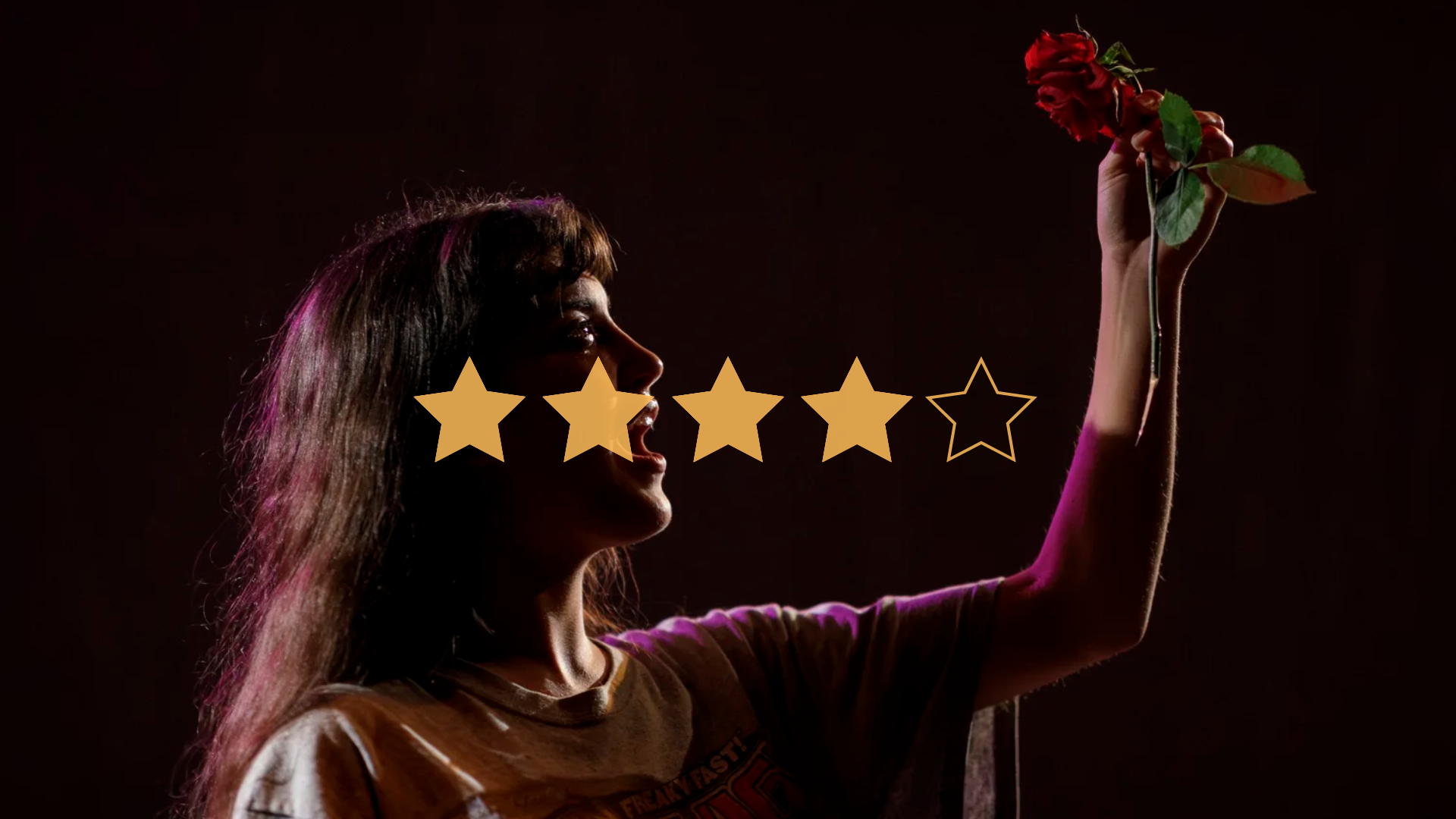
★★★★
Death is a theme used extensively in theatre, but it’s still rare to see it explored through the lens of young love. WILT, a two-hander from writer-director Jazz Summers, follows Nadia and Elliott, a twentysomething couple whose relationship begins to crumble in the
aftermath of Nadia’s father’s abrupt death. Structured around the five stages of grief, the play may not reinvent the wheel conceptually, but it brings a fresh emotional honesty to the subject that’s dextrously done.
For the most part, Summers captures the couple’s affectionate dynamic with intimacy and humour. The chemistry between Nadia and Elliott (India Erlam and Joe Northstone) is clearly strong, and established well—there are some genuinely touching moments, albeit some
cheesiness to the silly games the couple play together that could be ironed out—the “nduja” puns (“I’d ndu-you”) don’t quite land, and some of the playfighting plays out a little off-key, tonally at odds with the naturalism that defines the rest of the piece.
Where WILT finds its footing, though, is in charting the disintegration of that relationship, with Summers sensibly choosing to show the impact of bereavement not just on the person experiencing it directly but everyone in its orbit. As Elliott grows increasingly frustrated with
Nadia’s all-consuming sorrow, her grief stands to jeopardise the good in her life, so she risks not just losing her dad but her partner to boot. When Elliott says “I’m grieving too,” it feels less about her father’s death than the fading of their connection. What’s striking is how
rarely theatre explores this kind of loss from the perspective of young adults, which seems like the reserve of film more often. The death of a parent in one’s twenties—when identity, love, and cohabitation are still taking shape—brings a distinct kind of emotional upheaval which Summers captures with precision. Both Erlam and Northstone handle the material with sensitivity, delivering performances that feel raw, truthful and deeply human. Whether the relationship is repaired in the end is never entirely clear. It’s a wise choice, since either ending works, and love, like grief, resists tidy conclusions.
The script could benefit from more detail as to why it’s just the two of them, when in the aftermath of a death, there are generally a wider circle of family or friends that are noticeably absent here. Some detail is given to explain this but more is necessary to make it gel, especially when Nadia’s grief reaches its zenith, as it’s unlikely the couple would be left in isolation to contend with it. When her emotions reach their breaking point, the scene is elevated by effective use of lighting and sound, which draw us deeper into her spiralling mental state. Still, a stronger sense of what exists beyond the couple’s bubble would give the drama greater realism and emotional scope.
The running time is perfect at 65 minutes—any more and it’d be too overwhelming. Snippets of audio from real-life bereaved people discussing their experience bookend the play, a feature that could come off as mawkish but here it gives the piece some further poignancy.
WILT doesn’t always maintain tonal consistency, but it’s heartfelt, insightful and quietly devastating in its best moments. A promising work from a writer-director unafraid to explore the fault lines between love and loss.
WILT will be performed at Bath Theatre Royal (Ustinov Studio) on 24 and 25 October.
Words by James Morton
Support The Indiependent
We’re trying to raise £200 a month to help cover our operational costs. This includes our ‘Writer of the Month’ awards, where we recognise the amazing work produced by our contributor team. If you’ve enjoyed reading our site, we’d really appreciate it if you could donate to The Indiependent. Whether you can give £1 or £10, you’d be making a huge difference to our small team.