
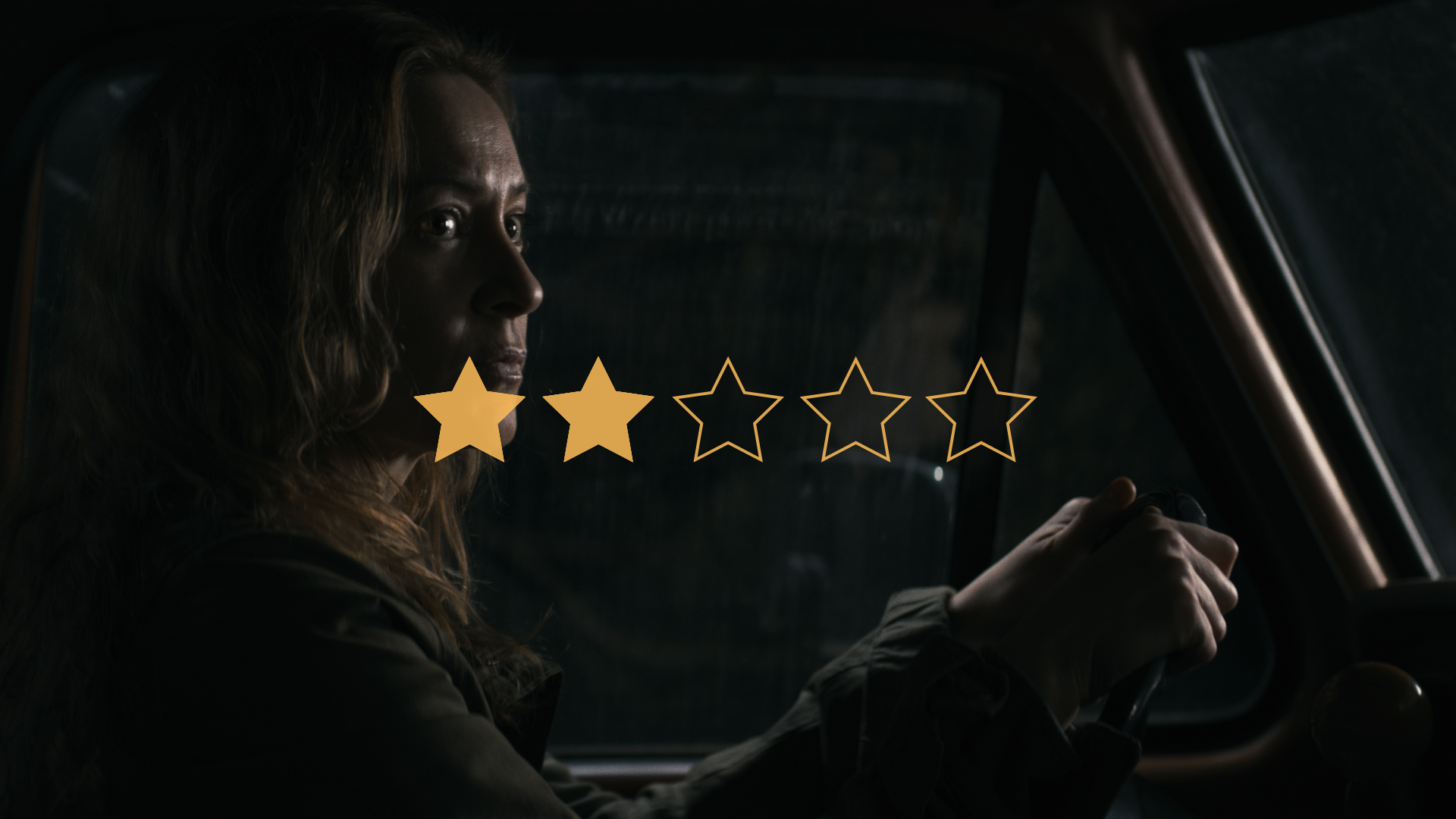
YouTube critic-turned-filmmaker Chris Stuckmann crafts an effective horror in Shelby Oaks with some genuinely terrifying scenes, but suffers from too many ideas in the third act, resulting in a woeful third act and a terrible ending.
★★☆☆☆
A long line of some of the greatest filmmakers we’ve ever had have moved from film criticism to film production: François Truffaut, Peter Bogdanovich, and even Kleber Mendonça Filho, this year’s director of The Secret Agent; all critics who watched films religiously and rightly believed they could do it themselves. Now we have YouTube critic Chris Stuckmann, a pioneer of video film criticism, who has successfully used Kickstarter to fund his feature and create a horror film that heavily draws on its influences, but also showcases Stuckmann as an effective horror filmmaker.
A group of internet ghost hunters called the Paranormal Paranoids goes missing in the abandoned town of Shelby Oaks. While the bodies of the other three members are found, Riley Brennan (Sarah Durn) remains missing. Twelve years later, Riley’s sister Mia (Camille Sullivan) still holds onto hope that her sister will be found. When a man kills himself at her front door, Mia is shocked and terrified, until she sees that he is holding a tape labelled ‘Shelby Oaks’. Keeping it from the police, Mia discovers the tape is the last footage the group filmed in Shelby Oaks, showing the final moments of the others and offering a clue to Riley’s whereabouts. Mia travels alone to the abandoned town, uncovering an evil spirit that has haunted the Brennan family for longer than she realised.
The film plays with various types of footage, using a VCR-style recording to show Riley’s program, mimicking the Blair Witch Project’s found footage style; a 16:9 aspect ratio and a DSLR-style for the YouTube documentary scenes; and a widescreen cinematic camera for the rest of the film. Playing with these different techniques creates an engaging visual style, and it’s great to see that even a filmmaker so immersed in the digital world understands the effectiveness of using analogue items such as cassettes instead of just regular files. There are several fantastic shots and a very clever use of shadows and mist, with the scene in the abandoned prison being the visual highlight of the film. However, there are times when the cinematography does not continue to hit the same heights, and you can tell that this may be due to budget concerns.
The acting on display here leaves a lot to be desired, with lead actor Sullivan giving an unremarkable performance, rarely doing anything spectacular but holding the film together until the end. Durn is not much better, with a strange news-anchor type performance to begin with, and a turn at the end that is meant to be feral but comes across as forced. It was nice, however, to see Keith David rock up for one scene; a cameo king who elevated the singular scene he had.
The story of Shelby Oaks heavily leans on its influences. It gives the impression that you may have seen much of this film before in the horror classics you love, as it shifts from a YouTube documentary about The Black Witch Project to going full Hereditary by the end. The plot is filled with great ideas, but fails to execute any one of them well. This is acceptable in the first two acts, as we are still watching the mystery unfold, but once the mystical elements are truly established and we discover Riley Brennan’s fate, the film completely unravels, becoming a chaotic mix of horror tropes you’ve seen countless times before and conflicting with the slow-burn narrative that had been previously built up.
The Verdict
For a debut, this film features moments of brilliance and confident direction, but it is undermined by a weak script and limited budget. With more funds and a clearer vision of the ending, this could have been one of the best indie horrors of the year.