
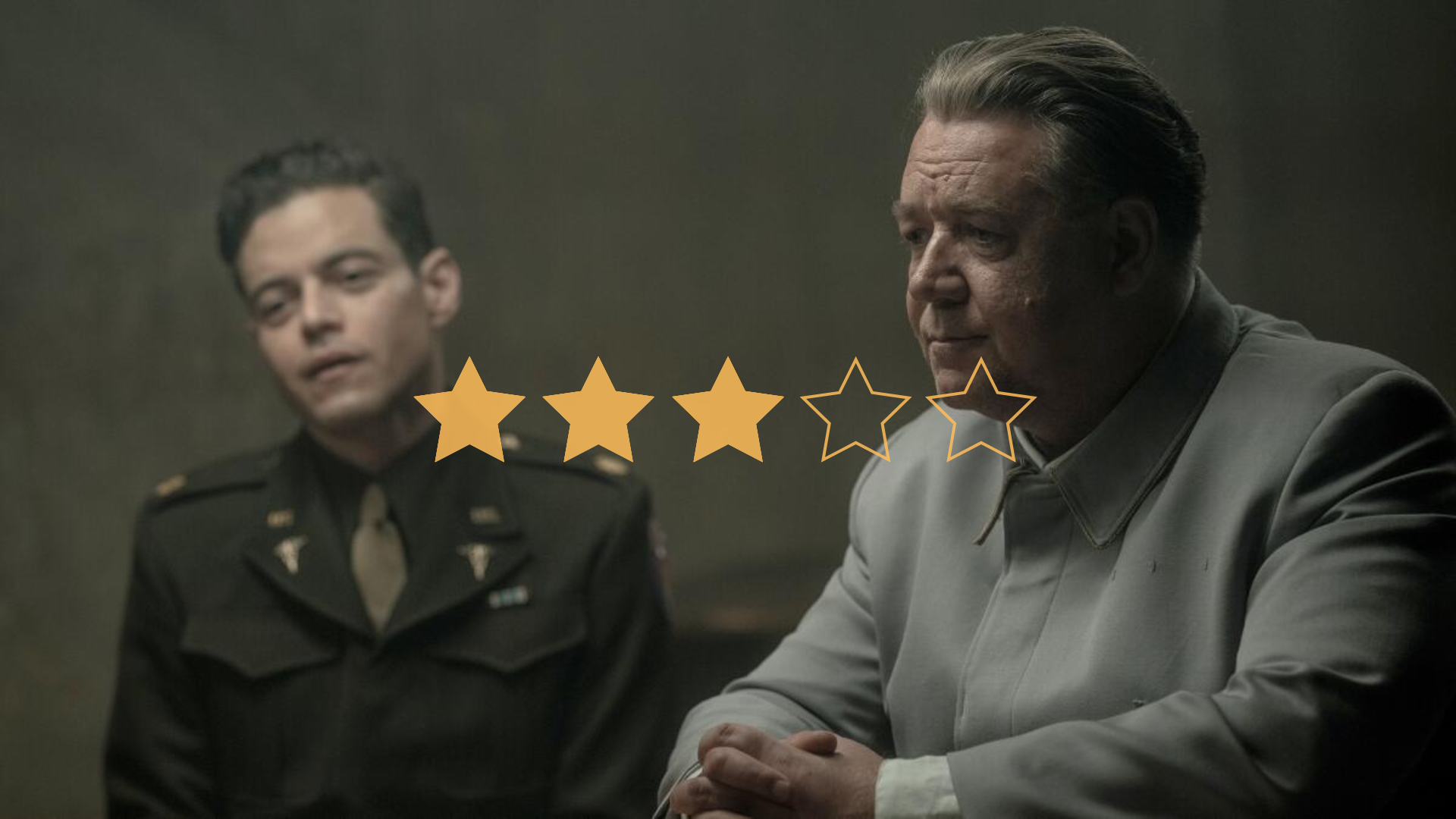
This latest retelling of the Nuremberg trials packs a punch and delivers some memorable performances, but ultimately fails in its delivery.
★★★☆☆
Nuremberg, written and directed by James Vanderbilt, is the latest retelling of the events following the end of the Second World War, when the major world powers confronted the full magnitude of the Nazis’ horrific crimes. Based on the book The Nazi and the Psychiatrist by Jack El-Hai, it looks at the trials from the perspective of army psychiatrist Douglas Kelley, who was brought in to observe and study the defendants—including, most notably, Hitler’s former Number Two and the most senior Nazi still left alive: Hermann Göring.
While previous dramatisations attempted to look at the trials as a whole, or, in the case of Judgement at Nuremberg (1961) retold events using fictional characters, this new version focuses almost entirely on the interactions between Göring (Russell Crowe) and Kelley (Rami Malek), playing out almost as a Silence of the Lambs-esque thriller, as they each attempt to play the other. Over the course of the film, we see Kelley gradually becoming more unsure of himself as he slowly develops a relationship, and even a friendship, with the high-ranking Nazi.
This angle is arguably the biggest strength of the film, yet also the most obvious issue with it. Crowe has already won widespread praise for his performance as Göring. He provides the character with a genuine charm and likeability, and the scenes in which we see his more vulnerable side, or where we meet his seemingly sweet and normal family, help to create a genuine sense of complexity about the character that mirrors Kelley’s own inner conflict.
At the same time, however, the choice to focus almost entirely on this dynamic means that many of the other individuals involved are treated largely as an afterthought. The film perhaps leans too much into trying to present these events as if it were in fact a thriller, with Göring presented as some kind of mastermind who might genuinely walk free, as opposed to it largely just being a question of whether or not he’d get the rope.
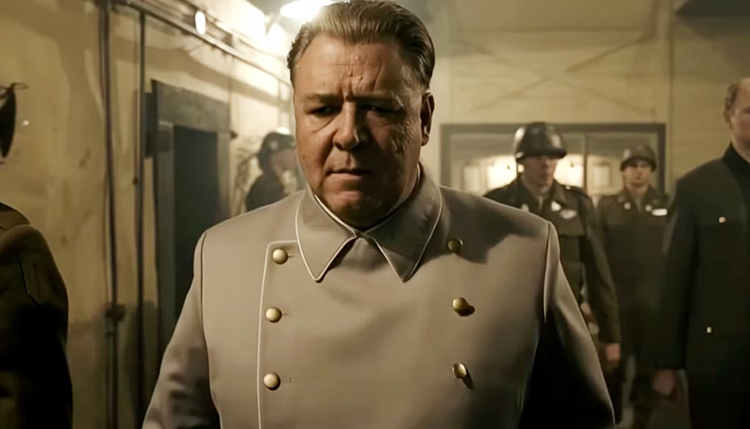
The trial itself actually ends up being condensed to just a couple of scenes that feel highly simplified, to the point where the entire verdict seems to rest on a few brief exchanges; the switch from the prosecution’s apparent defeat to their then winning the day taking place in the space of several minutes, on the basis of just one issue.
Malek’s character, and the insights he gained into Göring’s psychology, are portrayed as far more crucial to the outcome of the case than in reality. There are a number of exchanges that feel quite contrived, and indeed, very Hollywood, as Kelley goes from initial arrogance, to apparent defeat, then to a moment of sudden motivation after the importance of the trial is brought home to him.
Meanwhile, the case is portrayed as one that entirely begins and ends with Göring and his fate. A couple of the other defendant’s, such as Julius Streicher and Rudolf Hess, are depicted, but only briefly, whilst other major defendants such as Rudolf Höss or Albert Speer—the one who arguably did get away with it—are entirely left out of the narrative.
The film is one that is often also prone to moments that feel cliched or predictable: the Jewish army officer who states he will he smoke after the war is done and then finally pulls out a cigarette at the close of the film, or the judge who, for some reason, feels he can only hammer home his point about the evils of the Nazis by taking Kelley in the middle of the night to the site of Hiler’s rallies. These all stand out as scenes where one can practically feel the screenwriter typing away behind them.
The film still has plenty of moments that are undeniably powerful. The cast almost all impress, with particularly memorable turns from Michael Shannon and Richard E Grant as the two chief prosecutors. Like Judgement at Nuremberg, the film also does not hold back from showing actual footage from the concentration camps—footage that remains just as shocking when watched back now. But it’s perhaps precisely because of content like this that other scenes feel that bit more obvious in their artifice. Having to witness heaps of bodies and emaciated prisoners in one scene only makes it stand out all the more when, for much of the rest of the film, we get heavy-handed dialogue that feels like it’s come straight out of a Marvel movie.
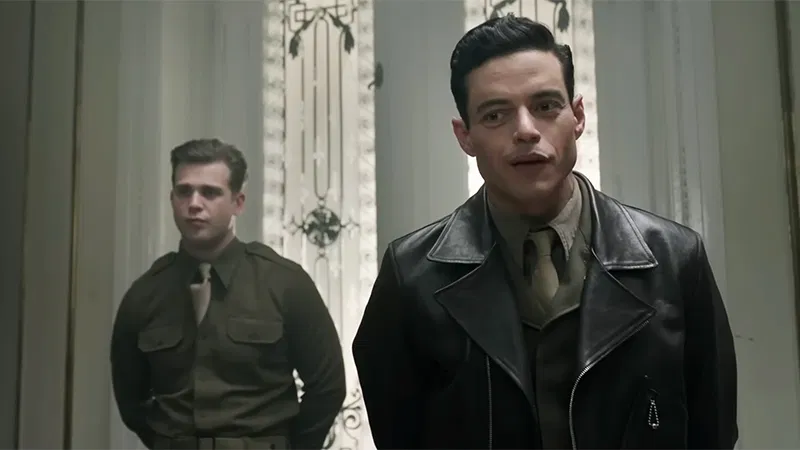
Ultimately, the film is one that feels as if it’s been made on the assumption that its audience are themselves largely ignorant about much of what happened, spelling things out in a way that does not feel natural, and which too often simplifies the actual individuals and events depicted.
The message it ends on—that this can happen again, and that we wouldn’t necessarily recognise it because the perpetrators won’t be wearing the same “scary uniforms”—is an important one that unfortunately feels all too timely, but, as with much of the rest of the film, is something that is just outright stated by the characters in question, rather than something that feels earnt, or is naturally built up to.
The Verdict
James Vanderbilt’s depiction of the Nuremberg trials focuses on a fascinating new side to the events in question, with its more personal focus on the relationship between Kelley and Goring. Crowe in particular deserves praise for what is a brilliant, layered performance. However, the film exaggerates the importance of this dynamic and simplifies much else that took place, with some clumsy dialogue and moments that don’t land as they should.
Words by Daniel Goldstraw
Support The Indiependent
We’re trying to raise £200 a month to help cover our operational costs. This includes our ‘Writer of the Month’ awards, where we recognise the amazing work produced by our contributor team. If you’ve enjoyed reading our site, we’d really appreciate it if you could donate to The Indiependent. Whether you can give £1 or £10, you’d be making a huge difference to our small team.