
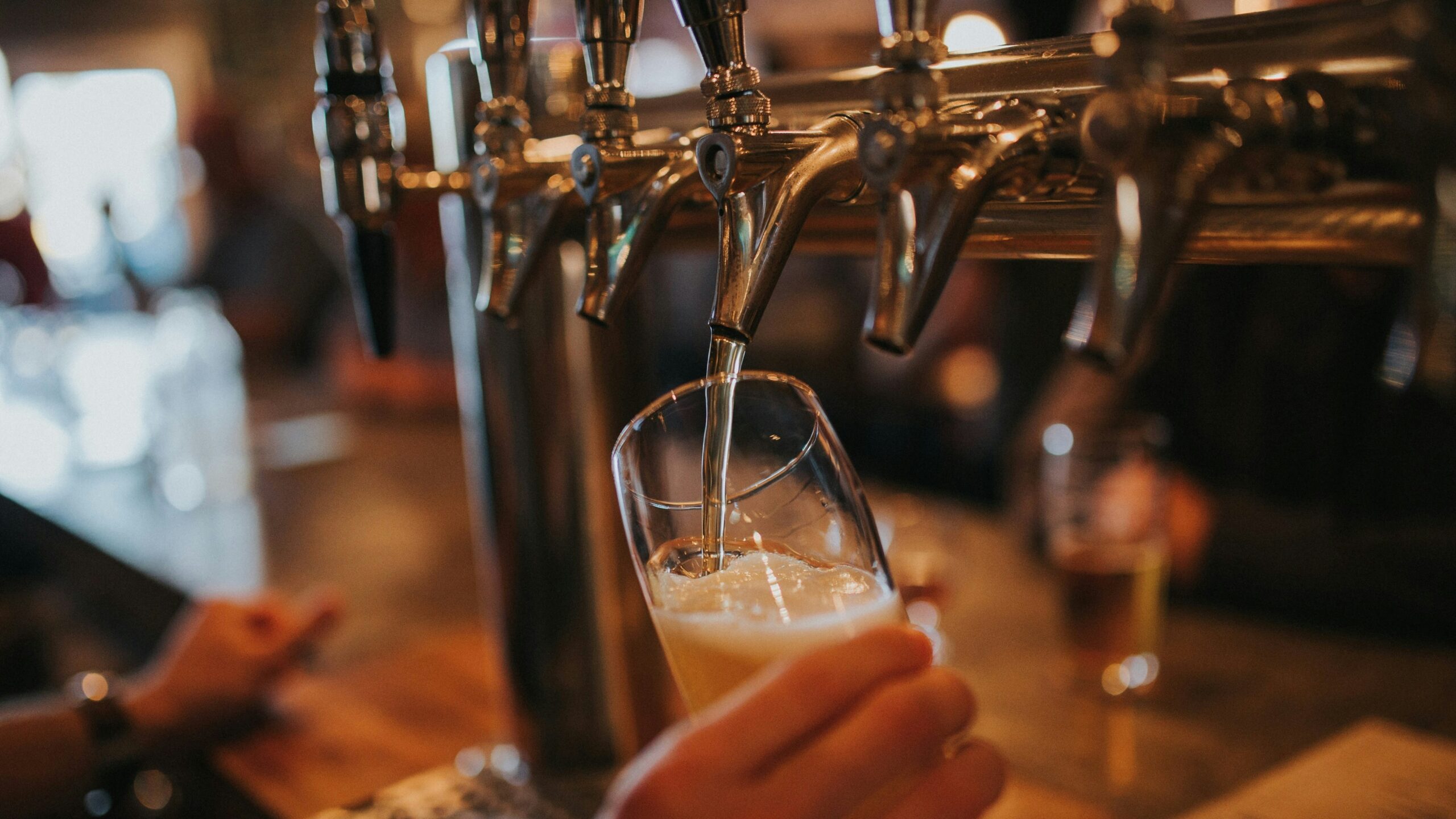
George Orwell affectionately depicts his favourite pub in the 1946 essay ‘The Moon Under Water’. He lovingly details its Victorian architecture, strawberry-pink china cups, barmaids that call everyone ‘dear’ “irrespective of age or sex” and a snack counter that teases mussels, liver-sausage sandwiches and pickles. However, we come to learn that “there is no such place.” Orwell’s fantasy is simply an amalgamation of ideals, fragments of memory and yearning. This pub exists in his dreamstate. Perhaps that’s how many of us think of the contemporary pub too. An emblem of something larger.
For many, the construct of ‘the pub’ sits on a glittering cultural pedestal; hailed as the pinnacle of British community and even British-ness in general. The pub weaves itself into our temporal rhythms. Many live for their weekends, with Friday and Saturday nights reserved for drinking trips. Even wakes and weddings are hosted by our locals. Pubs teeter between both the sacred and the profane, part of the fabric of national identity, a construct that, arguably, hasn’t been successfully replicated in other countries. There is nothing like a British pub. However, beneath this romanticised image lies a slightly more complex reality. Marginalised communities have long been excluded from these spaces, and now we risk losing them entirely.
Amid rising rents, licensing restrictions, and the everpresent cost of living crisis, we see pub and nighttime venue closures at a soaring high, with one pub a day closing permanently in England and Wales in 2025. This isn’t just about the mild annoyance of struggling to find somewhere to buy a pint. We risk the erosion of a vital social infrastructure.
In an age of online echo chambers and algorithms, the need for in-person, real-life social spaces has never been more urgent. Pubs aren’t just about drinking; they serve as microcosms for wider society, reflecting and reproducing social norms. The pub offers something that online communities cannot. Spontaneous conversation, intergenerational connections, and unexpected solidarity. Whether that stems from a game of pool or bumping into a neighbour. Without them, we lose spaces to have free discussion and debate. This jeopardises a true democratic society. If the public don’t have opportunities to casually socialise, society could become even more polarised and divided than we see currently.
However, despite the romanticisation, it is essential to recognise that pubs have never been equally accessible to everyone. Traditionally, boozers have been actualised as male dominant spaces, with women and queer people often discouraged to take part by unwritten rulebooks of who belongs and who doesn’t. Throughout history, working-class women have typically been restricted to domestic spaces, whilst their middle-class counterparts had more freedom to at least host in private. Here, class and gender intersect, restricting women’s access to public leisure. Queer people and other marginalised groups have also long been restricted from these spaces, whether that’s through flags, unwarranted stares or blatant chalked signage. In response, communities have built safe spaces, in the form of gay bars and events. However, these spaces now see the same closures.
More broadly, drinking culture has long been reserved for straight, white cisgender men. If we look to the reams of ‘pints and good chit chat’ TikToks, and the aestheticisation of Guinness and ‘splitting the G’, men are largely at the forefront of these trends. Most importantly, even when men are mocked (such as the pints and good chit chat guy), the comments are far less scathing than content that villainises women for being ‘unladylike’ and solely attempting to appeal to men by taking part. When men drink, it’s about forming male bonds and community. When women drink, it’s shameful or attention-seeking. So when we discuss ‘saving’ the pub, the important question of what this really means arises. Which pub? For who? And what are we really saving?
Whatever the answers to these questions might be, it is true that many of the pubs managing to survive today are those being restructured for a wealthier clientele.The popularisation of the gastropub, with its subsequent £7 (at least) pints price out regulars. The stereotypical local with its beloved sticky carpet, darts league, and karaoke night is vanishing. With it, we’re losing spaces where people could belong without the added pressure of performing status. Ultimately, the decline of pub culture is very real, and it risks further perpetuating a sterile, isolated society. This is about more than the closure of a few local watering holes. This is about the symbol, the communal realities. We need casual, inclusive spaces that offer safe spaces for diverse groups without the pressure of status. Regular local gatherings, reinforcing our sense of community.
As Orwell understood, the perfect pub may never have existed, but the idea of it matters. As we watch more of these spaces disappear, we need to ask what kind of society is being built in their place.
Words by Isobel Slocombe
Support The Indiependent
We’re trying to raise £200 a month to help cover our operational costs. This includes our ‘Writer of the Month’ awards, where we recognise the amazing work produced by our contributor team. If you’ve enjoyed reading our site, we’d really appreciate it if you could donate to The Indiependent. Whether you can give £1 or £10, you’d be making a huge difference to our small team.