
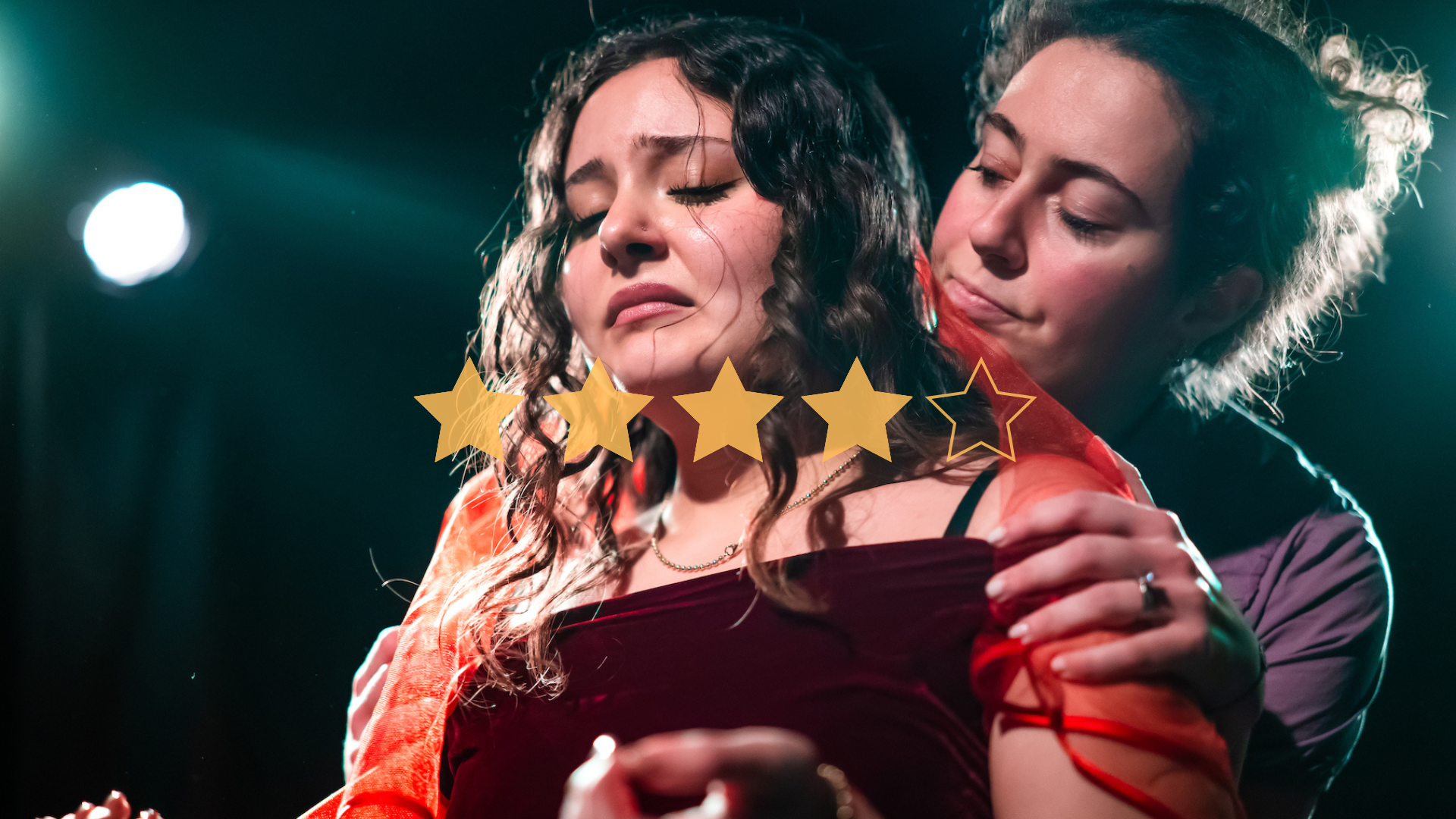
This reimagining of an Ottoman classic comedy about arranged marriages takes intersectional identity as a starting point for humour, pain, and questions. It gives no easy answers, but shows us how to dance while we wonder.
★★★★✰
Producer/actor Duru Ağırbaş and director Erica Rosa Lima bring a lived awareness of diaspora identity to this version of Ibrahim Şinasi’s 1859 The Wedding of a Poet staged at the intimate Canal Café Theatre. While the original centres on a man being tricked into marriage, this nearly all-female production brings the story up to date, and switches focus to the bride. Using Turkish language onstage, breaking the fourth wall to interact with the audience, Gelin takes on generational clashes, cultural customs, and identity politics with a warm-hearted humour that allows for exploration without irritation.
Twenty-nine-year-old Aylin (Güneş Soysal) lives at home with her Turkish mother while she tries to start a business. When the mother sets up a date as a precursor to an arranged marriage, Aylin sends her friend Yaz (Elif Gülalp) in her place, believing Yaz’s ditsy ways will put off the beau and end the arrangement. Yaz and the date, Emre (Pedro Milan Duke), fall for each other, and the deception is maintained through a series of farce-like scenes until the wedding, when all is revealed. A happy ending follows, with Yaz and Emre married for real, and Aylin getting her business off the ground, while her mother comes to understand that times have changed and her daughter cannot be forced through the same conventions she experienced long ago in another country.
The complexity of identity and its maintenance during immigration is a subject prone to provoking strong opinions, even violence, but Gelin’s cast bring a self-deprecating, witty approach that softens the edges of the debate. A young cast performing to a mostly young audience, their attitude is joyful and celebratory of the complex existence of second-generation immigrants navigating portfolio careers, financial insecurity and the London dating scene (crypto and gym bros, prepare to be sent up!). They are also humorous about the convention-driven mores of their older parents. From the beginning, Aylin’s mother is presented as a well-meaning and loving character, involving the audience in a humorous way through set pieces that use the cabaret-style seating first as a party for mothers of prospective husbands, and later as the wedding party itself.
The thorny issue of arranged marriage is navigated with a lightness of touch. The harsher realities of “honour killings” in the UK and the intransigence of nationalism and conservatism would have made for a very different play, and the cast’s positioning does well to avoid the heavy-handedness that could have ensued, without shying too far from the central questions that must be asked. The audience are taken through Aylin’s experience in a way that humanises it, provoking empathy, without didactic lines being drawn between right and wrong. All the same, it is the mother who compromises and changes in the end, while everyone else gets what they want. The mother’s rapid growth from arranging a marriage to saying “Şimdi anladım [now I understand], you’re not me,’ is perhaps a rushed journey, and the role with which the production empathises least. But the mother’s humour is key to her survival, as is the play’s.
Elif Gülalp brings a warmth and fun to her bumbling and eccentric character that makes a sweet and charming Pedro Milan Duke’s smitten acceptance of her fraud believable. Their chemistry carries their scenes and foils Güneş Soysal’s frustrated lead nicely. Indeed, Gülalp’s character’s acceptance of who she is, who she loves, and her own complex (messy) existence carries any meaning the play intends; that it’s going to get difficult, but the best you can do is laugh about, and dance at the wedding.
Gelin is a worthy attempt at a modernisation of the first Ottoman one-act comedy. It knows its subject matter and the cast carry off the script with verve and fun at the forefront.
Words by Dai Murphy
Support The Indiependent
We’re trying to raise £200 a month to help cover our operational costs. This includes our ‘Writer of the Month’ awards, where we recognise the amazing work produced by our contributor team. If you’ve enjoyed reading our site, we’d really appreciate it if you could donate to The Indiependent. Whether you can give £1 or £10, you’d be making a huge difference to our small team