
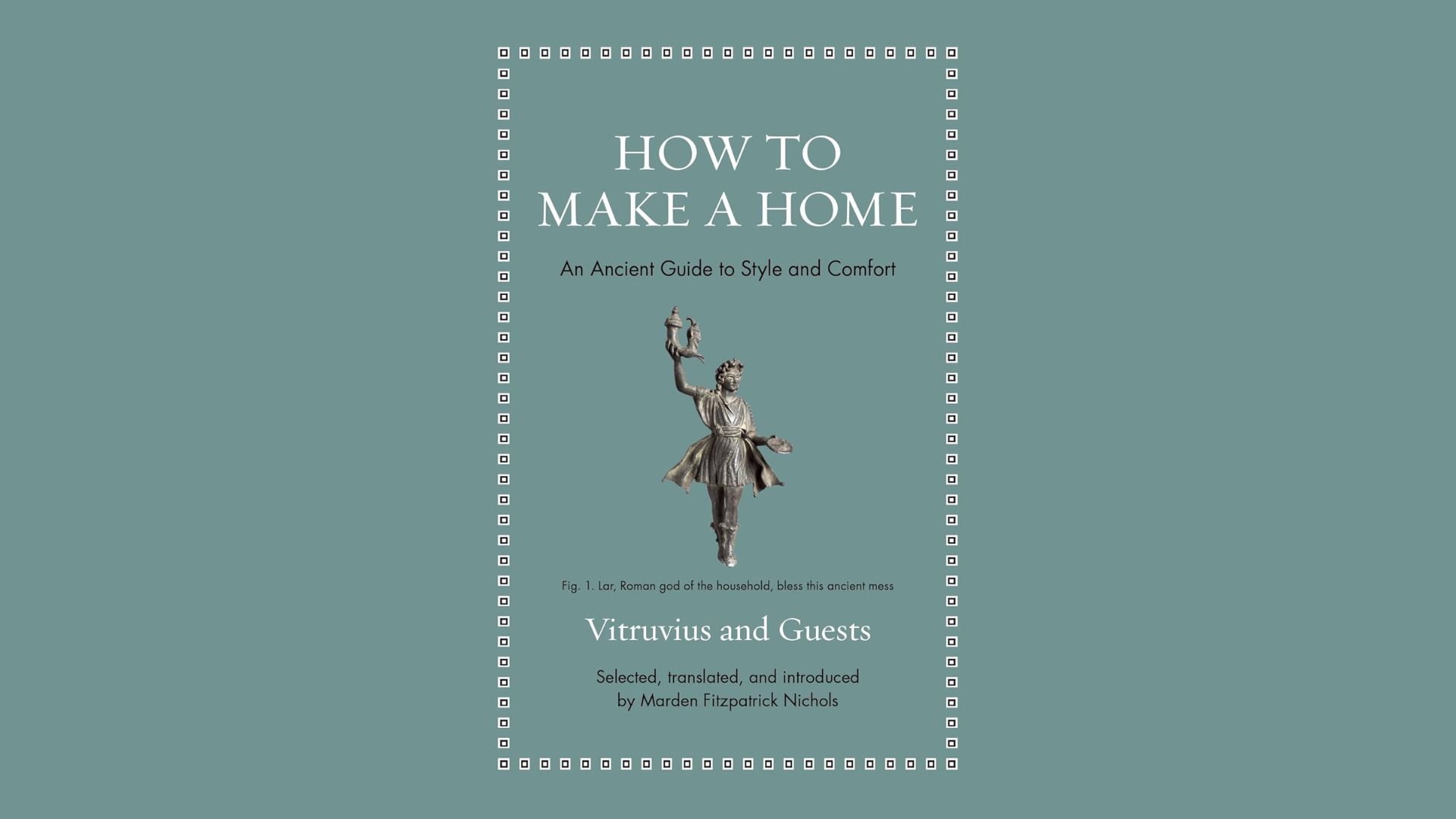
When you think of Roman architecture you might think of the ruins of grand temples battered by the midday sun, or tentative walls in some muddy field that need hefty amounts of imagination to resurrect into something approaching a building. But regardless of the what you imagine, there will be some sense of style, unlike the image of a rustic iron age roundhouse for instance. As such it is apt that How to Make a Home is a handsome little book in a tasteful shade of grey with a bronze figure of a household god on the cover. I could easily see it slipped with a sense of faux carelessness into the pocket of a designer’s chore coat.
Speaking of designers, it seems now that you can’t go more than a few minutes when watching any design program without mention of ‘flow’. And whilst this is, quite rightly, much criticised as an overused catch-all term used lazily by those adverse to nuance and detail, How to Make a Home shows that Romans did care about something akin to ‘flow’. Roman homes were designed not for building codes or planning restrictions, but for clear sight lines that would stretch in town houses from the door through the atrium to the tablinum and onward to the airy peristylium at the back.
Now Vitruvius and Cicero would never use a word like ‘flow’ (after all Cicero would never let a verb, even one masquerading as a noun, appear too early in a dense and verbless twenty-minute-long sentence) but these were homes consciously built to a plan that was focused on how an external viewer would progress through it. For city town houses this would stretch from the busy street, perhaps through a door kept open with attendant doormen for the very rich, into the public atrium and business focused tablinum, with view of the more relaxed garden beyond. Country villas with that odd blend of rural agrarian simplicity and remote pleasurable luxury were somewhat different, but How to Make a Home makes clear the same sense of how a house would be viewed by guests governs the layout.
It is not all positivity with moralisers then and now insisting homes should be utilitarian, with perhaps the odd nod to comfort, even as many use their homes to reflect their wealth and status. I think Romans would have loved a glossy magazine insert in a Saturday or Sunday paper, replete with every so tastefully redone Tuscan villas or surprisingly spacious Kensington terraces, with that strong whisper that you too could have all this if only you put the work in.
However, for all the mention of the perils of trying to be too flash, with vermillion paint quickly fading to black as it reacts with light, and villas built unwisely out into the sea, that seems ever so pertinent now, it would be wrong to project modern ideas onto these buildings.
We, for all our prurient desire to see into the houses of politicians or celebrities, value privacy and would baulk at the idea of a home as an intrinsically public space in which business happens, and that’s even with modern work-from-home tendencies. Yet for a Roman family, (or more accurate familiae as the English word is quite different in connotations, and perhaps for our meaning domus would be better) as it would have included a range of relatives, associated business partners/clients, and multiple enslaved people, there would have been a very different understanding of private space.
Of course, this is partially down to the focus of the book. This is a book about making a home based on townhouses and villas, not based on those shivering homeless in the meagre shelter of an aqueduct or crammed into an overly small room on the eighth floor of a shoddily built block of flats (as you can see much hasn’t changed in the last few thousand years).
Yet, that is in not something to criticise the book for, as it is quite open about the limitations of its focus, and to be honest, most of us now live in houses that would have amazed most Romans, with running water, lights that work at the flick of a switch and the ubiquity of mass produced, cheap, household goods.
I rather doubt anyone is reading How to Make a Home for tips about their villa, instead it is an entertaining review of a specific range of Roman homes, that can give inspiration to us, but not direct advice. Though it was rather apt to have read chapter 13 on the issues of work being overbudget etc as I waited for a friend who turned up and launched into a litany of complaints over his new kitchen, now in the seventh week of the original two-week estimate. Some things never change.
By ending on a consummate villa (Pliny the Younger’s Laurentian beach pad) the book, having neatly gone through the development, trials and tribulations that such houses could pose, gives a sense of how such houses could work at when they were at their best. It is rather telling that for all the talk the Romans have about valuing the simple life (think of Cincinnatus the famed farmer-solider) they developed and really took to these extravagant houses carefully crafted for their owner’s pleasure. And this was no short-term fashion, from Scipio’s Campanian villa in the 2nd century BC to Chedworth villa in Britian which appears to have been redeveloped with mosaics into the 5th century AD, after the Romans officially pulled out of Britian.
Perhaps it reflects something deeper in the Roman, and I would hazard human, psyche. The Latin word for ‘pleasure’, the sort of thing a villa might be for, is ‘otium’. In contrast ‘business’ is ‘negotium’, which comes from ‘nec otium’ (not pleasure). People will always strive to make their living space, be it a house, a flat, etc., into a home—that is a place of otium, a place designed for them.
Words by Ed Bedford
Want more Books content from The Indiependent? Click here
Support The Indiependent
We’re trying to raise £200 a month to help cover our operational costs. This includes our ‘Writer of the Month’ awards, where we recognise the amazing work produced by our contributor team. If you’ve enjoyed reading our site, we’d really appreciate it if you could donate to The Indiependent. Whether you can give £1 or £10, you’d be making a huge difference to our small team.