
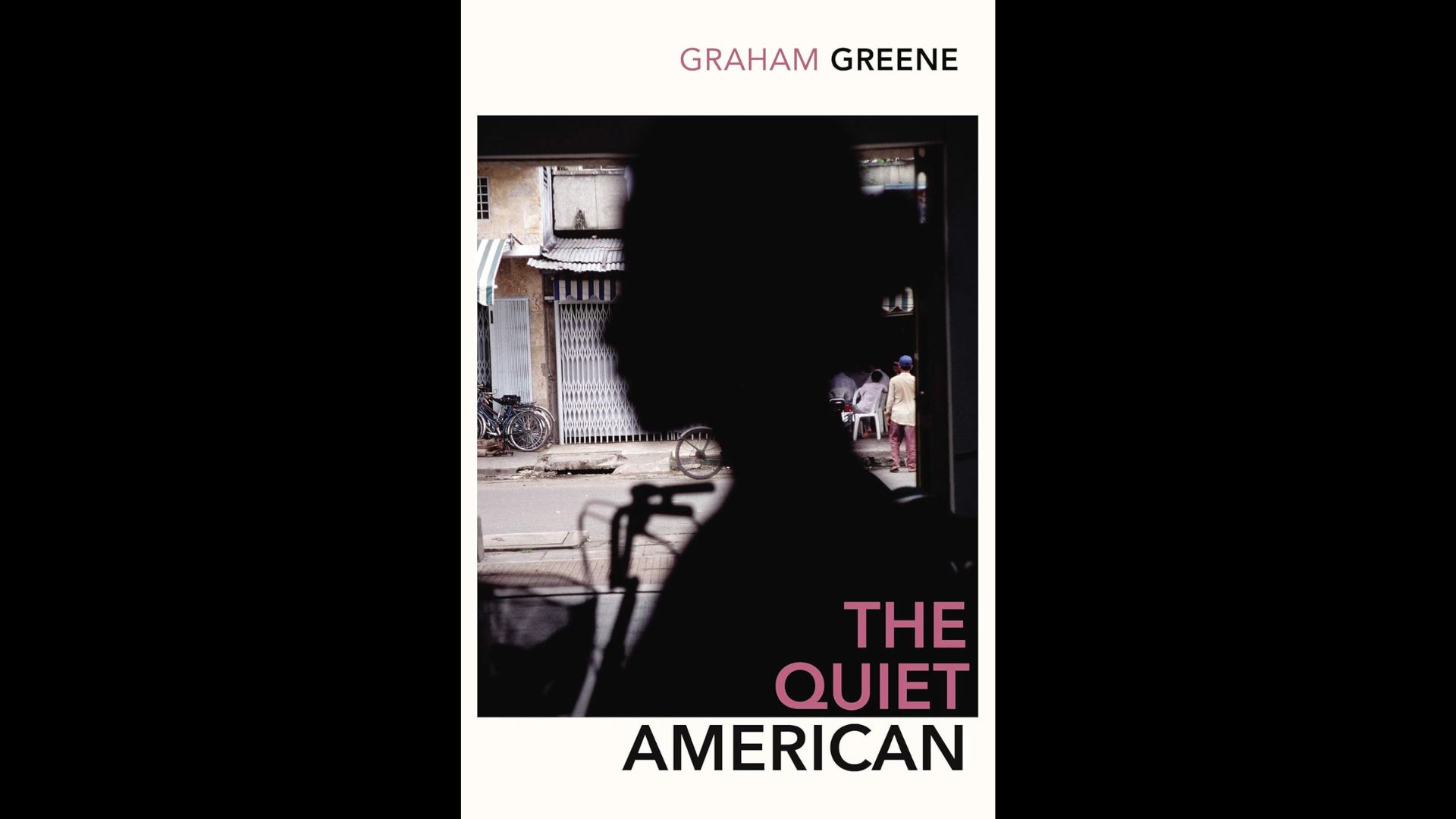
“God save us always from the innocent and the good”: The Quiet American and US foreign policy.
Graham Greene’s 1955 classic The Quiet American warns against naivety and an unwavering ideological commitment to a so-called ‘greater good’ in foreign policy, and continues to ring true today. Included in the BBC’s 2019 list of 100 Novels That Shaped Our World in the ‘Crime & Conflict’ section, the book is narrated by veteran British journalist Thomas Fowler (who prefers to go by his surname) and his dealings with young, fresh-faced CIA agent Alden Pyle (whom Fowler refuses to call Alden) in 1950s Vietnam during the First Indochina War, as French colonial forces fight to maintain control of the country.
It’s hard to ignore the uncomfortable and archaic exoticism in Greene’s presentation of love interest Phuong. Argued over like a disputed territory by Fowler and Pyle, she takes a passive role in the book and is most loved by Fowler for her ability to make up opium pipes and cups of tea. She is, for the fifty-something year old journalist, “the hiss of steam, the clink of a cup…a certain hour of the night”, an escape from his wife back in England who refuses to grant him a divorce on religious grounds. The love triangle exists as a clear parallel to the geopolitical setting of the novel: Fowler as an old colonial force, weak and impotent in age but a realist, Pyle as the young and idealistic upcoming power, and Phuong as a passive subject of debate, simply seeking stability. Despite this, it’s hard to read through deeply uncomfortable scenes such as Fowler’s fond recollection of the moment he fell in love with 18 year old Phuong at first sight, even if they do contribute to the geopolitical parallel.
But disconcerting age differences aside, the most intriguing conflict in the novel comes in the clash between Fowler’s cynical realism and Pyle’s naive goals as a clandestine agent. Fresh from Harvard University, Pyle is infatuated with developing the theoretical ‘Third Force’ in Vietnam, a democratic middle ground between colonialism and communism conceived by fictional author York Harding, who only visited Vietnam in passing and failed to develop a real understanding of the region. In the name of Third Force democracy, Pyle distributes plastic explosives to insurgent General Thé which are then used in a terrorist attack on a high street in Saigon, killing and injuring many. Greene provides a biting commentary on the civilian casualties accepted as collateral damage in interventionist American foreign policy, a criticism that has proved itself accurate time after time.
Unwavering Western support for Israeli military action in Gaza, the West Bank, and Iran regardless of the rising death toll of innocent civilians comes to mind. UK and US arms deals with Israel continue to provide the state with weaponry and technology that are subsequently used against civilians and on residential areas. An estimated 80% of Palestinians killed in Gaza are innocent civilians and at least 380 Iranian civilians (with 319 undetermined also dead) were killed in the 12 day conflict, all with the supposed aim of combatting Islamic fundamentalism in the Middle East.
To poach from Slavoj Žižek’s Welcome to the Desert of the Real, is military action that ignores UN resolutions, international law, and human rights not a form of fundamentalism itself? Writing in the midst of the ‘War on Terror’, Žižek identifies the irony of an ideology that claims to be anti-fundamentalism whilst utilising Guantánamo Bay prison to torture and illegally detain terrorism suspects. Pyle’s unquestioning commitment to the Third Force sees Vietnamese civilians massacred and military targets missed in a terrorist attack of CIA construction, in an attempt to implement Western values in the country. The Third Force, like the War on Terror, becomes a fundamentalist doctrine itself.
Like Pyle, the US is “impregnably armored by [its] good intentions and [its] ignorance”. Indeed, Texan senator Ted Cruz failed to answer questions regarding the population and ethnic makeup of Iran, days after calling for the Iranian regime to be toppled, highlighting a clear lack of knowledge and understanding of the state he seeks to destabilise in true York Harding ‘Third Force’ fashion. Whether it’s Trump’s 2,000lb bombs or Pyle’s plastic explosives, the US repeatedly wades into foreign interventions in the name of Western, capitalist, liberal democracy at the cost of innocent lives. Instead of choosing teams like a football match, is it possible to step back and recognise the fundamentalist attitudes on both sides?
Greene’s novel anticipated US involvement in Vietnam and identifies the American exceptionalist attitude that continues to drive foreign policy, whether it be in Iraq 2003 or Iran 2025.
Words by Arthur Clinton
Want more Books content from The Indiependent? Click here
Support The Indiependent
We’re trying to raise £200 a month to help cover our operational costs. This includes our ‘Writer of the Month’ awards, where we recognise the amazing work produced by our contributor team. If you’ve enjoyed reading our site, we’d really appreciate it if you could donate to The Indiependent. Whether you can give £1 or £10, you’d be making a huge difference to our small team.