
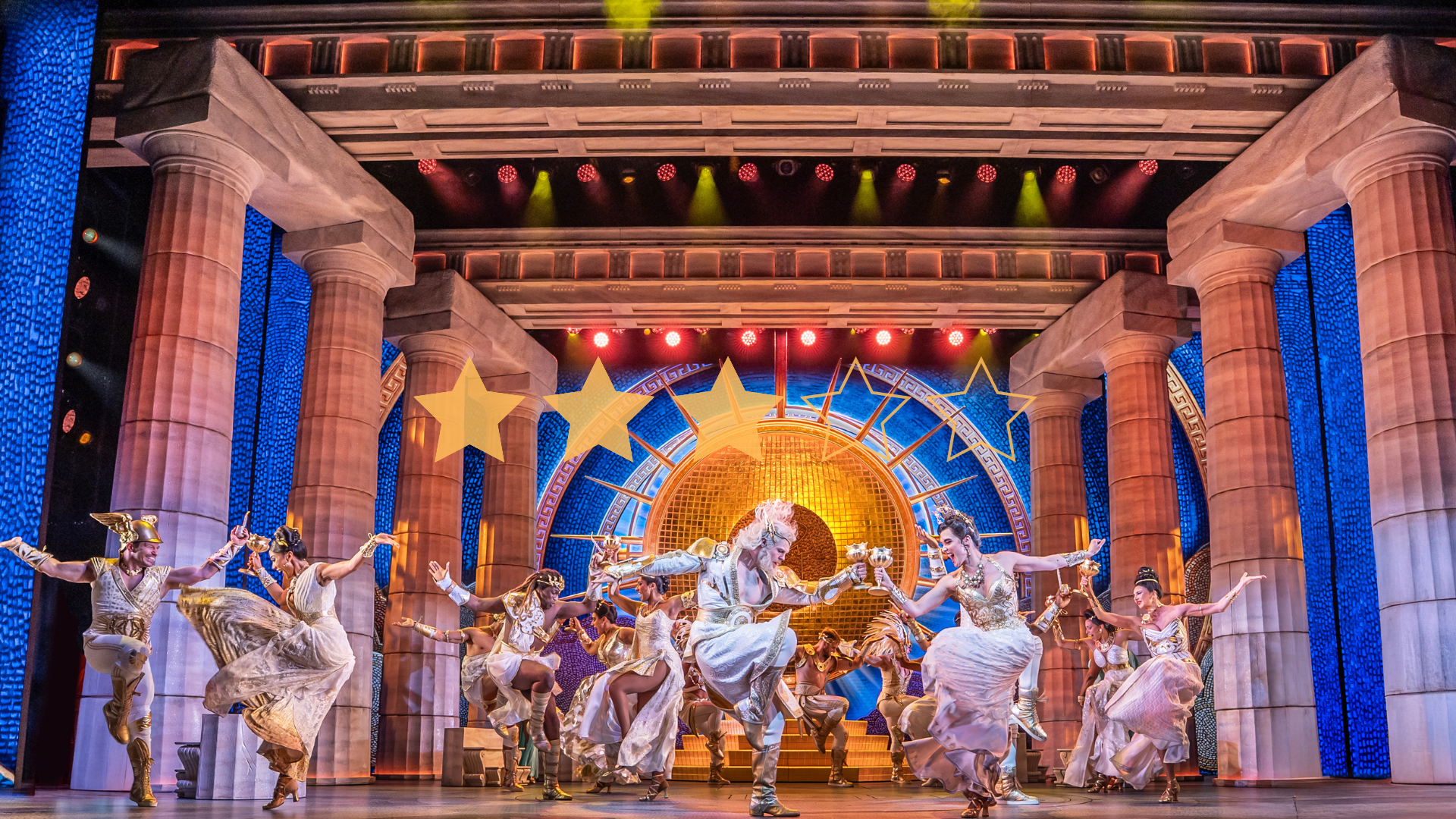
★★★☆☆
The West End’s latest musical, Disney’s Hercules, leaps from screen to stage with vibrant spectacle and nostalgia. Yet, its success hinges on your affection for the original film. This production dazzles in moments but is fundamentally weakened by cuts and substitutions that undermine its mythic impact—a clear reminder that spectacle alone cannot compensate for weakened storytelling.
The show very much follows the basic premise of the 1997 animated film: a baby born to the gods Zeus and Hera is stolen away, raised on Earth, and grows into a demigod determined to prove himself worthy of true heroism. What unfolds is the same modern spin on Ancient Greece that made the film a cult favourite, only now told with live spectacle, booming choruses, and shimmering light.
There are many triumphs and miracles on stage. With Alan Menken and David Zippel returning to orchestrate the music from the animated classic, the score is a faithful yet invigorated translation. Beloved numbers like ‘Go the Distance’ and ‘I Won’t Say I’m in Love’ land with the same rousing power, while the Gospel-inspired Muses remain a highlight. Candace Furbert (Thalia), Sharlene Hector (Clio), Brianna Ogunbawo (Melpomene), Malinda Parris (Calliope), and Robyn Rose-Li (Terpsichore) command the stage with wit, vocal firepower, and plenty of divine sass.
Another joy is in its set design and effects department. It’s no easy task to emulate the vibrant iconography of an animated movie on stage, but this production bristles with life thanks to an extraordinary creative team. Jeremy Chernick’s special effects, Gregg Barnes and Sky Switser’s costumes, and Jeff Croiter’s lighting design together conjure some genuinely wondrous moments. During ‘Go the Distance,’ the stage pillars themselves seem to move in choreographic harmony with Hercules’ journey. Zeus and Hera appear as living statues, bathed in shifting projections that feel divine in scale. Monster puppetry lends heft to the battles, and the costume design seamlessly blends ancient silhouettes with a West End glow.
The principal cast delivers strong performances across the board. Hercules (Luke Brady) and Meg (Mae Ann Jorolan) are well realised, their chemistry carrying the story’s heart. Musical theatre treasure, Trevor Dion Nicholas, steals the show as Phil, Hercules’ cantankerous trainer. Ironically, swapping his former role as Hades in Hadestown (from earlier this year) for one of Disney’s most lovable curmudgeons. Meanwhile, Stephen Carlile makes an excellent Hades here, revelling in the villain’s sly charm and sardonic wit.
Despite its visual splendour, the production suffers from storytelling issues that stem from rushed pacing and abridged sequences. These changes not only risk confusing newcomers and disappointing fans, but also represent the production’s central failing: glossing over key moments and undermining narrative depth for quick spectacle.
The cuts sting. Beloved sidekicks Pain and Panic have been replaced with two entirely new characters, Bob and Charles, who are inherently fine but hardly memorable. Pegasus, Hercules’ loyal winged horse, is grounded, and the fearsome Titans are nowhere to be seen, despite the budget stretching to other monsters like the Hydra. It was an ongoing discussion among many attendants during the interval and after the show.
On stage, that moral tension is significantly blunted. Hercules’ rise to fame plays more like a string of triumphs and set pieces than a meaningful confrontation with what it actually means to be heroic. The production celebrates his strength and victories, but never properly interrogates whether those things alone make him worthy of Olympus. As a result, the character’s growth feels incomplete, and the show misses the beating heart of the myth.
One omission is particularly telling: Hades never robs Hercules of his strength. In the film, this is a turning point. Powerless and vulnerable, Hercules faces danger without the safety net of his godlike abilities. In that moment, he demonstrates that his worth lies not in his lineage or his muscles, but in his inner resolve. By erasing it, the stage version robs the story of its emotional crescendo, the scene that proves Hercules is truly more than his parentage.
This omission exposes the show’s main weakness: a reluctance to probe deeper into themes beneath the surface. The conflict between “celebrity and true worth” resonates strongly in our times, but the production misses the chance to make Hercules’ journey speak to today’s audience in a meaningful way, settling for spectacle at the expense of substance.
Without that central thread, the show dazzles with gods, monsters, and light projections, but it stumbles on the very thing that made the animated film linger in the memory: a story that champions the quiet, stubborn strength of the human spirit over the glitz of glory.
In its best moments, Hercules is pure theatrical delight: vibrant, funny, and brimming with spectacle. The sets dazzle, and the music carries the heart of the beloved film onto the West End stage. Yet for all its divine flourishes, the production undercuts itself by side-lining characters and story beats that gave the original its mythic resonance. Perhaps a bolder reimagining could have elevated this from a fun tribute to a truly heroic retelling.
As it stands, Hercules is an entertaining evening that shines brightest for those willing to bask in nostalgia. But like its demigod protagonist, it hasn’t quite reached Olympus.
Hercules is currently showing at the Royal Drury Lane Theatre on the West End.
Words by Joseph Jenkinson
Support The Indiependent
We’re trying to raise £200 a month to help cover our operational costs. This includes our ‘Writer of the Month’ awards, where we recognise the amazing work produced by our contributor team. If you’ve enjoyed reading our site, we’d really appreciate it if you could donate to The Indiependent. Whether you can give £1 or £10, you’d be making a huge difference to our small team.