
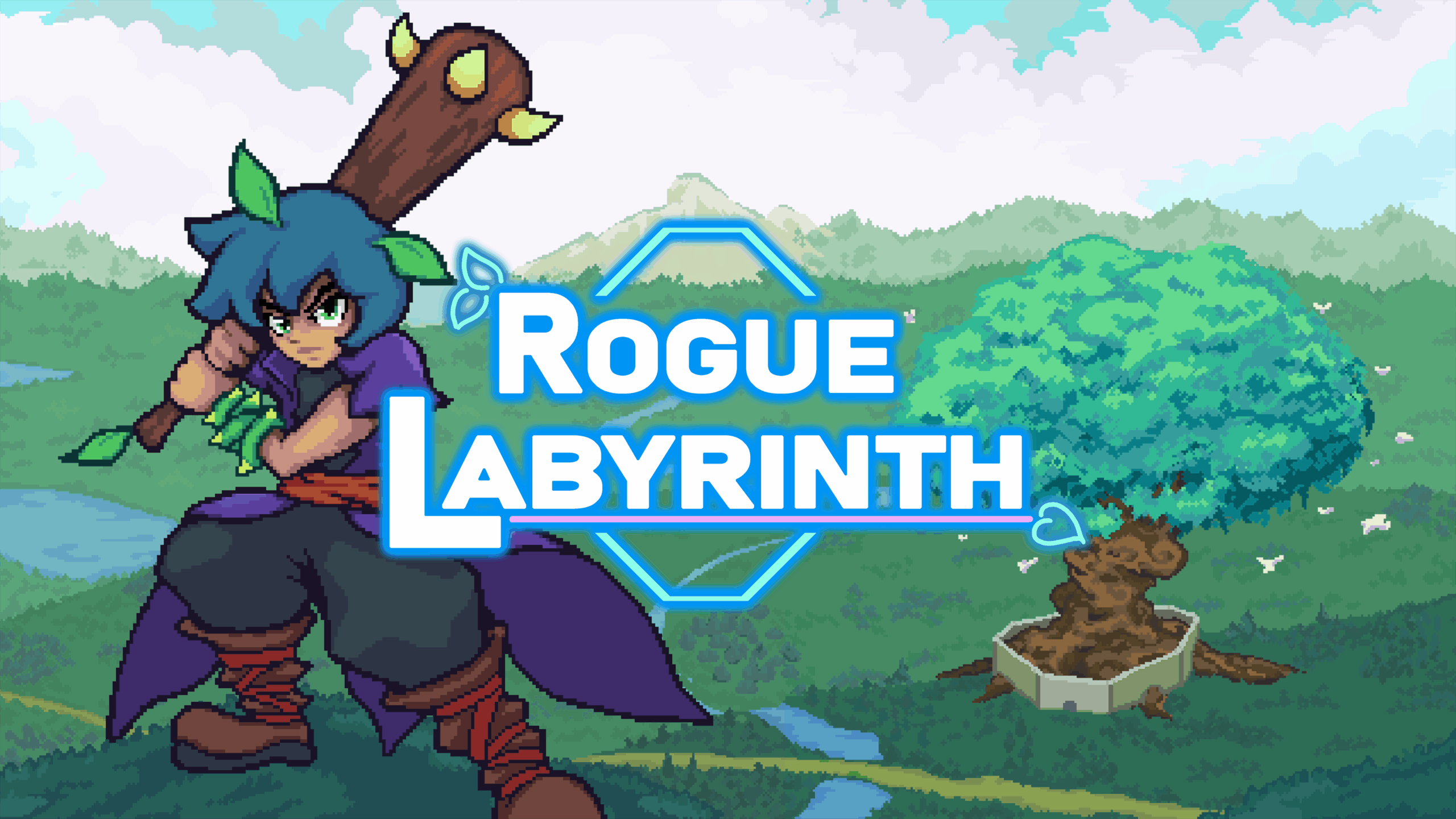
What happens when a billionaire builds a colosseum at the roots of the world’s largest tree—and the only way out is through applause and annihilation? In an era of flashy roguelites and endless runs, few games turn chaos into pure showmanship quite like Rogue Labyrinth. Developed by Seattle-based indie studio Tea Witch Games, Rogue Labyrinth throws players into a relentless, monster-crammed labyrinth where combat drives every moment and the crowd never blinks.
Contestants fight through a colosseum built by an egocentric billionaire at the base of the Great Tree, climbing the ranks for glory, survival, and a taste of fame. Each run reimagines the challenge with shifting arenas, ricocheting projectiles, and hundreds of abilities to experiment with—all while juggling rivalries, fan hype, and benefactor boons, making every climb through the ranks feel fresh and unpredictable.
At The Indiependent, we sat down with designer and programmer John and writer Shala of Tea Witch Games to unpack the making of Rogue Labyrinth. From early inspirations to inventive projectile-based combat and community-driven development, the duo shared the challenges, breakthroughs, and lessons behind years of self-funded creation—and what lies ahead for their ambitious roguelite.
What first inspired the idea of merging a roguelite with reality-TV spectacle, and what convinced you this unconventional mix could actually work?
John: The initial discussions around the game were about finding a narrative reason for an “event” that could justify a roguelike structure—something that could be done over and over with slight variations. Making it a game show just made sense. We imagined it as a kind of rich person’s spectacle that’s broadcast to the public, and from there, everything else fell into place: the people running the game provide permanent boosts and influence randomization; the cooler you are and the better you perform, the more prizes you earn; and, of course, the idea that some rich guy making fun of you you on TV is considered both cool and normal.
Conceptually, it all sounds clever—but how did that translate into gameplay mechanics without feeling gimmicky? Did the system ever produce outcomes that even surprised you?
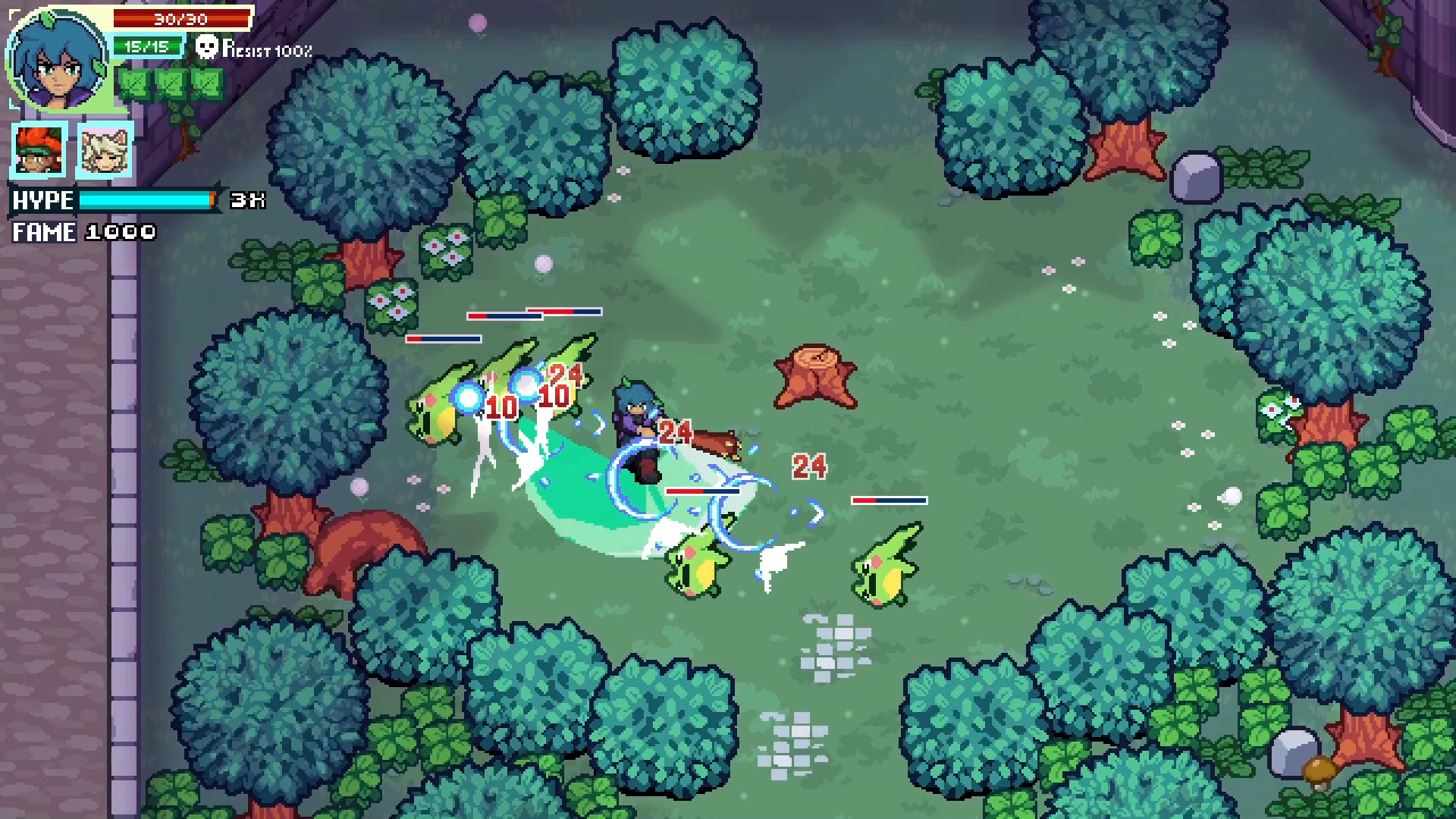
John: In general, players seem to understand that the better you perform, the more ‘Fame’ you earn—and with that comes more prizes. There are so many ways to gain ‘Fame’ that it might’ve ended up a bit too complex. There are really specific thing, like if you almost get hit by an enemy, you receive a ‘Hype’ boost that increases your ‘Fame’ potential when you pull off cool moves. But if you keep using the same attacks repeatedly, it works like a style combo system—your ‘Hype’ doesn’t rise as much, so even if you play well, you earn less ‘Fame’ for being repetitive and boring.
These ideas made sense programmatically, but I figured most players just play the way they want to—and honestly, we wanted that to be viable, too. Skilled Rogue Labyrinth players always tend to earn great ‘Fame’ scores whether or not they focus on ‘Hype’ and ‘Fame’. Overall, when designing any feature, we wanted Rogue Labyrinth to be approachable enough that ignoring systems wouldn’t hurt the experience—but for those who do pay attention, it adds satisfying short-term goals and the thrill of a cheering audience.
Beyond the mechanics, Rogue Labyrinth’s world feels layered and alive. How did you approach narrative design and worldbuilding that stay immersive across multiple runs?
Shala: I’ll be honest—writing a storyline for a roguelite was very difficult. It required a lot of spreadsheets and organization to make it work. The main plot is linear, but not everyone’s experience is—if that makes sense. I had to accept that every player would ultimately have their own version of the story. There’s the player who skips most of the dialogue, the one who reads everything, and the one who reads some of it. It’s exciting but also a little scary. You have to ask yourself, “How can I give every type of player the best experience for them?”
I had to acknowledge that not everyone would find or even care about every piece of dialogue. Still, I wrote a lot—over 4,000 lines—including silly in-world radio commercials as diegetic exposition for players who might find them funny. The main linear dialogue covers everything you encounter during the Intro, Rank Up, Zinnia, Narenga, Garjan Rival, and End Game cutscenes. The storyline still makes sense even if you only experience the core campaign and don’t meet every rival, but it’s much more fun when you talk to people in the Lobby and learn about the main NPCs through Meal Tickets—one-on-one meals that let you get to know characters better, inspired by the dining hall conversations in Fire Emblem: Three Houses.
Conversations were sorted into two types: evergreen ones that could appear at any point in the game and didn’t require prior story knowledge, and flagged ones that only triggered after reaching certain milestones, like specific ranks or meeting Zinnia, etc.
Since John (Director) handled programming and most of the art, we’d discuss what was possible for cutscenes, factoring in Construct’s limitations and our scope. We tried our best to make them feel dynamic while reusing assets in ways that wouldn’t feel jarring to players. As a small development team, we had to be efficient with our time, and I needed to be a good partner to John in finding creative ways to reuse assets so he didn’t have to redraw or reprogram too much.
However, a hard lesson came early on when a streamer played a very early demo of the game a couple of years back. As the writer, I’d packed a lot of dialogue at the beginning to explain the nuances, and it overwhelmed them. They got so frustrated that they skipped all dialogue for the rest of the stream. It taught me that I needed to get better about editing, especially for a fast-paced roguelite game. I’m glad I learned that lesson early, and John helped hold me accountable so I didn’t derail.
John’s a “plotter,” and I’m a “pantser,” if you’re familiar with those terms. He’s incredibly organized and always has the story’s structure written out, using it as a “north star” diligently. I, on the other hand, write on vibes—if I’m not feeling it, I can’t write and I’m a potato, but when I am in the zone, I can knock out dozens of pages in an hour. Despite being polar opposites in how we approach creativity and discipline, we found a rhythm that worked. John helped me organize my thoughts and connect the dots. Once Rogue Labyrinth was released—through all the blood, sweat, and tears—I felt proud knowing our creative partnership not only survived but truly leveled up over the three years we spent making it.
A big part of that world’s personality, of course, comes from its stellar voice cast. How did you approach casting and directing to ensure their performances matched the eccentric tone you were aiming for?
Shala: When the SAG-AFTRA video game strike was happening during our casting period, we wanted to make sure we supported their efforts as fellow creatives. That’s a big reason why we went through SAG-AFTRA—despite it being much more than we could chew. There were dozens of forms, endless paperwork, and countless emails back and forth. We didn’t know anything about the process beforehand, but in the end, it was a great learning experience, and it felt good to support the union’s cause. Going union also opened the door for us to cast both union and non-union actors, giving us a huge range of talent to choose from.
For some characters, we had a clear vision, and certain performers delivered exactly what we’d imagined. For others, the auditions took us in completely new directions—it really depended on the character. Every audition was unique, and we tried to approach each one with an open mind. The team was honestly blown away by so many of the performances, which made choosing just one actor for each role incredibly difficult.
During recording sessions, there were certain lines we needed delivered a specific way based on context, but we also wanted to give the actors freedom to make the roles their own. Actors do their best work when they’re having fun with the character, so we made sure the sessions were as enjoyable as possible—encouraging improvisation whenever it fit. One of my favorite moments was when Meredith Nudo, who played Melitta, improvised the line “Snikt, Bub” as a Wolverine reference, and we loved it so much we decided to keep it in the game.

Given how dynamic and chaotic the setup is, you’d almost expect a multiplayer mode—so why commit to a single-player experience?
Shala: The main reason comes down to scope. We’re a very small team who worked day jobs and developed Rogue Labyrinth at night over the course of several years. While John is the programmer, designer and lead pixel artist, I handled the writing and marketing. We’re the two people behind Tea Witch Games. We contracted Ram for music, who stayed with us throughout the entire development cycle, and Kyle for additional pixel art for a couple of months in 2023.
John and I funded the game entirely out of our own pockets; there was no external funding at any point. I think couch co-op could’ve worked for this game—we actually played around with the idea of Zinnia being player two, or teaming up with a rival for certain battles, but it ultimately didn’t make it into the final version. I don’t think multiplayer would’ve diluted the narrative, though; it would’ve been situational, more like Secret of Mana, where someone can hop into your campaign to help rather than having their own storyline.
Still, replayability is everything for an indie game—so how did you design the progression system to keep players coming back?
John: I’m not sure if multiplayer [system] would vary battles any better than a traditional progression system. Generally, we believe that if a game feels fun, it’s replayable. If players enjoy the satisfaction of hitting a fireball back at an enemy or spin-attacking five frogs that bounce around like billiard balls, that feeling doesn’t really lose its charm. Progression mostly came down to small moments of variation and addition—every few rooms, we’d introduce a minor new element that adds more to the gameplay. Suddenly, you can summon a little bird. Then, you can throw boomerangs. These small, noticeable changes give players new tools to experiment with, and by the end, they can practically cover the entire battlefield.
The same principle applied to permanent upgrades: new weapons, sub-weapons, and upgrade variants became available after a few runs, gradually expanding a player’s sense of choice—what they can do, or ignore. But really, it all circles back to that simple, satisfying feeling of knocking one enemy into another—that punchy feedback loop I don’t think players will ever get tired of.
That sense of freedom carries into its combat too, especially turning almost anything into a weapon. What inspired that mechanic, and how did you balance creativity with clarity to avoid sensory overload?
John: People mainly compared our major gimmick to two things: Zelda’s Puppet Ganon fight, where you hit a projectile back and forth, and the deflect build in Hades 1. Honestly, though, the real inspiration came from Breakout and Arkanoid. Rogue Labyrinth actually began as a roguelike Breakout game, where your character moved across the left side of the screen and automatically swung a bat to hit projectiles back at enemies on the right.
Between deflecting projectiles, you could also hit other nearby objects or use cards equipped to Smilax, which triggered effects like summoning additional projectiles, creating automatic deflection zones, or inflicting status conditions. We scrapped that initial concept because it felt dated—there was too much downtime waiting for enemies to shoot, and the limited movement got old fast. Still, we kept the general idea intact: you could hit everything.
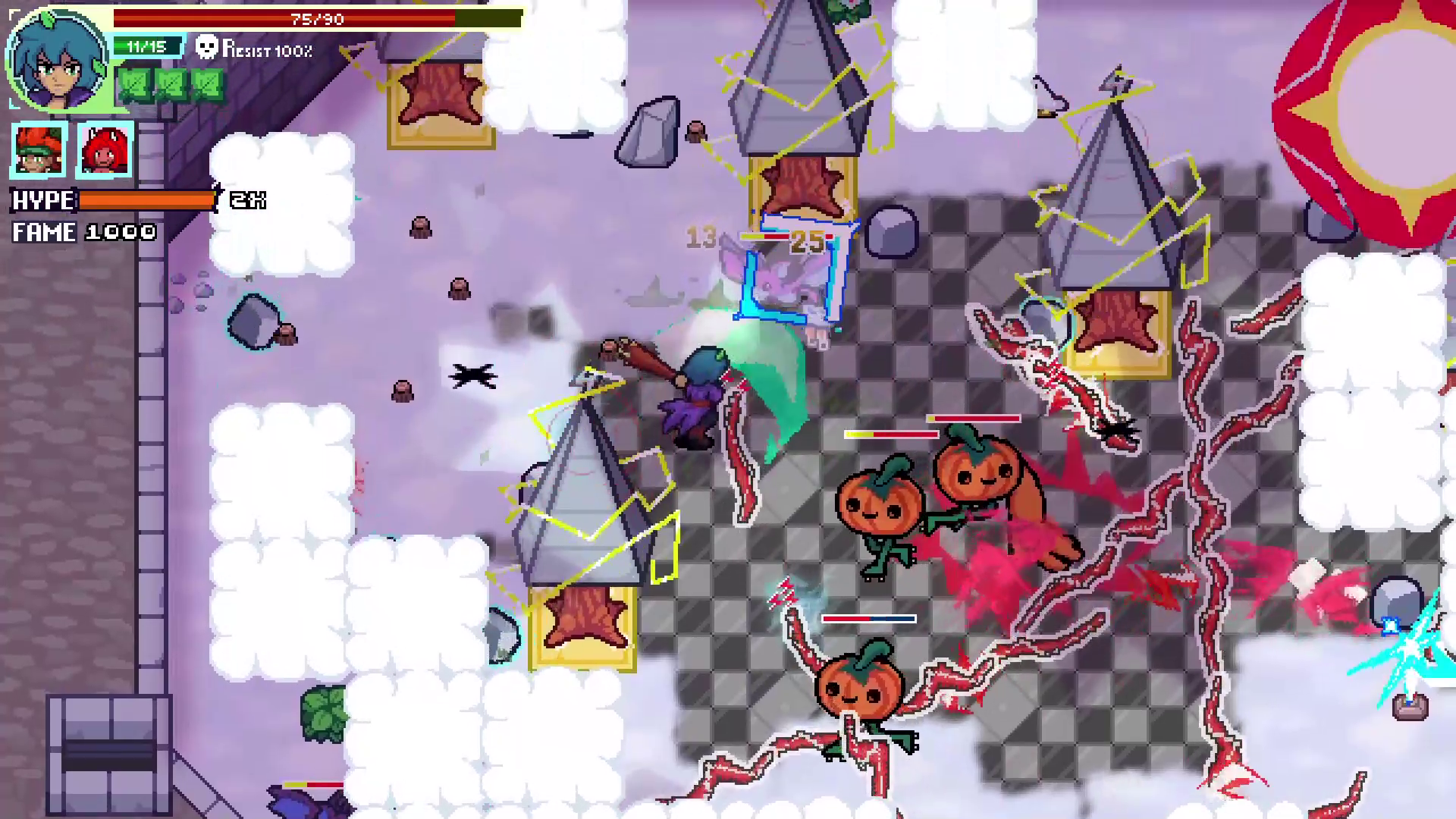
From the start, we used thick outlines and bold colors to help players parse convoluted screens into what was good and bad. We were always fine with tipping over into complete chaos, as long as players felt they had a move or ability to turn things in their favor—like a deflecting swing or a wide dash. As abilities advance, players can even create walls or temporary invincibility, so when things get truly overwhelming, they still have ways to feel safe.
Were any items unexpectedly hilarious, overpowered, or fan favorites?
The first overpowered feature we had to cut was Explosion Blessings. Explosions dealt solid damage but also obliterated the environment far too effectively. You can still see explosions in the final game—exploding flowers, birds tossing bombs, even Curie (a rival) uses them a lot—but Explosion Blessings broke rooms too easily. Anything that destroyed walls, trees, traps, and turned debris into projectiles was simply too powerful in a game built around multiplying projectiles. Typhoon Blessings became the compromise—they still destroy things, just not quite as dramatically.
The clear fan favorite, though, is the “Bird Build.” It’s been a whole meme in our Discord server since the very first test—the idea is simple: take every upgrade that lets you summon more birds, and then sit back and let them do all the work for you.
Since the community played a big part in shaping Rogue Labyrinth, how did early feedback influence the final product?
Shala: In the beginning, before we had a community, we would show Rogue Labyrinth at local Seattle events like the Seattle Indies Expo, Geek Girl Con, and so on. Watching people playtest early versions of a game is invaluable. In person, you can see where players might get confused with controller button placement or skip through dialogue. Once we had a dedicated Discord community, we held monthly playtests where many of the same folks would show up and really helped us fine-tune the game. Anyone who helped playtest a handful of times got a sprite in the audience within Rogue Labyrinth! People who playtested extensively or offered lengthy feedback were credited as community playtesters in our staff credits.
Of course, every smooth-playing game hides its fair share of challenges. What hurdles did you face in creating Rogue Labyrinth?
John: Honestly, the biggest struggle was that the game is made in the Construct game engine, which has some bugs that can’t be solved. Stuff like how the game runs on the player’s monitor refresh rate—so someone can have an awesome computer, but their game is running at 240 FPS and can’t keep up—or how no one really knows where Construct save files go, so we can’t use Steam Cloud. Image sampling, lack of good communication with the API, variable input lag across controllers, causing weird bugs—lots of little things that were very Construct-specific—really slowed down production.
When your game sits in the same genre as modern juggernauts like Hades or Cult of the Lamb, how did you balance expectations while carving out Rogue Labyrinth’s unique identity?
Shala: Everything is inspired by something. It’s an honor to be compared to Hades and Cult of the Lamb. I think what matters is that you can look at our game and instantly know it’s something different from the get-go. Sometimes there are games where you can immediately tell it’s just a reskin. The way we carved out our own identity was by looking at games we liked, putting in a mishmash of features, and then iterating over time as we play tested and had our community playtest.
There are also a ton of Easter eggs from games we love. The screen where you get defeated in Rogue Labyrinth? It’s inspired by the choreographed sword fight scene at the beginning of Final Fantasy IX. You can see the picture here!
With launch now behind you, what does success look like for Tea Witch Games—and what’s next for the studio?
Shala: Games are all about fun. If the player has fun, then we did our job. As for the future, we’ll let the fans guide us. We plan to do continuous bug fixing and some additional post-launch support, but as an indie company, we can’t afford to keep adding content if people aren’t asking for it. Time will tell!
Enjoyed this conversation? Tell us what you think on X, and explore more exclusive stories at The Indiependent.
Ready to step inside the labyrinth? Add Rogue Labyrinth to your wishlist on Steam.
This interview has been edited for clarity and length.
Words by Khushboo Malhotra
We’re trying to raise £200 a month to help cover our operational costs. This includes our ‘Writer of the Month’ awards, where we recognise the amazing work produced by our contributor team. If you’ve enjoyed reading our site, we’d really appreciate it if you could donate to The Indiependent. Whether you can give £1 or £10, you’d be making a huge difference to our small team.