
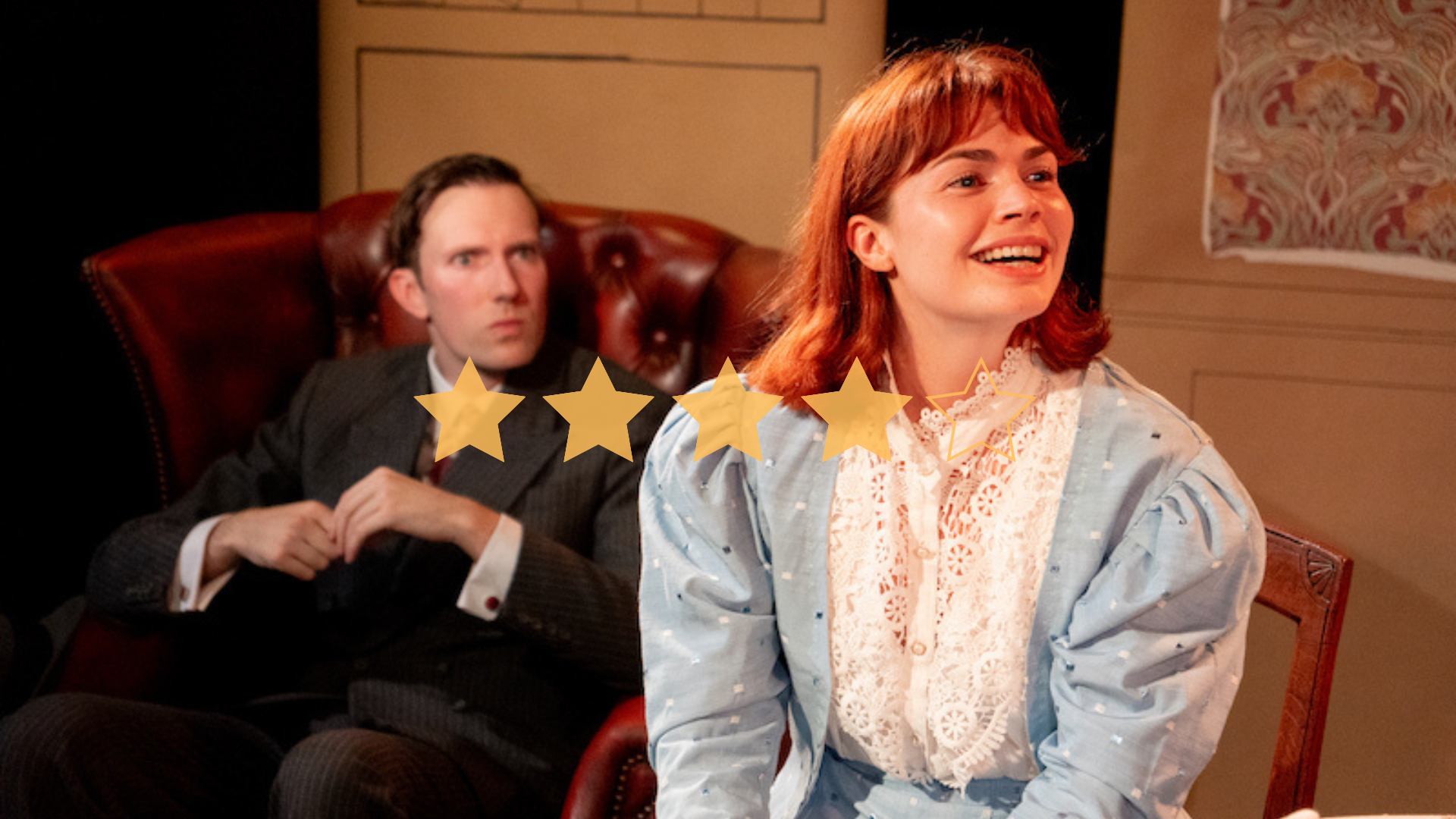
★★★★
Flywheel Theatre certainly take on a challenge at The Old Red Lion Theatre. On their Repertory Season, six actors aided by a larger group of satellite performers stage six plays across six weeks. In their penultimate play, the piercing screams of Marie Belloc-Lowndes’ 1913 crime novel transition into the more comically mannered and much better dressed sequences of George Bernard Shaw’s Pygmalion. By suppressing the decorum and accenting the absurdity of the 19th century “well-made play’” this work is admirably staged. There are also some raucously good laughs delivered along the way.
The original Greek myth of Pygmalion is not at all funny. A Cypriot sculptor decides rather foolishly to form an entrancing statue in ivory of his ideal woman, named Galatea. Shaw, both whimsically but also poignantly, adapts this story into an observation of gender roles within Victorian Society. The protagonist Eliza Doolittle flips from pavement flower girl to London’s most favoured Duchess with only the vocal tutoring and conceited arrogance heaped upon her by Professor of Phonetics, Henry Higgins. Ella Rowdon’s direction certainly crystallises the play down to the most vital parts and makes it run for only one hour and a half.
It almost goes without saying that Higgins’s experiment is doomed to fail from its very beginning. Alongside his friend Colonel Pickering (played by Joseph Stanley), Higgins fails to see how his narcissism will turn Eliza into a commodity for the Victorian public and fracture her identity right up to the breaking point. With a complete lack of foresight, he misses the disastrous consequences which await him.
The play’s two leads, Sadie Pepperwell (Eliza Doolittle) and Charlie Woodward (Henry Higgins) master the emotional fervour of their respective parts. However, at times, especially during their dialogue sections, the production fails to achieve the gradual turn of the emotive screw that builds so much tension in Shaw’s original. Instead, we are hurtled straight into Eliza’s Cockney screaming and volatile temper with absolutely no warning. Even the extravagant ball that became such a triumph across London and New York stages has been cut. One wonders whether they could have made a little more room for some of Shaw’s beloved extended cast.
Applause must be given for a set designer and technician at the very top of their form. The stage immediately becomes a very believable Victorian Street through clever use of light and sound. Later, in the 19th century sitting room, this set chimes nicely with this observational comedy of manners coming to life through the cast as a whole. Though, the set is reduced to its bare bones, this allows the acting to really take the forefront. Woodward must get a special mention here for his characteristic tantrums that got a hearty laugh from the whole audience.
Overall, by trimming Pygmalion right down to basics, Rowdon’s production may not have been popular with Shaw’s original audience. This certainly was not the case for these modern punters. The play’s abbreviated form struck nearly all the right chords by keeping Shaw’s social commentary and quirky humour in perfect harmony throughout.
Words by Harry Speirs
Support The Indiependent
We’re trying to raise £200 a month to help cover our operational costs. This includes our ‘Writer of the Month’ awards, where we recognise the amazing work produced by our contributor team. If you’ve enjoyed reading our site, we’d really appreciate it if you could donate to The Indiependent. Whether you can give £1 or £10, you’d be making a huge difference to our small team.