
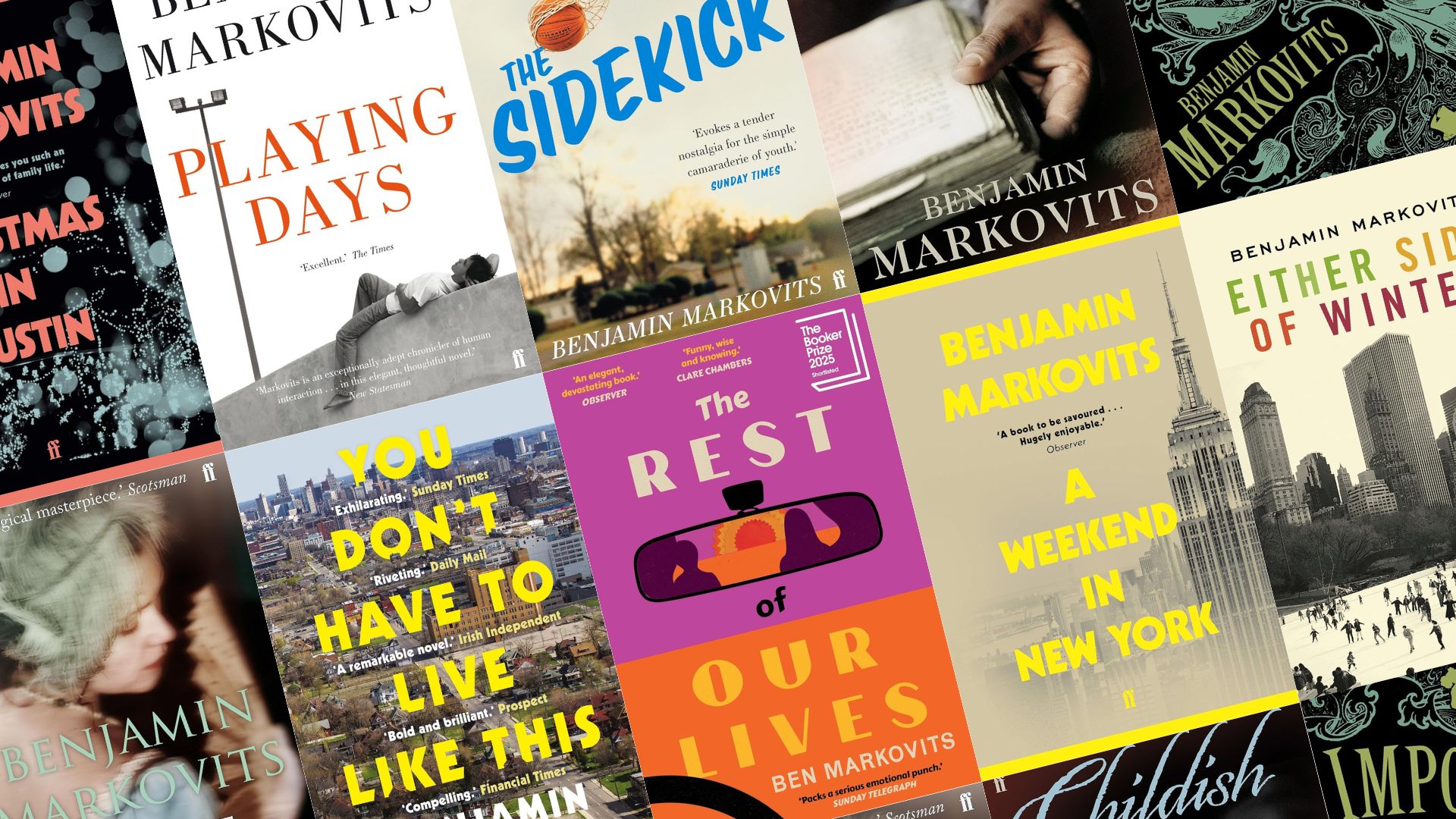
Amongst the six novels shortlisted for this year’s Booker Prize is Ben Markovits’s The Rest of Our Lives. Set in contemporary America, it follows law professor Tom Layward as he takes an impromptu road trip across the country via the homes of faces from his past. The judges described it as “a novel of sincerity and precision”: “matter of fact, effortlessly warm, and […] difficult to put down”.
Originally from Texas, Markovits has written twelve novels and also teaches creative writing at Royal Holloway, University of London. We sat down with him to talk about the inspirations behind The Rest of Our Lives, his previous work, and all things Booker Prize.
You’ve recently been shortlisted for the Booker Prize. How does it feel?
It feels great. When you’re a writer and you publish a book, you do everything you can to get people to pay attention to it, and the Booker is a very well-run organisation that does its best to help get your book out to people, so it’s very gratifying.
What’s the process behind being nominated? When did you find out?
I found out, I think it was the end of July. The truth is it’s all veiled in secrecy from a writer’s point of view. You don’t know if your publisher has submitted you. I think there’s a limit to the number of books they can put forward. There are also some other rules; I think if you’ve been shortlisted before you automatically get put forward and it used to be the case at least that judges could call in certain books that hadn’t been put forward. So there’s this whole complicated process that goes on to decide which books the judges have to read, and the writers don’t know anything about it. And then there is a moment when the longlist gets announced, and I used to pay attention to when that moment was, just to see if I was on it, but this time around I successfully averted my gaze. I thought it had already happened, and I got a call from my editor a few hours before it went public to say that I’d made the longlist.
The ceremony is next week. Are you looking forward to it?
Yeah. I live a fairly quiet life and this is a bit of excitement. I’m sure I’ll be stressed out by it too, but it’s been all good. Whatever happens, I’m very lucky to have gotten this far.
This is your twelfth book. How have you changed as a writer since your first novel?
That’s a good question. I feel like I’ve lost certain skills and I’ve gained others. I probably have a clearer sense of how to put together a longform narrative than I did when I started out. When you start out you just start writing and hope that the energy carries you through to the end, and now I have a slightly more practised sense of what has to go where and how far you have to get along to get there. But I also wouldn’t want to exaggerate that, because every book feels a little different; you have to come up with new rules for the game. But as you get older you also lose a little bit of that narrative energy, that descriptive energy, the rebel playfulness, because you start concentrating on other things. So there are athletic feats of the imagination that seem more difficult as you get older, but the structural challenge seems a little bit more interesting and you get better at that.
Have you got any books you’re particularly proud of looking back?
I’m a big fan of Christmas in Austin, which has a lot of different characters and they all take over the narrative at different points and the plot spans about a week. Nothing super-dramatic happens but I feel like I managed to weave them together in a way that I’m proud of.
You’ve also written historical fiction. How does your approach differ between writing about the past and the present?
I haven’t written historical fiction in a while. Part of what drew me to writing about Byron was the language of the period which I grew up reading and studying, and so the language interest is obviously very different. Most of my prose in contemporary fiction I try to make it sound as much like me as possible, or I try to write the kind of things I would actually say, but that was not the case for the historical fiction where part of the joy of it was to get into a language that I had always loved but that wasn’t my own.
So to move onto The Rest of Our Lives specifically: what was the inspiration behind it? How did you start writing it?
The truth is I just had an idea for the opening page more or less, and I got up one afternoon and just wrote it down. I was working on something else at the time but I came back to it later and thought there was something there. I was interested in the idea of a marriage in which the man had not had the affair and felt that he had done nothing wrong, because it might allow me to explore the possibility that that feeling that you’ve done nothing wrong itself might be part of the problem, and so it grew out of that.
And how about the road trip element?
Part of what I guess I liked about the idea was that I write modest realism. I tend to emphasise what actually happened and not exaggerating events, and I’m a big fan of that but sometimes it can lead to a certain grimness. Everything starts becoming a rainy Tuesday morning as you try to make your story as close to the quietness of real life as possible. And this story about a guy who drops his daughter off at university but then keeps driving? That seemed to add an element of fun to it. So the road trip was a way of making the breakdown of his marriage a little bit more fun. Everybody likes a road trip, you get to visit old friends, and that was part of what drew me to it.
Did you always have in mind the characters Tom would come across on the way?
I don’t know. I guess the danger of the road trip novel is that it becomes very episodic, and so it was important for me that he would run into people that would allow me to explore parts of his past that were relevant to what he was going through now, and it seemed like a natural progression: grad school buddy, brother, ex-girlfriend, son. All these people are clearly relevant to his ongoing life in ways that would allow me to keep the story moving not just forward through the past but forward into the future.
There are some aspects of this novel which seem similar to your own life. How do you approach putting these elements into fiction?
Tom is very unlike me, but there’s one thing we have in common, which is that we both got sick with cancer, and in the same way. I don’t think about it that much, but when there’s anything interesting that happens to me, as awful as it was going through chemo, it was very interesting. I mean, I’d never done it before. And all the things you feel, just the physical details of what happens to you in the hospital, all those things seemed worth writing about to me. And if I’m interested in what’s happening to me, it’s an indication that maybe it’s worth pursuing on the page too.
I guess the danger is you don’t want to get things off your chest; it shouldn’t feel personal in a subjective way. If I’m mad at somebody, I don’t want to take it out on the page unless I’m going to ironize it by showing up myself as much as anybody else in the story.
Many of your books (including this one) are set in the US, and I did feel as I was reading it that it was a very American novel. Do you feel like your novels are specifically American?
Yeah I do. I grew up mostly in America but not exclusively and by this point I’ve lived longer in London than I’ve lived anywhere else, and yet most of my fiction is set in America and this feels like a very American book. Some of it is that I like writing about stuff I miss, so it’s a way for me to experience an American adulthood that I didn’t really get to have. But a lot of it is also that English people are hard to write about. They have these highly distinctive accents and differentiated local cultures that, even though I’ve lived here a long time, I could easily get the details wrong. I’ve got a new book coming out in a little over a year which is partly set in England so I’m getting closer to home.
That was actually my next question! What’s coming next for you?
I’ve got a novel coming out in 2027. It’s a kind of counterpart to The Rest of Our Lives. It’s more or less a love story about the beginning of a marriage rather than the end of it, or the second half of it.
This interview has been edited for clarity.
Interview conducted by Eleanor Harvey
Support The Indiependent
We’re trying to raise £200 a month to help cover our operational costs. This includes our ‘Writer of the Month’ awards, where we recognise the amazing work produced by our contributor team. If you’ve enjoyed reading our site, we’d really appreciate it if you could donate to The Indiependent. Whether you can give £1 or £10, you’d be making a huge difference to our small team.