

Harry Sherriff’s feature debut is a charming, softly comedic, and decidedly British drama about our relationships with mediocrity, stoicism, and the devastating loss of hope. It also unfortunately makes careless use of the women in refrigerators trope that causes the film to waste the otherwise perfect atmosphere it builds.
★★★☆☆
*this review contains spoilers*
Taking place at a dying hotel, Misper follows the apathetic staff as the hotel falls into decline and one of their own goes missing. The film primarily focuses on Leonard (Samuel Blenkin) who lives and works at the hotel and who seems perfectly happy spending the entirety of his days there, gently attempting to lift the spirits of those around him and failing to ask out colleague Elle (Emily Carey). Content in mediocrity, the highlight of Leonard’s day appears to be watching Elle cross the grounds each morning, and the most romantic gesture he can muster is to share with her his packet of ready salted crisps.
One day Elle disappears, and as Leonard slowly falls apart, his colleagues wrestle with their own grief and guilt, hoping that perhaps she’s simply gone on holiday…
Starting out as an affectionate delve into the British stiff-upper-lip philosophy, the film makes excellent use of its supporting cast. Working alongside Leonard is manager Gary (Daniel Ryan) who gives himself pep talks in the mirror and obsesses over bad reviews, handyman Kalid (Sunil Patel) who hides out in the hotels smaller spaces and avoids his responsibilities, and Pam (Christine Bottomley) who has accidentally found herself stuck at the hotel over time like a form of purgatory. We also meet cleaner Viv (Rosalind Adler) who spends the majority of the film displaying a delightful level of optimism, interrupted only by a quick sob mid vacuum in one of the hotel’s deteriorating passageways. The supporting cast are truly the stand out element of the film. They’re the perfect combination of bored and disillusioned but charming and friendly, and as a viewer I felt right at home in the staff room alongside them.
The film also makes use of the real former Grand Hotel in Folkestone, Kent which makes for a truly impressive set. The hotel is put on incredible display as we follow Leonard and the team throughout their day exploring the space. There’s the dark and empty Palm Court, a former conservatory space which would have made a bright and airy place to enjoy tea by the sea, a host of large empty dining rooms which are shown with a wide lens to convey their sparsity, and a beautiful grand reception in which Leonard sits alone every day waiting for customers that never arrive. Understandably, then, new girl Faye (Iona Champain) describes the hotel as a “waiting room for the afterlife” which perfectly captures the liminality between the hotel’s Grand history and upcoming foreclosure.
Samuel Blenkin also gives a strong performance as Leonard. Leonard doesn’t seem to have aspirations, surviving on the tentative hope that one day he might ask out Elle, and with Elle and that shred of hope gone, Leonard’s gently sunny disposition dims. Blenkin offers an expressive but restrained performance as a man whose life begins to unravel, perfectly blending the comedic and tragic elements of the film to give both laughter and heartbreak. However, I couldn’t help but find his character somewhat underdeveloped compared to less prominent characters. This problem also extends to Elle who is entirely relegated to the “pretty dead girl” by the end of the film.
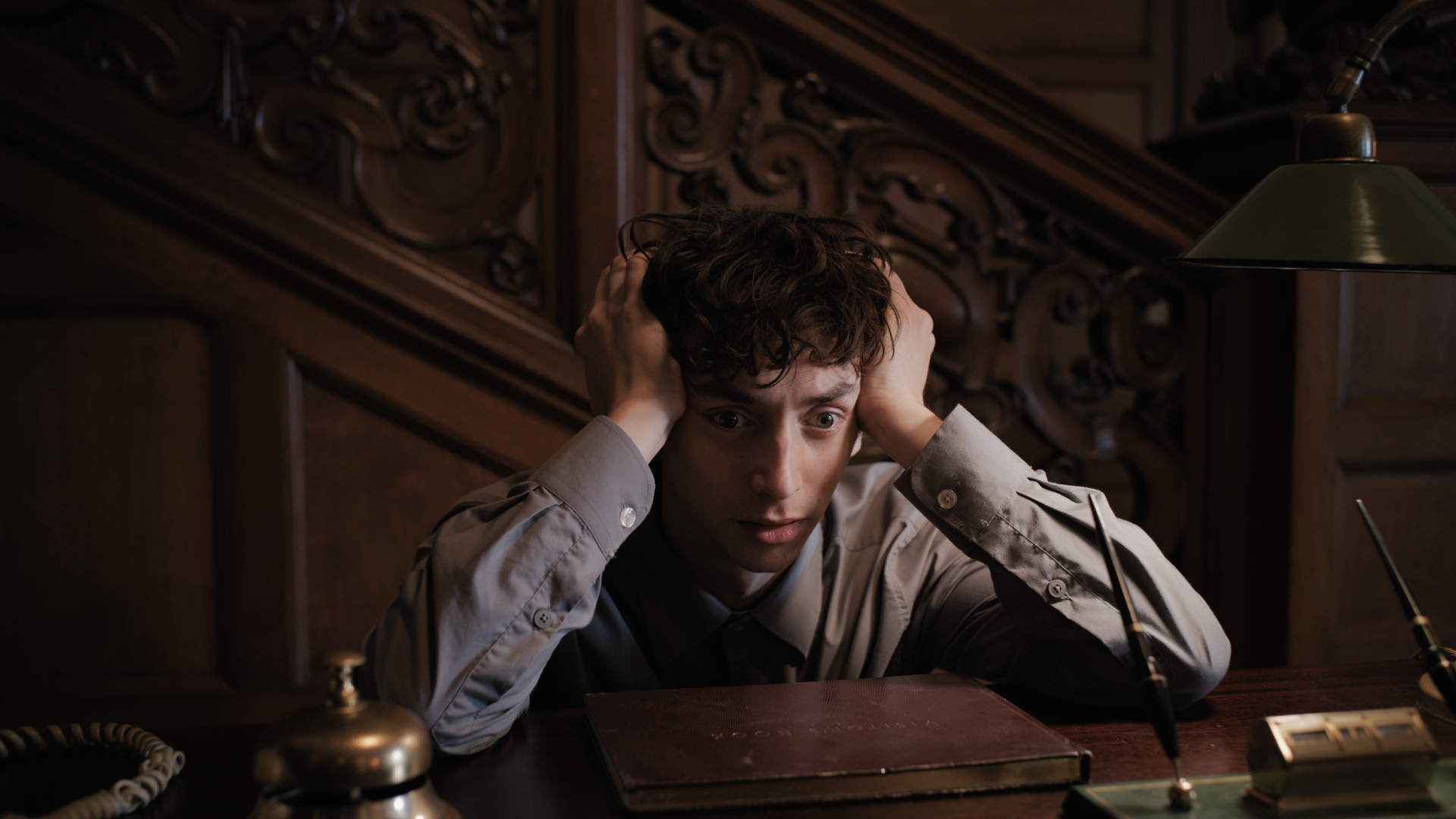
Indeed, the entire “true crime” plotline cheapens the film and feels entirely unnecessary when the real horror of the staff losing their workplace and homes would have sufficed. The end result is a somewhat frustrating waste of the atmosphere that otherwise feels so carefully crafted as the film makes a slow creep into horror film territory. The score becomes haunting, with some impressive sound mixing, and builds when Leonard watches callous reports on the murder, is accosted in a dark alleyway, and has nightmares of Elle bound and screaming. How truly awful for him.
The murder plotline happens somewhat on the periphery, in newspapers blowing past, in radio coverage that gets abruptly switched off, until it’s directly in front of Leonard in the form of a film set at the former hotel when an actress dressed as Elle turns to face him. It’s hard to say what was meant to be achieved by keeping Elle’s fate on the periphery, but it felt like a disappointing use of clichés, subjecting a female character to unnecessary throwaway sexual violence for the advancement of the male lead. It feels especially egregious when the only development Leonard faces is that he moves out of the hotel, which was closing anyway. The stakes feel very low considering what happens to Elle, and there was no reason why she could not have simply quit the hotel.
Where the film excels is in its exploration of the ways in which the events affect the hotel employees and the humour behind their realistically underwhelming coping methods. In one scene Leonard reads what happened to Elle in the newspaper and Kalid and Viv offer a cup of tea and a biscuit to help; the number one cure to any ailment in the UK. There’s a really well crafted identity throughout the film that this hotel and those that occupy it are a true relic of that specific, bygone “Keep Calm and Carry On” era of British identity. The wallpaper may be peeling and yellowing, but there’s cups of tea and biscuits on every surface, ready to offer comfort to those who may be in need of it. Even through all the misery they face, everyone keeps trudging along, never letting the storm fully consume them.
The Verdict
In the end, Misper is a fantastic debut, with strong performances and an incredible location that was explored with the utmost capability and respect. It’s funny, it’s heartbreaking, it has a uniquely British familiarity, and it also has an unfortunate fridging problem. If you can move past the murder plot line however, it is a perfectly enjoyable way to spend seventy five minutes, maybe on a rainy afternoon with a nice cup of tea.
Words by Camille Murray
Support The Indiependent
We’re trying to raise £200 a month to help cover our operational costs. This includes our ‘Writer of the Month’ awards, where we recognise the amazing work produced by our contributor team. If you’ve enjoyed reading our site, we’d really appreciate it if you could donate to The Indiependent. Whether you can give £1 or £10, you’d be making a huge difference to our small team.